



 24.12°C Kathmandu
Sat, Apr 4, 2026
Entertainment
Staying true
With his nonchalant disposition, Ashesh Rai usually comes across as someone who couldn’t care less about what the world has to say about his music.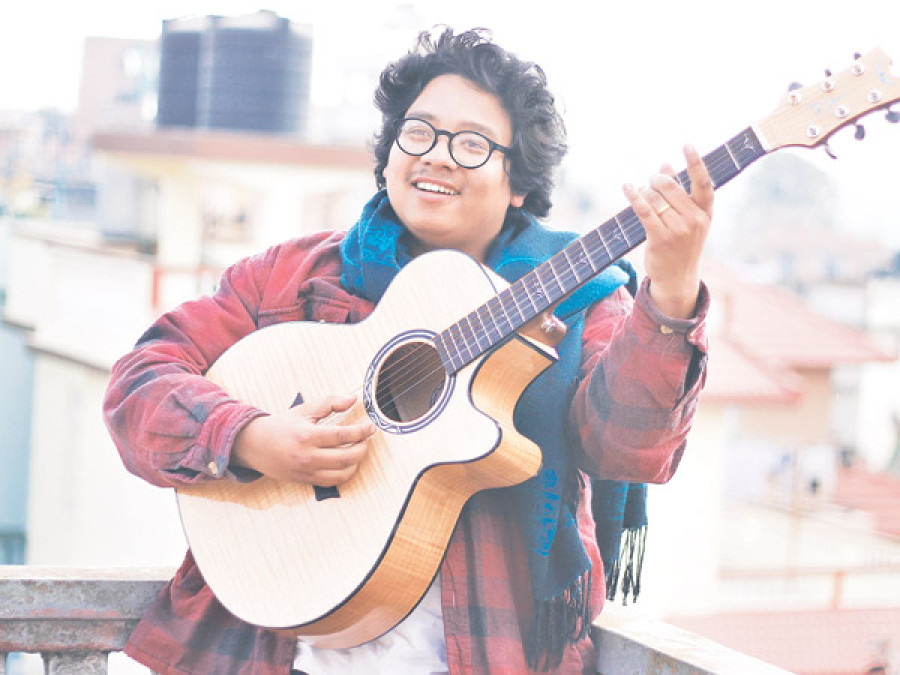
bookmarkWith his nonchalant disposition, Ashesh Rai usually comes across as someone who couldn’t care less about what the world has to say about his music. But that’s not to say he isn’t serious about what he is doing. He’s been around music for a long, long time: He started taking tabla lessons in early childhood, explored many other musical instruments on his own during his teens, and for quite some years now he has been regarded in the industry as a special talent. However, it was his first recorded single Fulbutte Chari, which he released on Soundcloud around a year ago, that has garnered him a serious, almost cultish, following. The Post’s Gaurav Pote recently caught up with Rai to about his music. Excerpts:
Published at : June 30, 2015
Updated at : June 30, 2015 08:26
When you make music, it seems you always hit just the right notes and sing just the right lines. How does that happen?
Well, that’s quite a difficult concept to explain. It easier to listen to the music and feel it, instead of having someone try to explain it in words. That’s what I believe and so do my friends Kishan and Parbat (of Baaja), with whom I create many of my tracks. It’s also the energy and spirit that we share that helps us shape what we create.
To be honest, we are all different in our own ways and that means we have different views of music. But we try to truly listen to what’s inside us and then try to make our findings work. We try to keep things simple, and often we just add elements that fit the tune.
You play so many instruments—the tabla, guitar, murchunga, sarangi, violin and many more. That’s quite a lot of instruments, wouldn’t you say?
I merely play music. That’s relatively simple concept, isn’t it? I’ve always believed that when you know your music, the instrument part is only secondary. But playing a new instrument with a childlike curiosity is always so enthralling and gives you a lot more ideas that you can work with.
And for you, is the art aspect almost as essential as the craft component?
It’s all about striving to create music that has quality. And, yes, ‘quality’, is the mother of it all—the key essence. When you realise that, you start pursuing that essence, and everything becomes so much more fun afterwards. That’s what art is for me, and I’m always chasing that.
Are the roots of your music, as well as the journey you have been on, just as interesting as your music?
I started off early as a tabla student under the tutelage of my grandfather, Shree Ram Hari Gurung. Later on, as my visions for sound expanded, I understood that the journey was what’s more important. When you consider what you’ve done to reach somewhere, your life story seems just different, not amazing.
You’ve put so much effort into all that you do, yet your songs are free to download. What’s the catch?
I had never thought about this until you asked me. It might be that we’re more comfortable doing things this way. Staying in the background is really fun once you see your art being appreciated for what it is, rather than the creator’s being celebrated. For us, doing things this way helps us maintain our integrity.
What, as a Nepali indie artist, is your view of mainstream music, fame and money?
In my opinion, it is the listeners who are more mainstream than the music that’s being produced. Many tend to jumble things randomly into one playlist and stick to that. Everyone seems to be following some genre of music, but I don’t like how we slot music into specific genres. They’re merely conventions and we should not let them to affect our art.
As for fame, that is not so important. Since fame, by definition, has to do with popular reception, you might end up disheartened when you’re not well-received. But money, I think, is important. However, the point is to earn enough to live decently enough, and then focus on doing the things you love, which is quite possible. Also, I don’t really prefer being labelled as an ‘indie artist’. “Independent” sounds just as fine, doesn’t it?
What is your take on what has been happening to Nepali folk music in recent times?
It has undoubtedly evolved. Our individual perceptions and preferences may make us view things differently, but I would say Nepali folk music has definitely adapted to the times. Pure folk, however, is limited mostly to the rural places, and hence, it’s still very ‘underground’ in that way. Perhaps it is better that way.
What do you think contemporary musicians can do to improve Nepali music?
I think you can’t concentrate too much on your art if all you are concerned about is money. What we, as Baaja, try to do is pour our souls into what we do. We haven’t figured out how exactly we are going to make money off our music. But we never stop playing. I think for everyone, it’s the spirit and perseverance to create really good music that’s needed right now.
When I listened to Samjhana Matrai Bho on Soundcloud, I couldn’t help but wonder about its lyrics. How would you describe it, and what inspired it?
Samjhana Matrai Bho is my favourite Baaja song. It was written by Kishan. For me, it’s a song that has put into words so many feelings that I could not name earlier. It’s so difficult to explain its creation process—perhaps because that energy has always been beyond our comprehension. I think in most instances of creation, we all go with a feeling or a muse, and trying to capture that feeling into words is how songs are born.
We hear you’re also working on a musical. How does that compare to just writing and recording songs?
We’ve been planning that for a long time, and now the pieces are falling into place. Although we’ve had the project on our minds, we hadn’t quite worked out everything; but we sure can feel the energy building up, and for now that’s good enough. I recently worked on Dhon Cholecha, my first musical, and it made for a great growing experience. It’s so nice to sit in a dark corner, feeding live music to all those people out front and yet, in a way, to be a little apart from them.
Finally, what are you working on these days?
Oh nothing much, just practicing, and practicing some more.



Editor's Picks
Nepal risks losing up to 132,000 jobs, $1 billion after LDC exit
Raped and left to die, teenager’s family wants answers
Bengal tigers move to mid-hills. Sighted in Palpa, Arghakhanchi

Escaping poverty at home, Nepali women fall into the Gulf trap
Once the heartbeat of Nepali democracy, now a ghostly shell
E-PAPER | April 04, 2026

×