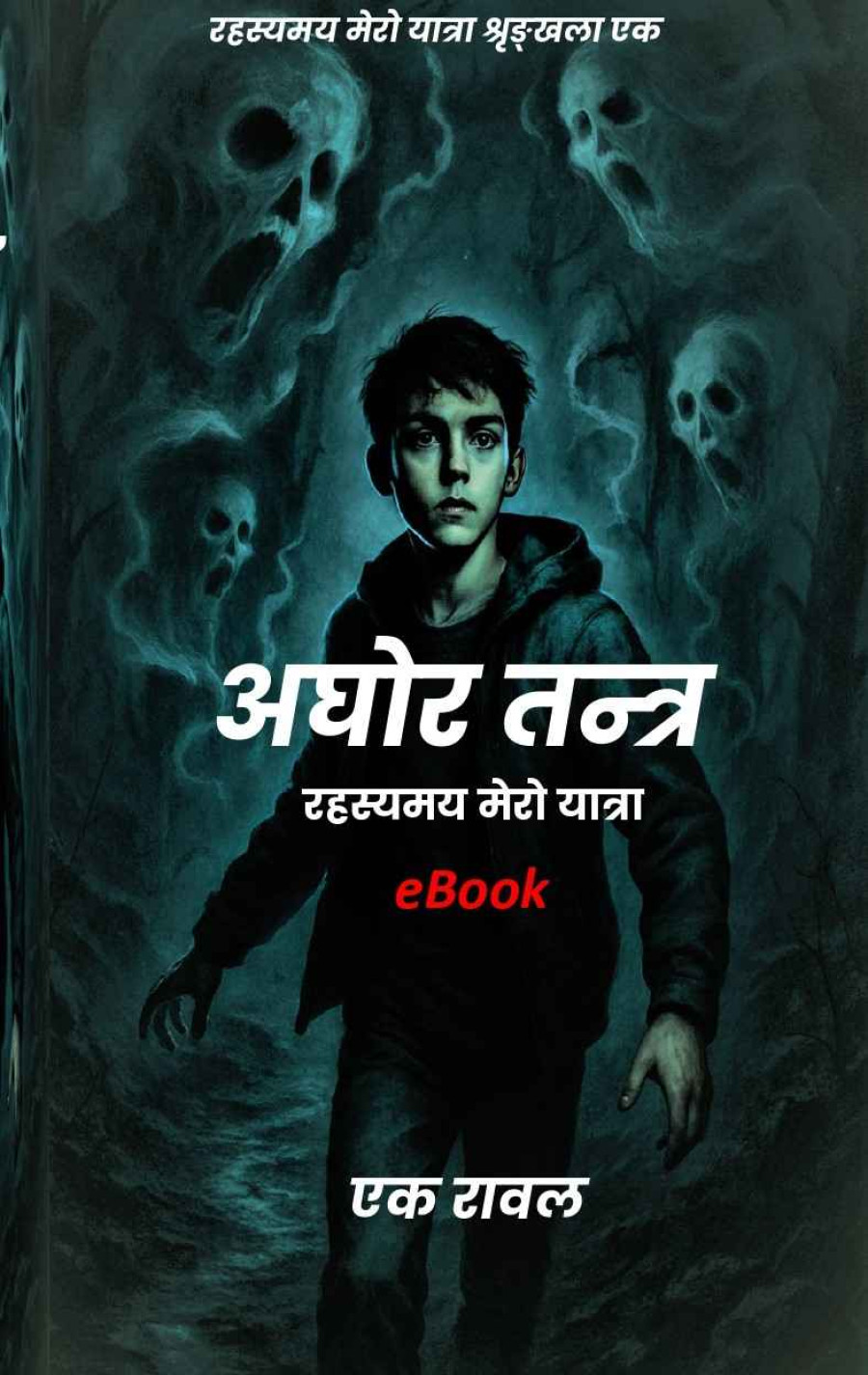
Nepali horror has often found itself caught between two impulses: imitating familiar western supernatural fiction or leaning so heavily on folklore that it becomes little more than a catalogue of ghosts and legends. ‘Aghortantra’ attempts something more ambitious.
It borrows from oral traditions, Tantric mysticism, village myths and psychological suspense to create a horror novel that feels unmistakably rooted in Nepal. While the novel occasionally loses momentum under the weight of its own mythology, it succeeds in proving that local landscapes and belief systems can be just as unsettling as any haunted castle or Gothic mansion.
The novel follows an unnamed narrator struggling with fragmented memories and recurring nightmares. Accompanying his friend Muskan to a remote village in Rukum, he expects little more than a visit to the countryside. Instead, he stumbles into a place haunted not merely by spirits but by its own forgotten history. Strange dreams, abandoned caves, unexplained disappearances and stories passed down through generations slowly reveal a web of ancient rituals and curses that binds the village to forces far older than its inhabitants.
What makes ‘Aghortantra’ compelling is that it never rushes towards its monsters. The novel understands that fear grows best through anticipation.
Long before anything overtly supernatural appears, the landscape itself begins to feel hostile. Forests seem to remember forgotten tragedies. Rivers separate more than villages. Caves cease to be geological formations and become living repositories of secrets. Animals react to unseen presences before humans do. By allowing atmosphere to carry much of the horror, the novel recalls the rhythms of oral ghost stories told in Nepali villages, where silence and suggestion often prove more frightening than revelation.
The book's greatest strength lies in its mythology. Rather than importing vampires, demons or other well-worn horror figures, it builds its supernatural world from local belief systems. Dhamis, ritual purification, sacred ash, village legends and Tantric practices are woven into the narrative not as exotic decoration but as living traditions that shape how the characters understand danger. The supernatural never feels detached from everyday life because, for the villagers, these beliefs are everyday life. Their understanding of the world is informed by inherited stories as much as by observable reality.
This cultural grounding gives ‘Aghortantra’ an identity that distinguishes it from much contemporary horror. Even readers familiar with the genre will find themselves navigating unfamiliar terrain. The horror emerges not simply from what lurks in the forest, but from the possibility that the stories dismissed as superstition may contain uncomfortable truths.
The novel also avoids reducing its characters to victims waiting for supernatural punishment. The friendship between the narrator and Muskan provides the emotional centre of the story. Their bond develops naturally through shared danger rather than melodramatic declarations, lending emotional weight to the increasingly bizarre events around them. Muskan, in particular, acts as the novel's moral compass: brave without being reckless, compassionate without becoming sentimental. Their relationship keeps the narrative grounded when the mythology threatens to become overwhelming.
Equally effective is the way the novel treats memory. The narrator's forgotten past mirrors the village's suppressed history. As buried legends resurface, so do fragments of his own identity. This parallel transforms the novel from a simple ghost story into something more reflective. The real horror is not merely that evil exists, but that communities and individuals alike cannot escape what they choose to forget. Ancient mistakes continue to shape the present, suggesting that the past is never truly buried.
Yet ‘Aghortantra’ is also a novel that asks for patience. Its fascination with mythology occasionally works against its storytelling. Lengthy explanations of village legends and ritual histories interrupt scenes just as they begin to gather momentum. There are moments when readers understand the implications of a legend before the narrative has finished explaining it.
Repetition, too, becomes noticeable. Characters frequently respond to danger in similar ways, and descriptions of fear sometimes echo one another closely. A firmer editorial hand could have tightened these sections without sacrificing the richness of world-building.
The supporting character, while colourful, rarely develops beyond their narrative function. Characters such as Kiran, Dorje and several villagers primarily exist to guide the protagonists through successive mysteries or supply pieces of folklore. Although this helps sustain the atmosphere, it occasionally leaves emotional investment concentrated almost entirely on the central friendship.
Perhaps the novel's boldest decision is its refusal to provide complete closure. While the immediate supernatural threat appears contained, the ending suggests that deeper mysteries remain unresolved. Instead of presenting evil as something permanently defeated, ‘Aghortantra’ portrays it as cyclical, waiting for history to repeat itself. The final pages imply that the protagonist's journey has only begun, resisting the temptation to explain every mystery. For some readers this ambiguity may prove frustrating; for others it will be precisely what lingers after the final page.
In recent years, Nepali genre fiction has steadily expanded beyond romance and social realism, and ‘Aghortantra’ demonstrates how horror can contribute meaningfully to that growth. Its greatest achievement is not that it frightens readers—though it often does—but that it trusts Nepali folklore to sustain an entire fictional universe. Rather than borrowing its fears from elsewhere, it discovers them in the country's own forests, rivers, rituals and oral traditions.
‘Aghortantra’ is an uneven novel, but it is also an imaginative and culturally confident one. It shows that horror need not abandon local identity to become compelling. By turning inherited myths into living nightmares, it opens intriguing possibilities for the future of Nepali speculative fiction.




 20.13°C Kathmandu