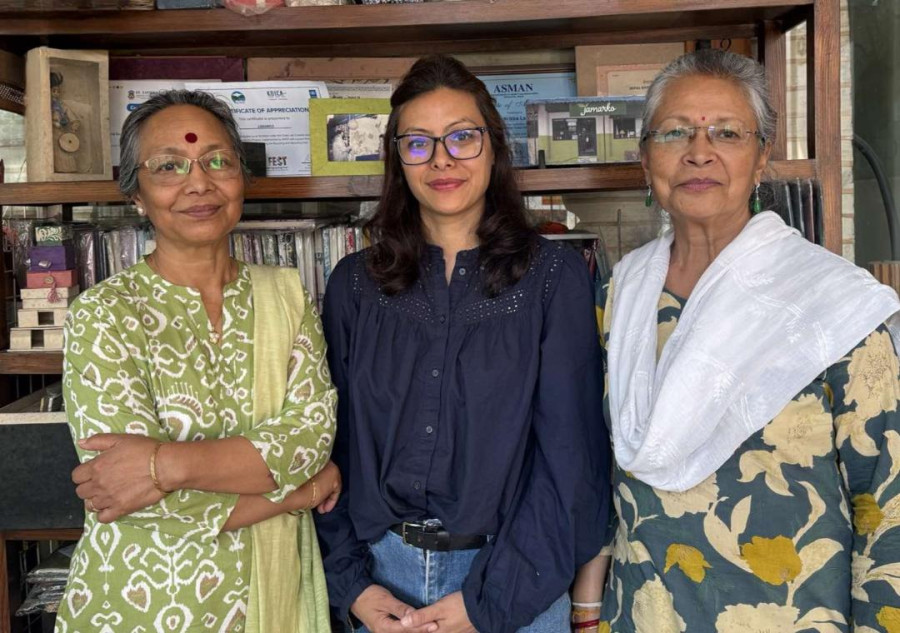
Inside Jamarko’s workshop, discarded paper is transformed into handmade creations—in a reminder that waste is not always the end. (From left) Co-founder Muna Shrestha, Current Executive Kritica Lacoul, and Co-founder Aruna Lacoul. Photos: Courtesy of Jamarko Nepal
Most of us believe that waste is the end of a story.
A notebook is useful until the school year ends. A calendar matters until December. An office document serves its purpose and is forgotten. Once something enters a dustbin, we rarely think about it again.
For Aruna Lacoul and Muna Shrestha, the founders of Jamarko, it is where their story begins.
Long before Jamarko existed, the two sisters paid attention to something that was mostly ignored. They were observing the burden of waste around them and wondering whether something useful could still exist within it.
“We were observing the growing environmental burden of waste around us and felt compelled to respond in a practical way,” they say. “We had limited capital, but strong intent, and we explored small, feasible interventions.”
That search eventually led them to the paper.
Of all the environmental problems they could have focused on, paper seemed manageable. It was abundant, accessible and recyclable. Unlike larger waste-management challenges, it was something they could realistically tackle with the resources they had.
To bring their idea into fruition, the sisters attended workshops, visited paper factories, learned recycling techniques and spent months experimenting. Some batches failed, and many products didn't work as expected. In 2001, recycling was hardly a familiar concept in Nepal. Much of the work had to be learned from scratch.
“The moment it became real was when we successfully transformed discarded paper into handmade paper sheets and saw that waste could become something beautiful and useful,” they say. That moment would eventually become Jamarko.
The name itself is a testament to how the founders see their work. ‘Jamarko’ is a Nepali word meaning ‘effort’ or ‘earnest attempt’.
“The name was chosen because they never believed they could solve Nepal’s waste problem alone,” they explain. “Instead, they wanted to make a meaningful contribution through their own effort.”
That philosophy still defines the organisation twenty-five years later.
The first workshop was in a modest shared space in Baluwatar. It was also a space to educate people about sustainability. Schoolchildren were welcome to learn about recycling. Many international students came to observe the process. Customers stopped by to see how discarded paper could be upcycled into something valuable.
But the visitors did not see what it took to get there.
In a handwritten note shared during the interview, the founders describe the challenges they faced. “Only after five years of struggle, managing all the twists and turns, obstacles and financial problems, working voluntarily and spending out of our own pockets to meet expenses, Jamarko sustained itself,” they write.
Behind those five years of struggle was the confidence that a discarded sheet of paper still had a story left to tell. So, what happens to a paper after it is thrown away?
At Jamarko, its journey opens with sorting. Staples, plastic coatings and contaminants are removed. The paper is torn by hand, soaked in water and transformed into pulp. The pulp is then lifted onto a screen mould, pressed, dried naturally in sunlight and stacked into handmade sheets. Only then is it ready to begin a second life as a notebook, greeting card, gift box or photo frame.
For the people at Jamarko, every paper is special. “Most people see paper as something disposable,” they say. “We see its potential.”
After working with paper for more than twenty years, they speak about it almost like a craft. They understand its textures, strengths, limitations and possibilities. They know how to recreate what others consider waste into something that can be used and treasured again.
Still, transforming paper has often been easier than transforming attitudes.
When Jamarko began in 2001, environmental entrepreneurship was not widely understood in Nepal. Recycling businesses received little institutional support, and some people even viewed waste-related work negatively.
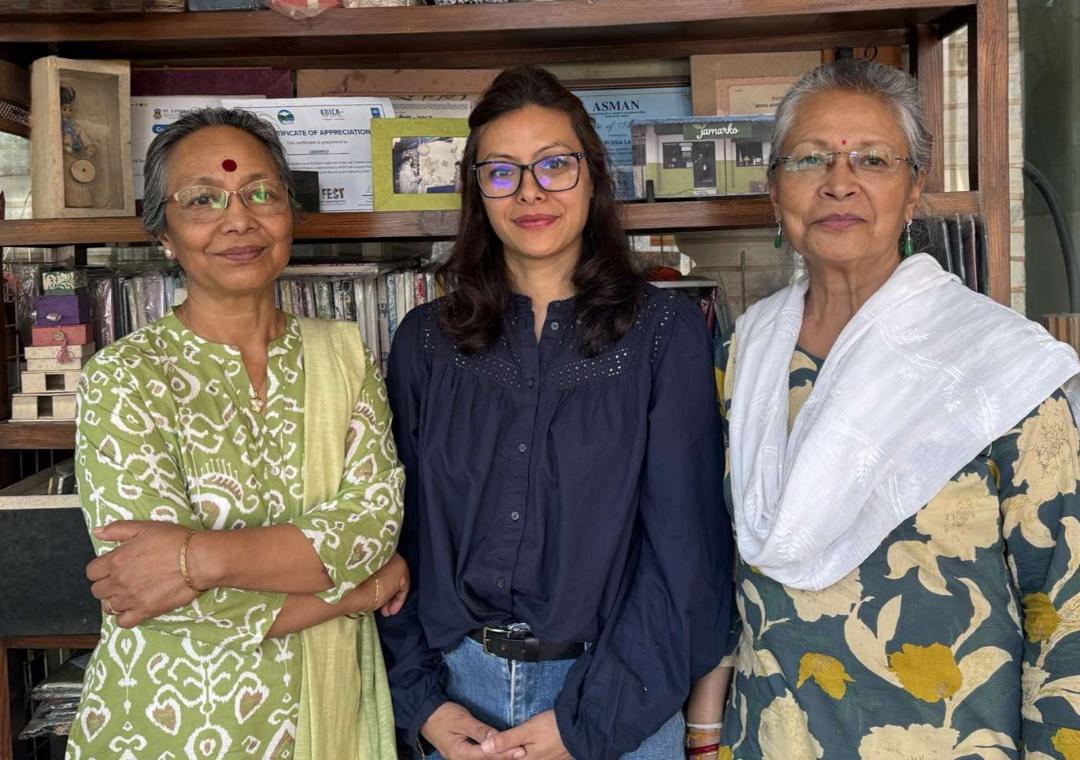
(From left) Co-founder Muna Shrestha, Current Executive Kritica Lacoul, and Co-founder Aruna Lacoul. Photos: Courtesy of Jamarko Nepal
“It was challenging,” they say. “As women entrepreneurs entering a largely unfamiliar field, we often had to prove our credibility repeatedly.”
Even today, one of the hardest truths they have learned is that environmental benefits alone are not enough to convince most people.
“Many people support sustainability in principle, but purchasing decisions are often driven by price,” they say. “Recycled and handmade products require more labour and therefore cost more.”
Reflecting on the gap between public support for environmental causes and the realities of running such a business, the founders invoke a familiar Nepali saying: “hatti ko dekhaune daat ra khane daat.” The teeth an elephant shows and the teeth they use are not the same.
This is one of the more uncomfortable realities of sustainability. People often want environmentally responsible alternatives to exist. Supporting them, however, can be more complicated.
“Sustainability often costs more. It’s not a luxury, but someone is paying the cost of production,” they say. “Cheap products are often cheap because environmental and social costs are hidden.”
Even after a long time, the founders remain disappointed that recycled paper remains a niche sector. “We are surprised that paper recycling has not expanded as widely as we hoped,” they say. “When Jamarko began, the founders imagined many similar businesses would emerge over time.”
At the same time, the organisation faces a challenge familiar to many Nepali industries. Keeping paper alive is one challenge. Keeping the people who know how to work with it is another.
One of the biggest concerns today is the shortage of skilled workers. Handmade production depends heavily on people and craftsmanship, and those skills are becoming increasingly difficult to retain. The company has also had to handle events ranging from the 2015 earthquake to the Covid-19 pandemic and global disruptions that affected supply chains and customer demand.
Still, through all of this, the founders refuse to compromise on authenticity.
“Many products are marketed as ‘Made in Nepal’ even when much of the production happens elsewhere,” they say. “We remain committed to creating products that are genuinely made in Nepal and support local workers and artisans.”
Interestingly, when asked what would remain if the words “recycled”, “eco-friendly”, and “sustainable” disappeared from their marketing tomorrow, their answer has little to do with environmentalism.
“Quality, craftsmanship and customisation,” they say. “Sustainability may attract customers initially, but quality is what keeps them coming back.”
Twenty-five years after it began, Jamarko is now continuing under the family’s next generation. For the founders, that continuity is their definition of success.
The company was born without investors, advanced technology or formal business expertise. It was born with two sisters who believed waste could be an opportunity. Today, they see the organisation as proof that values, purpose and perseverance can be passed down just like a business.
The story they are still trying to write is a simple one. “We hope to inspire more people, businesses and communities to see waste not as a problem, but as a resource and an opportunity,” they say. “While we may not solve every environmental challenge, we believe that consistent, local action can create lasting change.”
Ultimately, their ambition remains modest. A notebook, a greeting card, a gift box. At Jamarko, all of them begin in the same place: a pile of paper someone decided did not matter.
Twenty-five years later, the organisation is still built around a firm disagreement with that decision. Waste is not always the end of a story.




 23.24°C Kathmandu