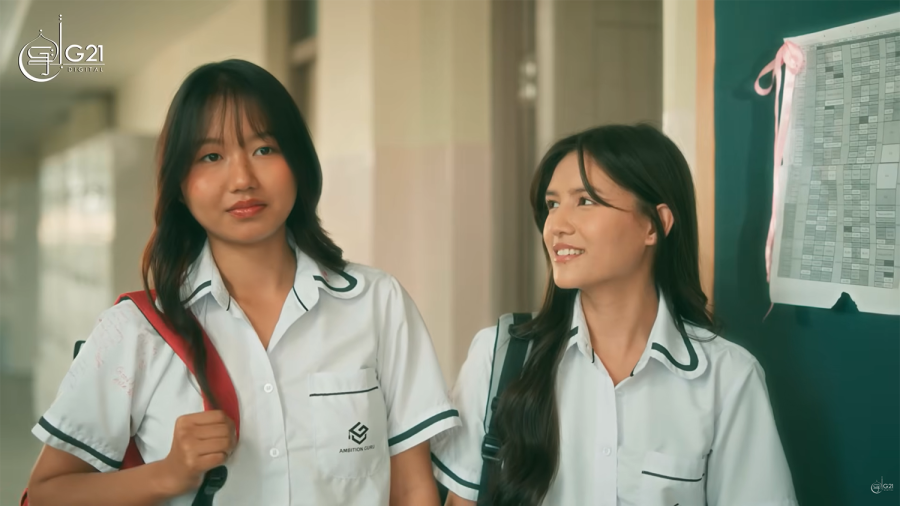
Korean dramas and high school romances have made a name for themselves on streaming services. As fiction about youth and friendship continues to grow, Nepali productions have also begun experimenting with the genre. An attempt to re-enact it, ‘Teen Spirit’, a 4-episode Nepali web drama, follows the lives of young adolescents.
Directed by Jeevan Swar and Suneel Gee, the series is presented by G21 Digital along with Young Hearts Films.
It doesn’t exactly follow a plot-driven narrative, as the episodes are better seen as tackling different issues and life dilemmas teens face every day. Using light-hearted characters, it addresses critical topics such as LGBTQIA+, academic pressure, harassment, and consent. These morally complex situations are effortlessly integrated into the characters’ plotlines, making it easier for the audience to empathise with them. That kind of social fiction only works well when the choice of subject matter is recurring within the audience.
The cinematography is very familiar: soft colour grading, slower motions and aesthetic backgrounds. They are staple elements of any Korean series, especially one that centres on high school. Throughout the series, you could see Charu (Malika Mahat), the main character, boxed into her own room. White dimmed lights, pastel objects, and modern homes make the setting feel very calm and refreshing. But at times, the film set seems to be disconnected from what actual Nepali settings look like.
The influence of East Asian dramas is very evident in the series, but the production sacrifices Nepali authenticity in the process. A more balanced approach could have been used to preserve the local visuals and to make the story more rooted in the Nepali context.
In the first episode, Charu’s friend Srijana (Manika Lama) is panicking after realising Karan (the guy she likes) is gay. It is handled by Charu, who comforts her, saying, “It doesn’t change anything about him.” Acceptance is an important part of the process after someone’s identity is revealed. That is what the entire conversation between the two tries to showcase.
While the inclusion of an LGBTQIA+ story in one of its episodes could be considered representation, it is only a brief mention and not an in-depth analysis of the struggles the community faces. Nor do we see, Karan, having any personality or even a short backstory—he is almost like a silhouette that just exists. In that sense, the representation feels as if it’s only done for brownie points, to appease an audience that has not even had a fair chance to see representation, let alone judge it.
The episode titled ‘Friendship Goals’ is where the most prominent issue of harassment is portrayed. Depicting harassment as something that doesn’t always happen in a sudden instance, it showed how a series of subtle inappropriate behaviours can escalate into a bigger problem.
Sabina (Anusha Bayang Rai), one of Charu’s friends, attends preparatory classes to study for the IELTS test. At first, the instructor seems to be sweet and helpful as a mentor, but as time goes by, he starts pestering Sabina, stalking her and harassing her. Traumatised by his actions, she isolates herself, not choosing to share it with anyone. She lives in fear, unable to take a stand, showing the lived experience and coping mechanism of many victims. But her friends, Charu and Srijana, come together to defend her from the harasser.
Screengrab from YouTube
The confrontation between the victim and the perpetrator was one of the most realistic moments in the series. The scene portrayed the kind of response that most high school students are realistically capable of. Sabina’s friends attempt to stand up to the harasser, but they quickly realise that physical confrontation is not a practical solution. Instead, they choose to document the incident and publicly expose his actions. This scene feels more grounded in the idea that tackling a harasser cannot always be a direct attack.
The characters are relatable; they do not overuse online slang, which is often a miscategorisation in many shows. But here, Charu and her friends have more realistic dialogues, with just a hint of pop culture references.
One of the characters who stands out is Srijana, a bubbly, energetic side character who will go to any lengths for her friends. Manika Lama’s acting has captured that bubbly personality, in contrast to ‘childish’ mannerisms.
There is a genuine effort to emphasise the psychology of young adolescents and their emotional burden. The uncomfortable conversations about consent and academic pressure to outdo your friends reveal teenagers' broader thought processes. These concerns are taken seriously in the series. Nepali web series rarely centre on teenagers and their mental health, but ‘Teen Spirit’ makes space for such crucial conversations within entertainment.




 14.59°C Kathmandu

.jpg)
.png)