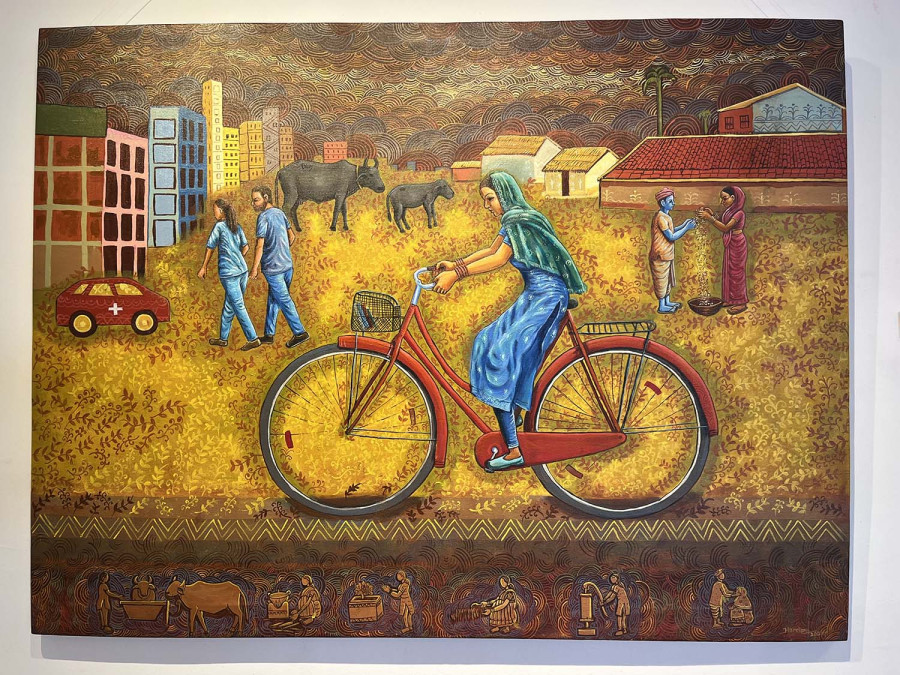
Artist Hare Ram Yadav’s ‘From Siraha to Kathmandu’ captures a region negotiating change, where village traditions and agricultural transformations coexist in complex ways. ‘Journey of Cultural Respect’ Photos: Rivash Rijal/TKP
The exhibition ‘From Siraha to Kathmandu’ is a sizable 28-piece collection of paintings that gives Kathmandu audiences an opportunity to familiarise themselves with life in the Mithila heartlands. Artist Hare Ram Yadav, born and raised in Siraha, has illustrated various aspects of life in Madhesh as he has seen it. From the retelling of the famous myth of “Lok Debta Salhesh” to depictions of several religious and cultural symbols, such as those of happiness and protection, among others, the exhibition leaves little more to be asked for in the way of an honest portrayal of village life.
Alongside being a detailed showcase of life in the lowlands, the exhibit is also an equally detailed showcase of the coming of modernity in Tarai.
Piece 13, titled ‘Journey of Cultural Respect’, depicts a veiled woman cycling. “The veil tells us that the woman is married. Women are often married young. Sometimes they have finished the tenth grade, and sometimes the twelfth. After marriage, these women are expected to take on much responsibility in their new homes. If they are able to continue school, they have to make time on top of what is expected of them after marriage,” says Yadav.
‘Modern Era’
In the painting, a woman rides a bicycle away from a couple engaged in household chores and towards another couple dressed in medical scrubs. The medical professionals are walking towards a red-cross-esque vehicle. Yadav explains that the woman, wearing a veil and cycling towards healthcare providers, symbolises the journey towards their dreams and aspirations that many women undertake while juggling household responsibilities and social expectations.
The painting places the woman in the middle and, behind her, depicts two realities of life. The background hosts both thatch-roofed village homes and modern buildings. The painting has both a car and cattle in the same frame. While Madheshi women now have access to better and higher education than in the past, the progressive developments brought by modernity have not replaced old ways. Instead, modern Nepal’s new opportunities exist in a messy, not necessarily harmonised, manner alongside old Nepal’s asks.
The very next piece, number 14, titled ‘Modern Era’, shows another woman. In this painting, the veil has been replaced by a helmet from which free, unkempt hair flows. This woman does not seem to be married. Maybe she is, but at the very least, she is not being asked to veil herself. Her wheels have definitely gotten better, too. She has gone from a bicycle to a motorcycle or maybe a scooter.
The life the viewer might imagine this woman leads is markedly different from the one Yadav describes in discussing the last painting. And yet, she is Maithili all the same. The designs on her apparel are distinctly Maithili in style. In piece thirteen, the woman is attempting to define a life for herself in tune with what has been defined for her. In piece fourteen, that attempt at defining and redefining has been completed. The woman seems to be truly independent while also being truly Maithili.
‘Ox-Farmer Bond’
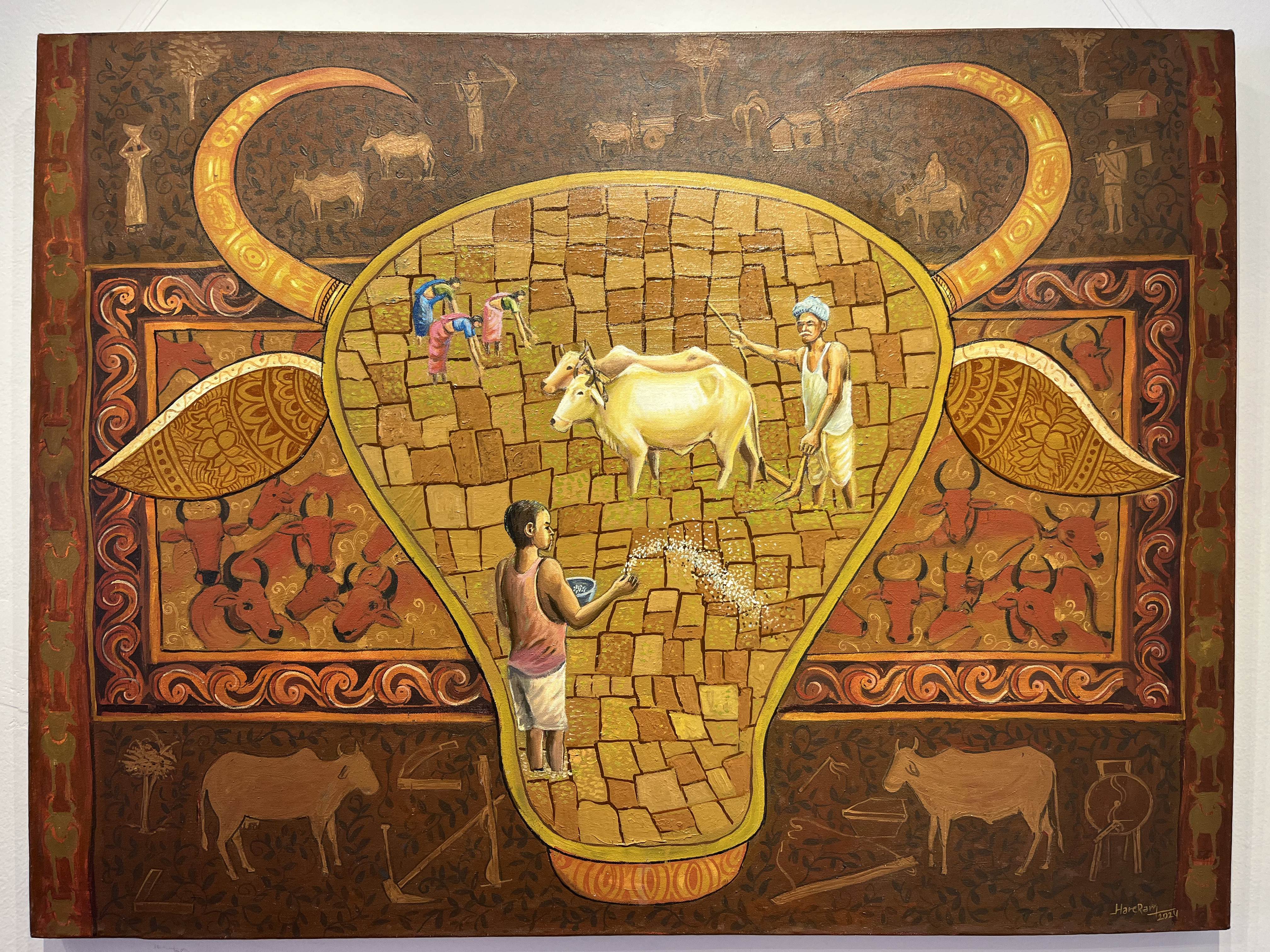
In addition to social change, Yadav shares that modernity has also brought structural change in Madhesh. Piece 23, titled ‘Ox-Farmer Bond’, primarily illustrates the use of oxen in ploughing the fields of Nepal’s breadbasket. “It is hard to find these kinds of oxen nowadays,” Yadav says. “It has been replaced by tractors and chemical fertilisers. Modern equipment is expensive. Oxen eat what grows in the fields; we have to buy fuel for the machines. The chemical fertilisers destroy the soil, whereas the oxen produce manure for us.”
The painting glorifies the beast of burden in many ways. The whole piece is framed by the outline of a cattle skull. In the forefront sits the image of a man ploughing the fields with yoked oxen, while another man scatters seeds, and some hunched-over women work the field with their hands. The painting depicts hard work. Add in the several small images of similar agrarian work, and it is hard to miss the conclusion that the farmer’s life is not easy. Despite the toil, however, there is a sense of harmony in the image. There is no modern technology in sight, and one gets the sense that life just works.
Nepal has seen much development in the past few decades. In different ways and degrees, modernity has arrived in all parts of the country. As such, every aspect of people’s lives has changed. Most of Hare Ram Yadav’s paintings show life as it has existed for centuries. These depictions of old Mithila are beautiful. And some of his paintings show new Mithila life as it undergoes change. Are these changes good? Are they wanted? Are they welcome? Depends who you ask.
Yadav does not have the answers, but he has certainly asked the questions in a captivating way.
_______________________
From Siraha To Kathmandu
Where: Kathmandu Art Gallery, Baber Mahal Revisited, Kathmandu
Rivash Rijal is a culture and lifestyle intern at the post. He is also a rising senior at St John's College in Santa Fe, NM. He will be graduating from the class of 2027 with a BA in Philosophy, Literature and Natural Sciences.




 28.31°C Kathmandu

%20(2).jpg)