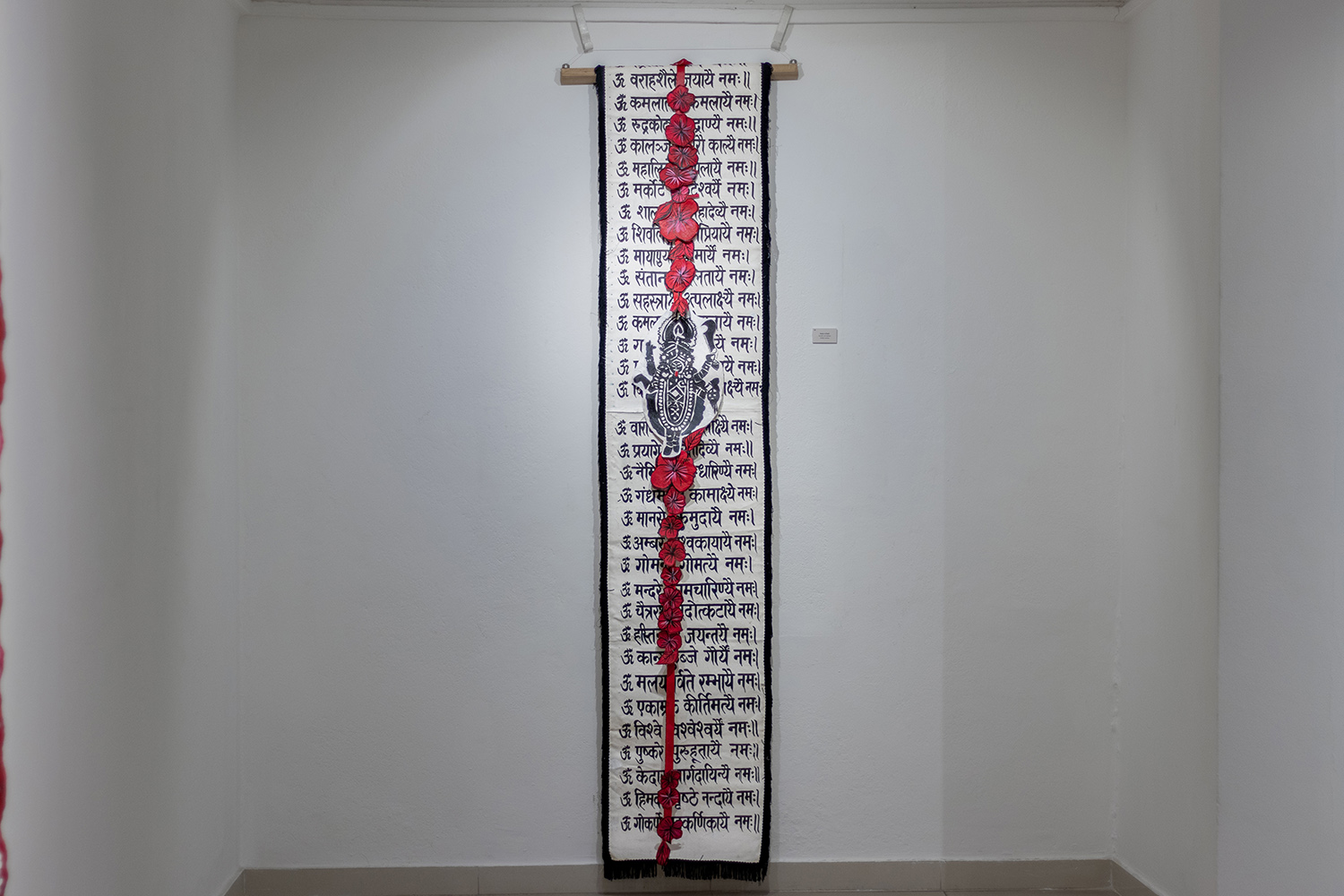
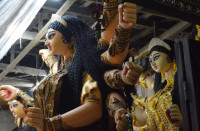
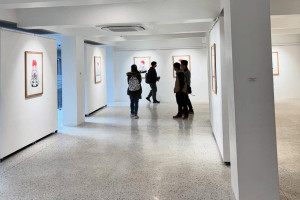
Drawing from multiple traditions, ‘Invocation of the Goddesses’ resists fixed meanings, inviting viewers into a space of uncertainty and inquiry. Photos: Courtesy of SAG
Sometimes, repetition becomes a language in itself. A word spoken once may pass unnoticed, but spoken again and again, it begins to gather weight—becoming rhythm, then prayer. To walk into Sara Guberti’s ‘Invocation of the Goddesses’ at Siddhartha Art Gallery is to enter that space of repetition: of symbols, of bodies and of voices that refuse to remain unheard.
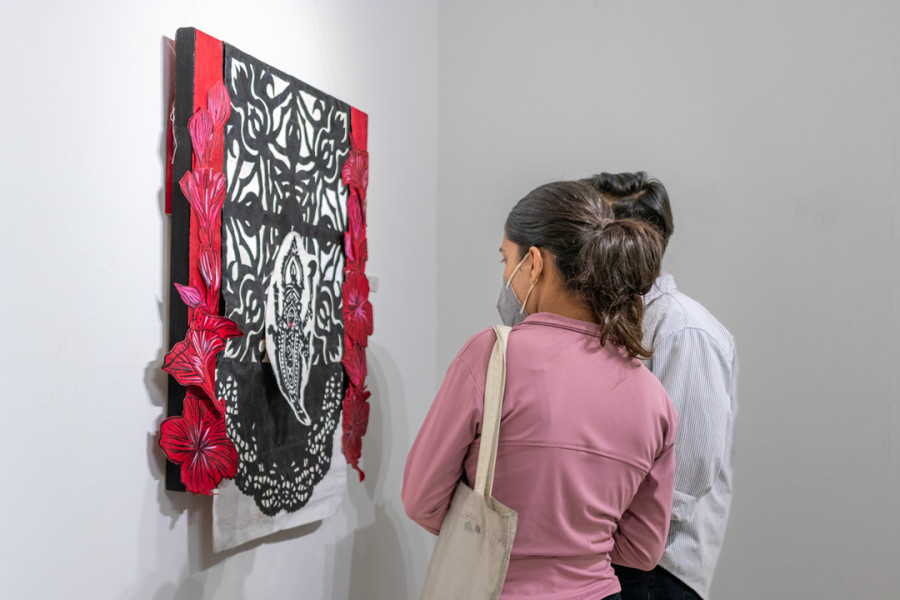
Italian artist Sara Guberti’s solo exhibition, inaugurated at Baber Mahal Revisited, unfolds as both a visual and spiritual inquiry into the feminine—its erasure, its endurance and its urgent reawakening. Working across painting and collage, and using acrylic on canvas, Guberti lifts her pieces off the surface. With a restrained yet striking palette of red, black and white, she constructs an environment that is at once reflective and confrontational.
“Today we are in a very difficult situation,” Guberti says. “Most of the energy around us is male energy. This exhibition is an invocation to the goddesses because we need to, as women, recognise our power, our choice, and our responsibility.”
Born in Ferrara, Italy, in 1970, Guberti has long rooted her practice in spirituality and symbolism, drawing connections between belief systems across cultures. In ‘Invocation of the Goddesses,’ these threads converge, forming a visual language that is intentionally limitless. Hindu deities appear alongside Catholic iconography. Sanskrit script appears alongside Italian text. “This concept is seen around the world,” Guberti explains. “It is not only for the Catholic religion or Hinduism. Repetition and prayer are in every place.”
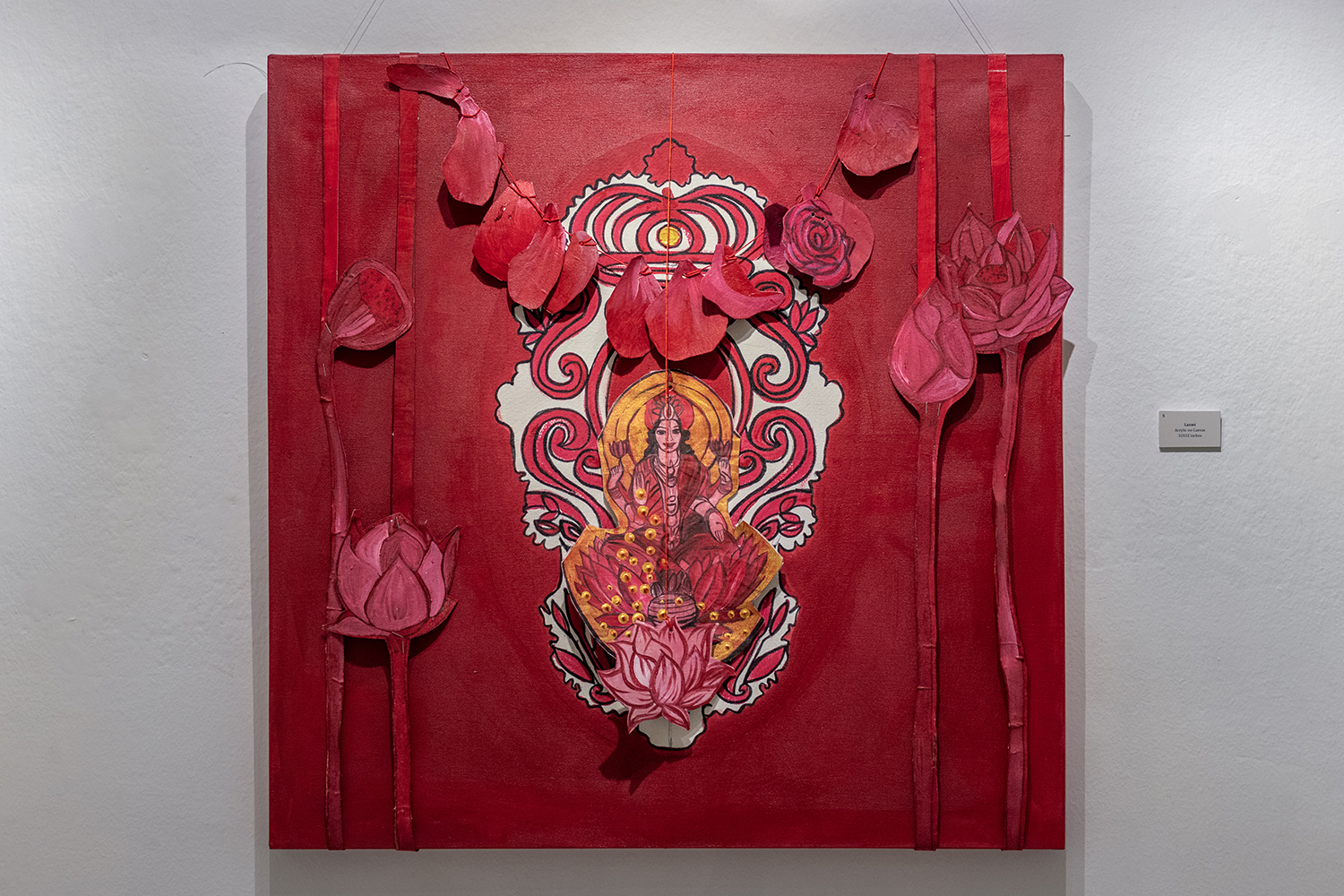
‘Laxmi’ uses a rose banner to extend the work beyond the canvas.
Guberti’s work is shaped by movement. She travels with her pieces, rolling and folding her canvases as she goes. “It is a travelling exhibition,” she says. “My bag was full of 20 kilograms of canvas rolls.” She also carries her materials. “I bring the strips and the paint because I don’t know what I will find in a new place,” Guberti says.
That movement carries into the art itself. “When I am in Italy, viewers are a little confused by the symbols from here. And when I am here in Nepal, they are a little confused by the symbols from there,” she explains. The work moves between cultures, asking viewers to sit with what they do not fully know. With this cross-cultural exposure, Guberti hopes viewers in Italy will come to understand Hinduism better, and vice versa.
The exhibit is structured less as a linear narrative and more as an immersive field of motifs. On the upper floor, large vertical canvases hang like scrolls. Across them, patterns repeat with a meditative precision: floral forms, architectural frames, and goddess figures. In some works, like ‘The Dakini Series I-V’, each iteration slightly shifts, as if testing the limits of recognition and meaning.
In ‘Prayer to the Dakini’, two long red panels flank a central column of repeated goddess figures, each enclosed within a black arch. While the symmetry is striking, it is the repetition that holds the eye. The figures do not progress; they echo. “For me, to use repetition in the painting is a form of mantra,” Guberti says. Like a chant, the work accumulates intensity, asking the viewer not to move forward, but to stay—to look again, and again.
This logic of repetition extends across the exhibition. In ‘Chakra’, a vertical composition set against a black background, a serpent rises along a central red line, weaving through circular forms that evoke energy centres. The snake, Guberti explains, represents untapped energy: “When he awakes, he travels up the chakras.” The work’s stark contrast—white mandala-like designs against jet black, interrupted by visceral red—suggests both tension and movement, a body in the process of awakening.
In ‘Prayer to the Feminine’, a vertical canvas is layered with Nepali script and red rose forms.
Colour plays a crucial role throughout the works. Red is used almost obsessively, drawing viewers’ eyes amid the black-and-white backgrounds. “The red signifies blood,” says Guberti. “It reminds us that men and women are the same.” In contrast, the black and white signify the imbalance of female and male forces. “If one becomes too much, all will be broken,” she says.
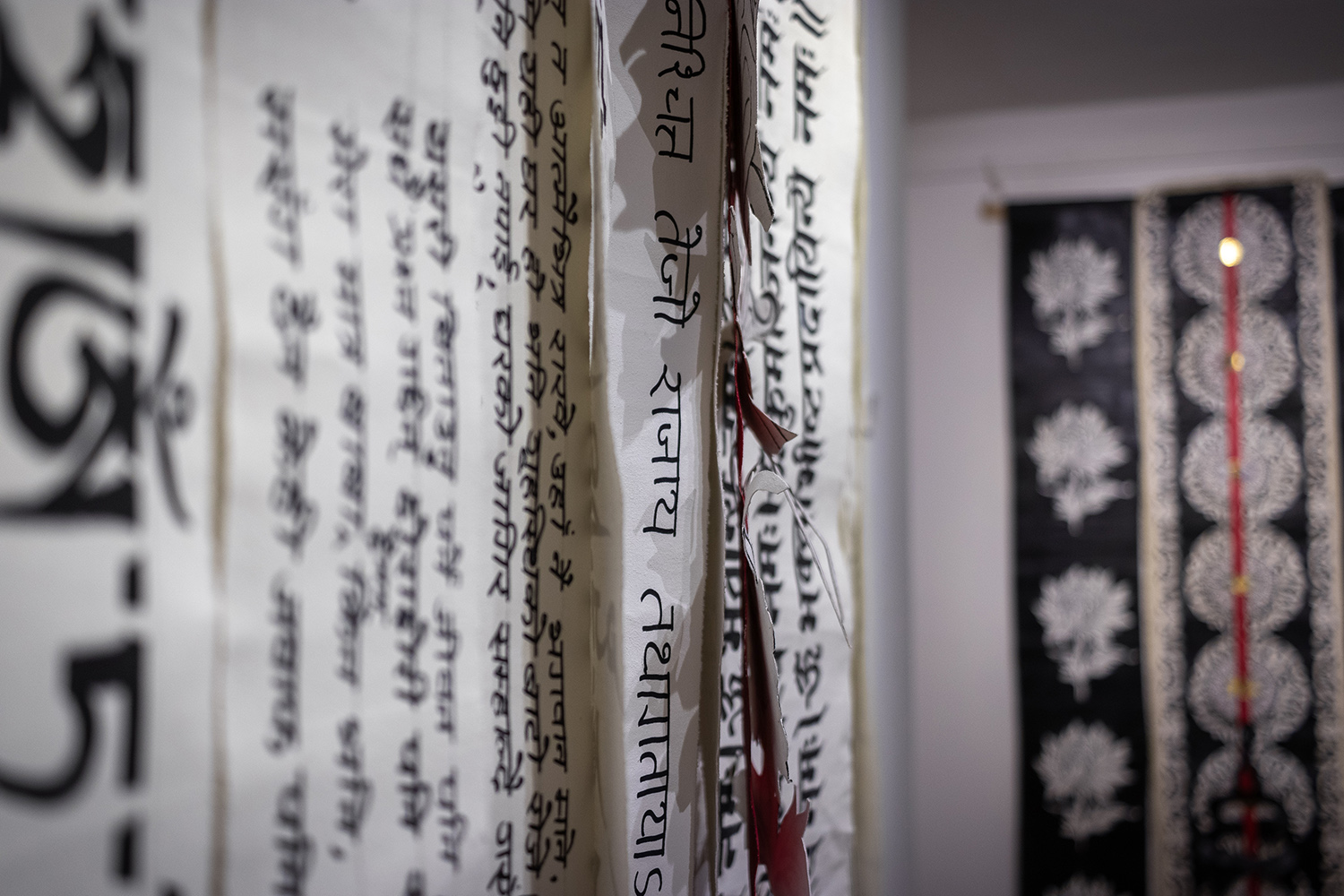
If many of the works inspire introspective and individual reflection, ‘Prayer to the Feminine’ leans into the collective. In this work, strips of canvas hang densely, layered with handwritten texts in multiple languages—Nepali, Sanskrit, Italian and others. Some are carefully inscribed, while others feel urgent, almost spilling across the surface. Standing before it, the effect is overwhelming, as if encountering a flood of voices long held back.
“Here, I ask women to write a prayer or wish,” Guberti explains. “I give them the strip, and I tell them to write what they want, in whatever script they want.” The piece becomes not just an artwork, but an archive of desire once left unsaid—private thoughts made public, individual voices woven into a collective invocation. The density of the text makes it difficult to read easily, and because the strips are written in multiple languages, no viewer can fully understand every word. But perhaps that is the point: one does not need to understand each word to feel their accumulation and urgency, and to grasp the message of the piece.
This act of gathering voices is central to Guberti’s vision, though it did not come easily. She had hoped to involve a large group of women in Nepal, inviting them to write their own messages on strips of canvas, but found it difficult to bring people together. “I tried the monastery, the university, the college,” she says.
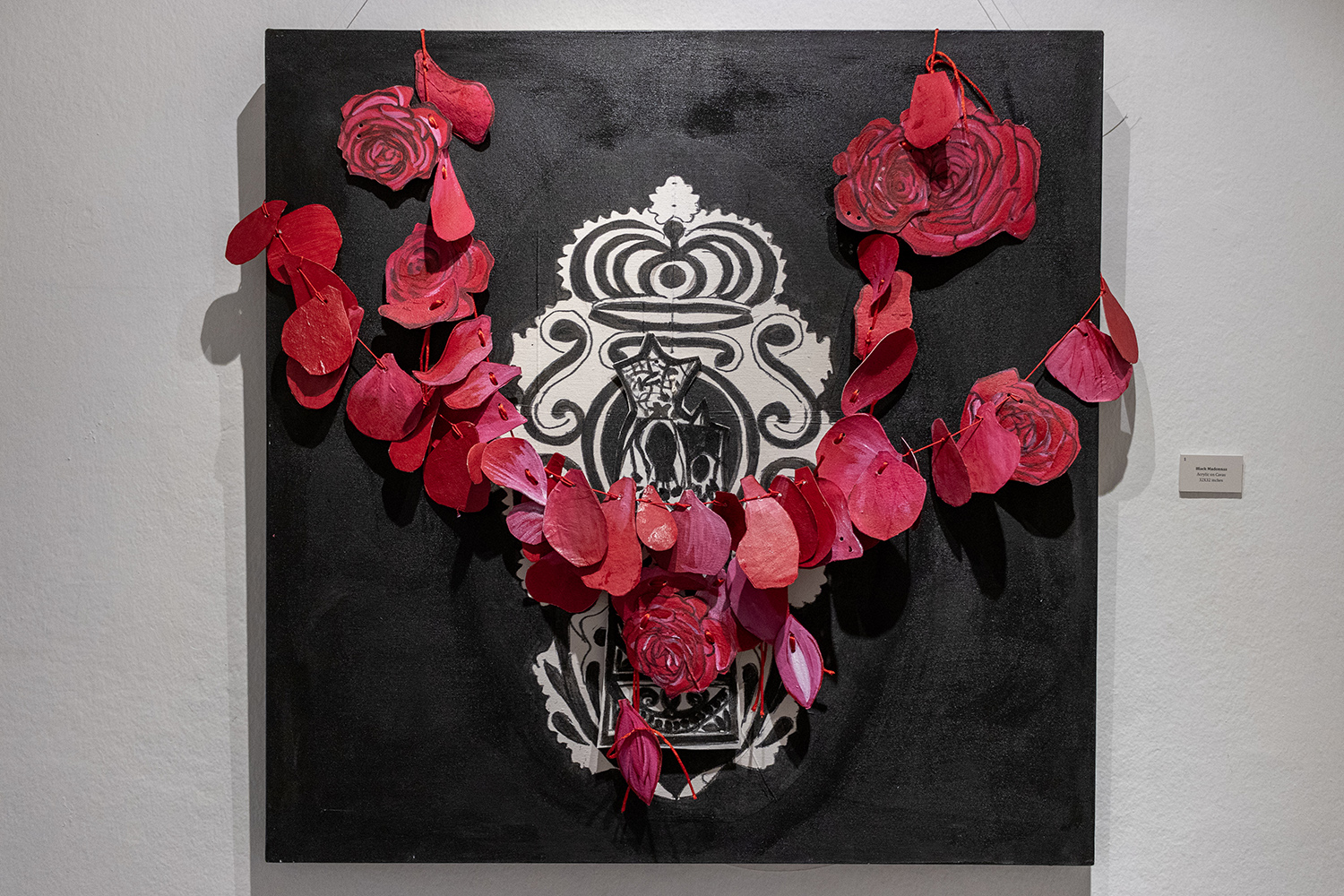
Another key thread running through the exhibition is Guberti’s engagement with the Black Madonna (a statue or painting of the Blessed Virgin Mary, often with the infant Jesus, depicted with dark or black skin). Historically depicted with dark skin, these figures were later transformed by the Church. “In the past, the Madonnas were black—a symbol of fertility of the Earth,” she says. “It was a connection with the moon, the ocean, the Earth.” Over time, they were whitened and reframed as symbols of purity.
For Guberti, this shift is political. “To be stronger, the Church understood that it had to fragment women,” she says. “Women had the power of life—the Church had to break the circles that women created.” In reclaiming the Black Madonna, Guberti’s work, namely ‘Black Madonnas,’ seeks to restore what was obscured: a vision of femininity grounded in connection, multiplicity and power.
This multiplicity is also reflected in her depictions of Hindu goddesses, like Laxmi and Saraswati. Figures appear not as static icons, but as layered, tactile forms. In ‘Saraswati’, a banner of red rose petals extends outward from the canvas, creating a three-dimensional effect. “I very much like the idea of collage,” Guberti says. “I like the tactile.” The physicality of the material—the cut paper, the layered surfaces—reinforces the sense that these are not distant deities, but presences within reach, beings that can be touched, assembled and reimagined.
Underlying the entire exhibition is a critique of imbalance—between masculine and feminine forces, between visibility and silence, between recognition and erasure. “This time is very important. We must recognise no one can decide for us,” Guberti says. “Right now, men decide for women what is better for them. The world is so dangerous because we’ve lost the balance.”
Yet when viewers exit the space, they are not left with a feeling of despair or defeat. The exhibition’s insistence on repetition, on gathering, on invocation, suggests that change begins with sustained attention. By saying something again and again, until it is heard.
“The project is an invitation for women to recognise their value inside,” Guberti says.
Walking through ‘Invocation of the Goddesses’, what lingers is not just the imagery, but the feeling of being addressed, of being asked to listen and perhaps even to respond.
________________
Invocation of the Goddesses
When: April 10 to 30
Where: Siddhartha Art Gallery, Baber Mahal Revisited




 12.67°C Kathmandu