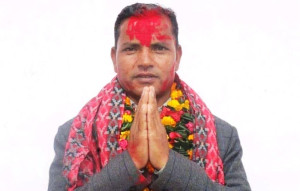
From chief minister to shopkeeper, Trilochan Bhatta embraces ordinary life
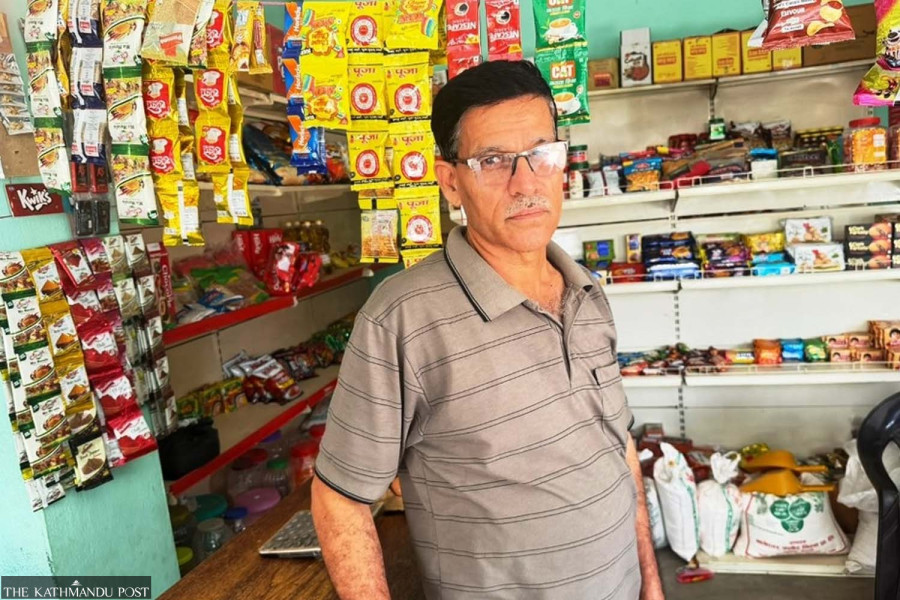
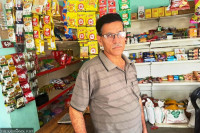
After five years at the helm of Sudurpaschim province, Bhatta has returned to a modest routine behind a grocery shop counter.Former Sudurpaschim chief minister Trilochan Bhatta at his grocery shop. Arjun Shah/TKP
A broad commercial junction stretches in front of the Cottage and Small Industries Office in Dhangadhi. A busy hospital, a shopping complex and a supermarket are nearby, while the provincial head’s office stands directly across the road. The area comes alive early each morning.
On the ground floor of a building at the heart of the junction is a small grocery store—New Prasthan Kirana Pasal. Customers begin arriving early. The shopkeeper serves them and sends them on their way with a smile.
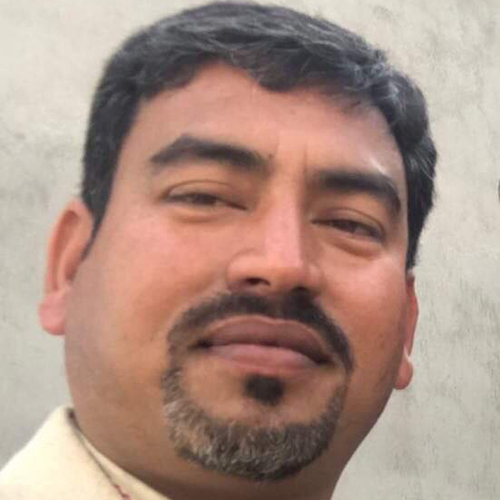
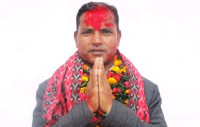
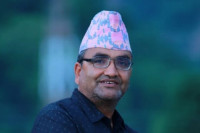
The shopkeeper is Trilochan Bhatta, the first chief minister of Sudurpaschim province.
Bhatta, who led the provincial government for the full five-year term of its first assembly, can now be found behind the counter of an ordinary neighbourhood grocery shop.
Until about three and a half years ago, his daily life was very different. He had an executive office, a government vehicle worth around Rs25 million, a security detail, a convoy of official cars and party workers competing to welcome him and offer courtesies.
But for the past two years, he has been running the grocery shop, trading the trappings of high office for the routines of everyday life.
Government vehicles bearing official flags pass almost daily to and from the provincial head’s office across the road. But Bhatta says he barely notices them.
“Government vehicles bearing official flags are frequently pulled up at the provincial head’s office but it does not really bother me,” the former chief minister said. “These days, I am happy with this routine. Friends also drop by from time to time, and we talk politics.”
High office is often associated with wealth and an affluent lifestyle. Bhatta, however, says he is content with a simple life after spending five years as the province’s chief executive.
He says he owns no significant property beyond an old ancestral house and a small plot of land in the hills. He started the grocery business two years ago with about Rs400,000-Rs500,000 he had saved while serving as chief minister, along with goods bought on credit from wholesalers.
“Shopkeepers and others often ask how someone could be chief minister for five years and not make money,” Bhatta said. “But if you don’t engage in corruption or other wrongdoing, what can a chief minister’s salary really cover beyond food and basic living expenses? I did not engage in such practices, so where would the money have come from?”
Bhatta said he had vowed on taking office that politics would be about public service, not making money. His two years behind the counter have also exposed him to an unexpected side of public perception. He has noticed that some customers turn away after seeing that the person behind the counter was once a chief minister.
“Some customers seem uncomfortable buying things from a former chief minister,” he said. “Wholesalers are also sometimes reluctant to give us goods on credit. Perhaps they still see me as a politician and wonder what I might do.”
Bhatta remains active in politics. He is a co-in-charge of the Nepali Communist Party in Sudurpaschim, where the party leads the provincial government. The provincial government has yet to present its budget, and political activity in Dhangadhi has picked up as preparations get underway.
Thousands of people have come to Dhangadhi from villages seeking development projects and budget allocations. They can be seen visiting ministers, lawmakers, ministers’ personal secretaries, ministry officials and the Office of the Chief Minister and Council of Ministers.
Bhatta, however, appears untouched by the bustle.
“People from the villages come and ask me to speak to the chief minister or ministers about projects,” he said. “I tell them no one listens to me now.”
Bhatta traces his ability to live simply to the hardship he experienced from childhood.
Born into a poor family in what was then Bhumirajmadu Village Development Committee-8 in Doti district, Bhatta dropped out of school after eighth grade and left home at the age of 14 because his family could not afford to support his education.
He travelled to India to work as a security guard.
“Every child wants to go to school and live with their parents,” he said. “But my family could not afford it, so I had to leave.” Bhatta went to India and found work at a Japanese company in Mumbai. He worked there for many years. “I started my political career there in 1990 as a member of the All India Nepal Unity Society, which was close to the Maoists,” he said.
After returning from India, he spent some time growing vegetables in his home district. He remained involved in politics while working in agriculture.
He contested the 2008 and 2013 Constituent Assembly elections as a Maoist candidate but lost both times.
In the 2017 provincial elections, he contested the Doti Provincial Constituency 2 seat for the Maoists and won. After entering the provincial assembly, he was unanimously elected parliamentary party leader of the Nepali Communist Party, formed through the merger of the CPN-UML and then CPN (Maoist Centre).
On February 15, 2018, Bhatta became Sudurpaschim’s first chief minister after the party secured nearly a two-thirds majority in the provincial assembly.
As chief minister, Bhatta was often called the “watchman chief minister” because he had once worked as a watchman in India.
“I never expected to become chief minister, and I was never very ambitious,” he said. “Some people mocked me and called me a watchman. Others made fun of me. But many were proud that I had come this far.”
Bhatta also drew attention while in office for sending his two daughters, Laxmi and Pushpa, to a government school in Dhangadhi.
“I enrolled them in a government school so that others would also gain confidence in public schools,” he said. “My son Bikash also studied at a government school and completed a junior technical assistant course in veterinary science.”
Throughout his five-year term, Bhatta had access to a government Toyota Fortuner. Today, he does not even own a motorcycle.
“I returned to an ordinary life the day my term ended,” he said. “I had no difficulty walking the streets from the very next day.”
He says he has also experienced the stigma attached to returning to ordinary work after holding high office in a society where such a move can invite ridicule.
“It is because of this attitude in society that I have begun to understand why so many politicians become obsessed with power and wealth,” he said. “Once you have neither power nor money, neither relatives, nor your party, nor the state seems to care about you.”
Bhatta says he managed to balance relations among different parties and political leaders during periods of conflict at the centre and remained in charge of the provincial government for the full five-year term.
“I hope society will one day value people who return to ordinary life after holding high office,” he said. “Only then will politics truly become public service.”




 17.65°C Kathmandu