Millions of rupees meant to save families from disasters go unspent
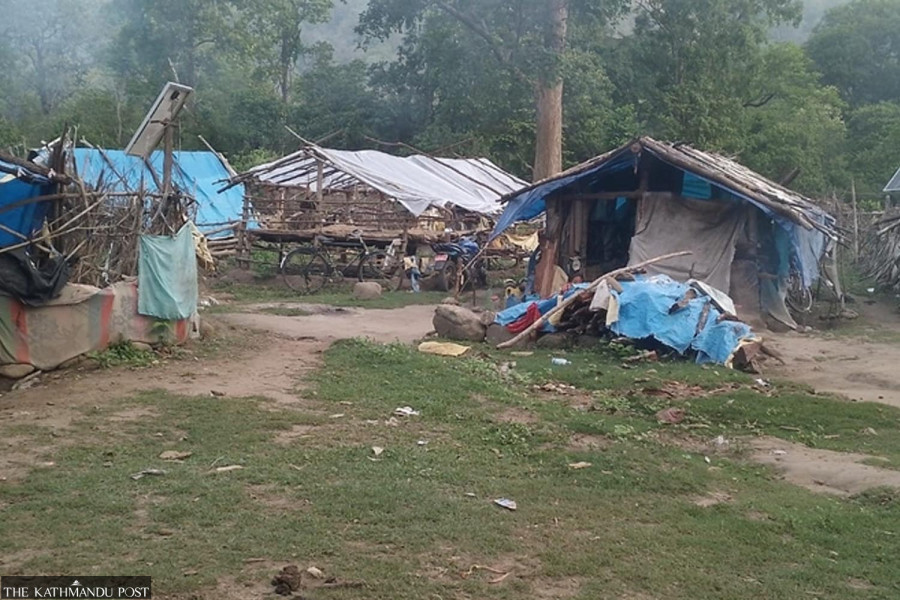
More than Rs160 million in provincial disaster funds has gone unused in six years, while over 100 families in Kailali continue to spend the monsoon in unsafe makeshift shelters. Huts of displaced people in Chure Rural Municipality. A landslide in 2020 displaced 116 households were displaced in the local unit’s wards 4, 5 and 6. Post Photo
Along the banks of the Baluwagada Khola in ward 4 of Chure Rural Municipality, a cluster of makeshift shelters built from torn tarpaulins and bamboo stands as a reminder of families still awaiting permanent resettlement.
Surrounded by a forest and a fast-flowing river, the settlement is exposed to threats from wild animals, venomous snakes and monsoon floods.
Thirty-year-old Meena Thapa has lived there for the past six years. She, her husband and their two children occupy a fragile hut that offers little protection from rain or wind. The couple earns a living by crushing stones into gravel, often struggling to earn enough for even basic meals.
Before the disaster, the family lived in Masurkhet in the same municipality. A landslide in 2020 swept away their house, forcing them to move from one temporary shelter to another. Their current shelter is so flimsy that the sky is seen through the roof.
“The tarpaulins are old and torn. There is nowhere to keep dry when it rains,” Thapa said. “During the monsoon, we have to choose between saving our belongings and our lives.”
Her family is among some 30 households living in similar conditions on the riverbank. Another settlement at Paneru Gana, where families displaced by the same 2020 landslide have taken refuge, also lacks basic services.
According to Chure Rural Municipality, 116 households in wards 4, 5 and 6 remain displaced by disasters.
Kali Bhatta, the municipality’s information officer, said repeated efforts to relocate the families have stalled for the lack of suitable land and funding.
For three years, the displaced families stayed at what was considered a safer site near the forest. However, in 2024, the Khairala Sub-division Forest Office cleared the settlement, saying it had encroached on forest land, forcing the families back on the riverbank under risky conditions.
The situation is similar in Bandargaudi in ward 4 of Kailari Rural Municipality, where families displaced by floods in 2021 continue to live in temporary shelters inside the Pawera Community Forest four years later.
Resettlement stalled by land and funding constraints
Provincial officials say the lack of land has prevented disaster-affected families in Kailali and Kanchanpur from receiving rehabilitation grants.
According to the Sudurpaschim Province Ministry of Internal Affairs and Law, more than Rs50 million was spent on rehabilitation during the current fiscal year, including Rs30 million allocated for resettlement and another Rs20 million from the Disaster Management Fund.
However, all of the money was spent in the province’s seven hill districts.
Janak Dhami, the ministry’s disaster liaison officer, said rehabilitation grants had been distributed in phases to victims affected since 2020.
“This year, Rs50 million was spent on rehabilitation in the seven hill districts. Kailali and Kanchanpur did not receive any allocation,” he said.
Under the Disaster-Affected Private Housing Retrofitting, Reconstruction and Rehabilitation Grant Procedure, 2024, households receive grants of Rs500,000 in mountain districts, Rs400,000 in hill districts and Rs300,000 in the Tarai to rebuild houses.
Families without land, or whose land has been deemed unsafe for settlement, are eligible for an additional Rs300,000 to purchase land.
In the Tarai, households requiring both land and housing qualify for a maximum grant of Rs600,000. The scheme is based on a cost-sharing arrangement under which the federal government contributes 50 percent, the provincial government 30 percent and the local government 20 percent.
Based on the guideline, all 116 displaced households in Chure qualify for the full Rs600,000 package, requiring a total budget of Rs69.6 million.
Yet that amount is less than half of the Rs164.2 million in disaster management funds that the provincial government has failed to spend over the past six fiscal years.
Under the funding arrangement, the federal government would contribute Rs34.8 million, the provincial government Rs20.88 million and the local government Rs13.92 million.
Krishna Shahi, an under secretary at the ministry, said the provincial allocation remained unspent because local governments had not secured land for resettlement.
“The province provides its share for rehabilitation once a formal proposal is submitted and all procedures are completed,” Shahi said. “The remaining responsibilities lie with the federal and local governments.”
Chakra Bahadur Bogati, chairperson of Chure Rural Municipality, said identifying suitable land remains the biggest obstacle.
“There is no safe public land available within Chure,” he said. “We tried several times to relocate the families, but the sites identified fell within forest areas, and the Forest Office cleared the settlements.”
Bogati said the municipality is coordinating with the District Administration Office to identify suitable land and will mobilise resources to build houses once a site is legally secured.
Pradeep Kumar Koirala, executive chief of the National Disaster Risk Reduction and Management Authority (NDRRMA), said local governments are responsible for identifying land and completing the verification process before affected households become eligible for rehabilitation grants.
Disaster funds remain largely unused
According to the NDRRMA, Sudurpaschim has recorded 4,116 disaster incidents over the past decade, claiming 429 lives and causing significant economic losses.
Despite regular budget allocations for disaster preparedness and response, provincial spending has remained consistently low.
Data from the Ministry of Internal Affairs and Law show that of the Rs537.5 million allocated for disaster management programmes since the fiscal year 2020-21, only Rs373.3 million has been spent. The remaining Rs164.2 million lapsed.
Spending from the province’s Disaster Management Fund has also remained low. Over the past seven fiscal years, only Rs253.7 million has been utilised.
This fiscal year’s disaster budget included Rs5 million for emergency air rescue operations, Rs700,000 for humanitarian assistance centres and provincial warehouses, Rs10 million for disaster insurance, Rs1.8 million for community awareness programmes and Rs550,000 for assistance to families of missing persons.
The budget also allocated Rs4 million for transporting search, rescue and relief materials, Rs850,000 for rescue drones, Rs4 million for flood early warning systems, Rs5 million for rescue equipment and Rs30 million for the province’s contribution to private housing reconstruction.
Dhami said a large share of the disaster budget is allocated for preparedness, early action and awareness programmes.
“When these programmes are delayed or cannot be implemented, the allocated budget remains unspent,” he said.




 17.57°C Kathmandu