Juwabairath residents complain they are remembered only during elections
In this neglected and impoverished Tharu settlement in Kaplivastu, people must make long treks for even basic services like schools, healthcare and markets. A maize stack, thatched huts, and grazing goats and chickens pictured in the Tharu settlement of Juwabairath in Bijayanagar Rural Municipality. Manoj Paudel/TKP
Mahadev Tharu, 86, has voted in every national election since the 1986 Rastriya Panchayat (national parliament) elections. As the country prepares to vote in the House of Representatives polls next week, Tharu is set to cast his vote for the ninth time. Yet the excitement that once accompanied election day has long faded.
“Back then, we believed change would come,” said the octogenarian, sitting outside his mud-walled home in Juwabairath, ward 1 of Bijayanagar Rural Municipality in Kapilvastu district. “The political system changed. Governments changed. But our village is still struggling even for basic needs,” he lamented.
Juwabairath lies in the far north-western edge of Kapilvastu, near the border with India. The Arra river flows beside the settlement, marking not only the district’s boundary but also the frontier between Nepal and India. Despite decades of political transformation—from the Panchayat era to federal republicanism— the local people say their village remains untouched by meaningful development.
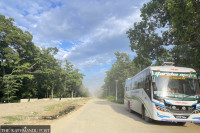
The settlement, home to 145 households predominantly from the Tharu community, is accessible only by a six-kilometre stretch of forest track from the nearest village, Nawalaganj. Until 2015, locals say it was difficult to distinguish the trail from the surrounding jungle. “It was barely a footpath. Only bicycles could pass,” recalled Patiram Tharu, the badghar (village chief). Each year before Dashain and Tihar, villagers would clear bushes and grass to reopen the route.
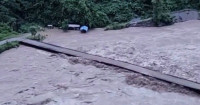
In 2016, the then District Development Committee widened the track to six or seven metres. But the road remains unpaved. During the four to five months of the monsoon, it becomes impassable. “When it rains, the road turns to mud. We have to push our bicycles,” said Patiram. Seasonal streams along the route swell with rainfall, cutting off movement entirely.
The condition of the village has dampened enthusiasm for the March 5 polls. “Leaders come during elections, make promises and leave. Nothing changes here,” said Patiram.
The constituency has its own political history. Mangal Prasad Gupta contested the 1986 National Panchayat elections and went on to lose six successive polls before finally winning a parliamentary seat in the 2022 general election from this area. Yet, residents complain, Juwabairath’s condition has remained the same.
Education illustrates the depth of neglect in Juwabairath. The village school, Kamana Basic School, offers classes only up to Grade 5. To continue to Grade 6, children must walk six kilometres through forest to Nawalaganj, where schooling is available up to Grade 8. And, for Grade 9, they must travel 10 kilometres to Gugauli.
“I dropped out after Grade 8. On the way to Gugauli, we have to cross the Chirai and Bisuwa streams. There are no bridges. The forest is frightening,” said Susmita Thapa. She estimates that at least 15 to 20 students in the village have similarly abandoned their studies.
Established in 2007, Kamana Basic School finally had a five-room building in 2013. But infrastructure and staffing remain inadequate. With 283 students enrolled, classrooms are overcrowded; early childhood classes and Grade 1 share space. Even office assistants sometimes teach due to a shortage of teachers.
Nisha Sigdel, principal at the school, said only about half the enrolled students attend their classes regularly. “Eleven girls who passed Grade 5 have dropped out this year alone. Poverty forces parents to take children along for daily wage labour,” she said. “We attempted to convince guardians to send their wards to school regularly but failed. They tell us, ‘First we must feed our families, then we can think about education.’”
Access to markets and services is equally challenging for Juwabairath residents. They must travel 22 kilometres either to Chandrauta in Nepal or Pachpedawa in India to buy essentials. Electricity reached the village only in 2017, and mobile connectivity became reliable four years ago after Nepal Telecom installed a BTS tower in Nawalaganj in 2021.
Before that, communication was nearly impossible, said local resident Paradeshi Tharu. “We voted for one party again and again, believing they would uplift the poor. Instead, leaders improved their own lives in Butwal, Dang and Kathmandu,” he said.
For even basic healthcare, villagers must make a six-kilometre journey to Nawalaganj. During monsoon flooding, the Arra river cuts off contact with India, while muddy tracks and swollen streams isolate the village from the Nepali side. Residents complain of harassment by India’s border security force when attempting to shop in nearby Indian markets. “We feel trapped, like frogs in a well,” said Harka Bahadur Rana Magar. “It feels like we matter only during elections.”
Agriculture provides subsistence but little surplus. Most families own between five and seven kattha of land [1 kattha is 338.63 sq metres]; few possess more than 12 to 15 kattha. Riverbank erosion from the Arra river threatens seven or eight homes on the western edge, while the Baza stream endangers four more in the east. “Whoever promises to control the river will get my vote,” said Ganga Tharu.
Most houses are made of mud walls with thatched roofs, with some tin-roofed dwellings and only a handful of concrete structures. Livelihoods depend on goat, pig and poultry rearing, supplemented by daily wage labour. There is no public transport. Motorcycles and bicycles are luxuries; the poorest must walk long distances even to cast their ballots.
“We have to walk six kilometres just to vote. I am still unsure whether I will go,” said Bal Bahadur Tharu. “Leaders remember us during elections and forget us the rest of the time. That is why villagers have been frustrated with them.”
Juwabairath lies in constituency 3 of Kapilvastu. A total of 36 candidates—13 from political parties and 23 independents— are contesting in the constituency having 118,404 registered voters.




 14.69°C Kathmandu