A 59-member Tharu joint family splits to form a new settlement in Bardiya
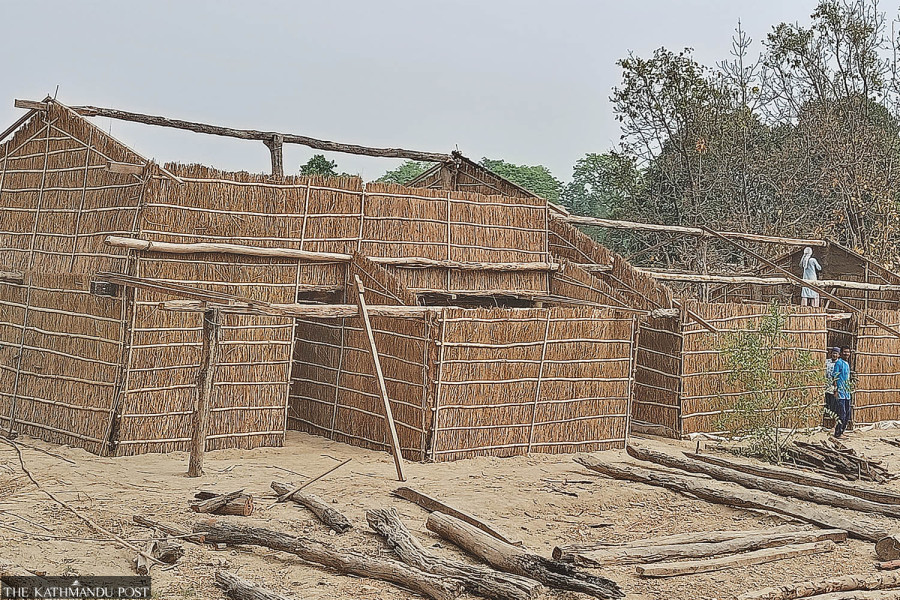
Rare joint household splits by mutual consent, yet preserves tradition of shared labour as members build a new settlement together amid changing rural realities. An under-construction house of one of the split Tharu families at Pattharbhojhi, Bardiya, pictured recently. Post Photo
As joint families become increasingly rare in Nepal, a large Tharu household in Pattharbhojhi of Madhuwan Municipality-1, Bardiya, has drawn attention after splitting into nine separate homes, forming a new settlement.
For decades, this 59-member family lived under a single roof, sharing a kitchen, a common purse, and a collective destiny. However, following a mutual agreement reached during the last Maghi, Tharus’ major festival that falls in mid-January, the family decided to separate. Despite the split, the bond remains visible in their labour. Instead of hiring external contractors, the family members and their relatives are working together to build all nine houses simultaneously.
“Earlier, we had one cook in the family,” said Mahangu Chaudhary. “When unpaid community labour was required, one person would go from the household. One person would take the livestock to graze… Now that we are separate, each house must send one person each for such duties.”
The shift reflects broader social changes across rural Nepal, where traditional joint families are steadily giving way to nuclear households. Increasing migration, economic pressures, and changing aspirations have contributed to this trend, highlighting rural demographic shifts and family restructuring.
In Pattharbhoji, the division was carefully planned and executed through mutual consent. The family’s ancestral lineage traces back to four brothers in the grandfather’s generation. Of their descendants, nine brothers formed the current generation that decided to partition.
“We marked and divided the land through agreement and began building homes accordingly,” said Lal Bahadur Chaudhary, the eldest son of the middle brother. “There has been no need to go to court. When brothers agree, legal disputes do not arise.”
Despite the separation, cooperation remains central. Family members work collectively on house construction. Some carry timber, others weave walls from bamboo, and several plaster surfaces with mud. A few are assigned to cooking and feeding the workforce, which includes both family members and relatives who have come to help.
“Relatives have come to support us, so I am cooking for around 65 people twice a day,” said Ramdulari Chaudhary, the eldest daughter-in-law. “It is demanding, but this is how we support one another.”
According to her, when the family lived together, the responsibility for cooking used to rotate. “Each person would take a turn cooking for about one and a half months,” she said.
While the nine new houses represent the fragmentation of a traditional lifestyle, the collaborative construction process suggests that the Tharu spirit of reciprocal labour remains intact.
“It is our tradition to support relatives in their time of need,” said Chhalluram Chaudhary, a relative who has spent six weeks helping build his brother-in-law’s house without pay. “We do not work for wages here. We work for each other.”
The Tharu family has evenly distributed household assets to avoid disputes. Timber, firewood, and other materials have been shared fairly, with each brother managing his portion independently.
While the separation offers autonomy, it also brings new challenges.
“Earlier, tasks were rotated. Now, each household must manage on its own,” said Lal Bahadur. “It is slightly more difficult than before.”
Even so, the spirit of mutual support endures. “If someone has a heavy workload, others still come forward to help,” he added.
The family relies primarily on agriculture. They own eight bighas of land and cultivate an additional 10 bighas under sharecropping arrangements. Previously, labour and responsibilities were shared across the joint household, making farm management more efficient.
The settlement lies within the Khata Bio-corridor, a 24-km pathway along the shared border of Bardiya National Park in Nepal and Katarniaghat Wildlife Sanctuary in India. As it is a critical wildlife passage, human-wildlife conflict is a persistent concern.
“We cannot afford concrete houses,” Mahangu said. “The traditional homes we build using local materials are often destroyed by elephants.”
Wild elephants frequently pass through the corridor, damaging homes and crops. In the past, affected families received little or no compensation. However, a micro home insurance scheme introduced under the Tarai Arc Landscape (TAL) programme has provided some relief.
“When elephants damaged my house, I received compensation of Rs14,000 once and Rs7,000 another time,” said Mahangu.
According to Hari Gurung, chair of the Khata Community Forest Coordination Committee, the insurance programme has been operational for three years. A total of 4,684 households across Madhuwan wards 1 to 5, Rajapur Municipality-10, and parts of Thakurbaba have been insured so far, according to Gurung. “Since the fiscal year 2022-23, we have provided Rs794,084 in compensation to 30 households affected by wild elephants and disasters,” he said.
Each household contributes Rs95 annually to the insurance scheme.




 25.58°C Kathmandu