A migrant came home with everything he saved. He is still trying to get it back
Money meant for urgent care was confiscated on suspicion of illegal cash, leaving a patient without treatment and her husband trapped in bureaucratic hurdles.Bidyanand Ram/TKP
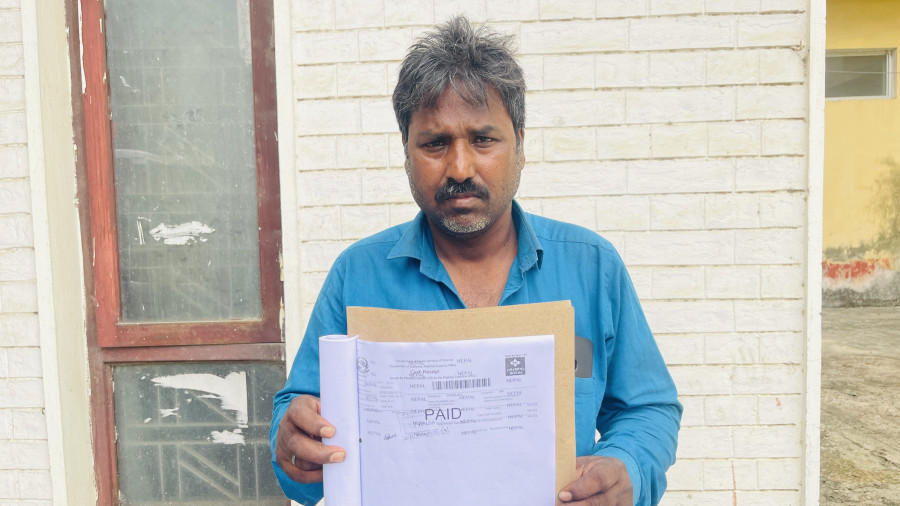
For the past six weeks, Ramchandra Sah has been moving between customs offices, police desks and local administrators, trying to recover the cash he said was meant to keep his wife alive.
Sah, from ward 4 of Rajgadh Rural Municipality in Saptari district, had returned from India in early March carrying his savings—250,000 Indian rupees—earned over years of labour in Gurugram, where he has worked for more than two decades. His wife, 50-year-old Maheshwari Devi Sah, has been battling cancer for four years, and the money was intended for her continued treatment.
The plan was straightforward. After reaching home, Sah needed to convert the Indian currency into Nepali rupees before taking his wife to BP Koirala Memorial Cancer Hospital in Bharatpur, one of the country’s main oncology centres.
What followed has left the family in limbo.
Three days after returning, Sah crossed back into India through a nearby border point to exchange the money. On March 13, he was detained at the Banainiya border outpost while carrying around Rs400,000 in Nepali currency.
Armed Police Force personnel handed him over to the Rajbiraj customs office the same day. Authorities initiated a case under allegations of illegal foreign cash, and Sah was sent into police custody pending investigation.
His family scrambled to respond. Relatives borrowed money from neighbours and lenders to deposit bail equivalent to the seized amount, securing his release. But the fund for treatment is yet to be managed.
“My wife would be undergoing treatment right now if the money had not been seized, ” Sah said. “Her condition is worsening, but we have no choice except to keep her at home.”
Since his release, Sah said he has been trying to recover the confiscated funds while also seeking fresh loans. Neither effort has succeeded. Lenders are reluctant, he said, and the administrative process has shown little urgency.
He said he has submitted documents to prove the legitimacy of the earnings, including salary slips from his employer in Gurugram, identification documents, travel tickets and medical records confirming his wife’s illness. “I showed everything,” he said. “But no one seems to understand what this means for a poor family.”
The case highlights a recurring issue along Nepal’s open border with India, where informal financial practices often result in legal complications.
For families like the Sahs, the consequences can be immediate and severe.
Sah said he has spent the past month and a half visiting the customs office, the Armed Police Force unit and the District Administration Office, seeking relief. The effort has drained both time and resources, with no clear resolution in sight.
“I have already taken loans from wherever possible just to get released,” he said. “Now I cannot arrange more money, and I don’t know when or if I will get mine back.”
On April 1, he filed a formal application at the District Administration Office requesting action and the return of the seized funds, citing the urgency of his wife’s treatment.
Naresh Kumar Yadav, information officer at the District Administration Office, said officials are looking into the matter.
Back in Rajgadh, Maheshwari Devi Sah remains at home, her treatment interrupted. For her husband, the days are marked by uncertainty—caught between legal procedure and a medical emergency he cannot afford to wait out.




 14.21°C Kathmandu