



 13.87°C Kathmandu

Tue, Oct 20, 2026
Koshi Province
Jhapa squatters’ long wait for land ownership continues
Entire settlements are without land deeds. The district has more than 50,000 landless squatters.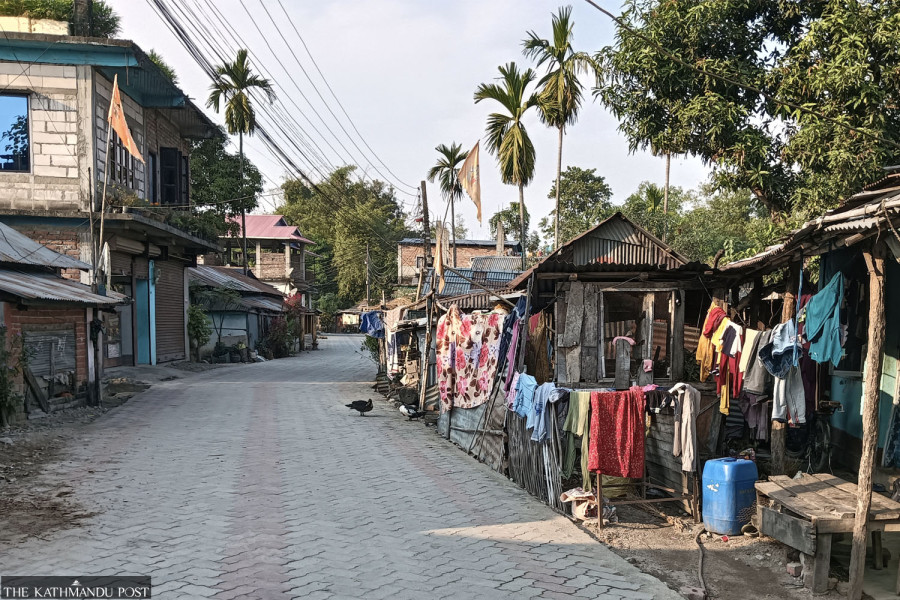
bookmark
Nawaraj Subedi
Published at : December 2, 2025
Updated at : December 2, 2025 06:51
Jhapa
When 70-year-old Champa Kumari Rajbanshi and her family migrated to the Phulbari area in ward 13 of Mechinagar Municipality in Jhapa in around 1999, they arrived with nothing—no home, no land.
Alongside her husband Birkha Bahadur and their children, they settled on the empty land beside the Phulbasa stream just north of the East-West Highway, constructing a makeshift shelter. For about 25 years they have lived there but remain without proper land ownership documents.
“We built our house on six dhur (1 dhur is 16.93 square metres) of land. Over the years, we filled out application forms four times, hoping that the government would give us land ownership certificates. Once even had the land surveyed,” she complained. “But the land deed has yet to come. We have frequented the district headquarters and municipality office again and again.”
Champa’s husband died seven years ago, still lacking any formal recognition of the land. “We are destined to die as squatters,” she said bitterly. “If only the government had given us the title, at least our children wouldn’t be squatters now.” In Phulbari alone 18 families live; none hold any legal documents of their land—only a persistent hope for “maybe soon.”
Phulmati Rajbanshi, aged 38, lives in the same settlement. She has built a modest brick home using her husband’s income from masonry work. But she too lacks land ownership. “We filled out the application three times. We were told the land commission would deliver soon but now that the commission has been dissolved, our hope seems lost,” said Phulmati. “How many times must we fill out forms? Why is the government inflicting this hardship again and again?” she expressed her disappointment.
The plight is not confined to the Phulbari settlement. In a nearby hamlet known as the 18-katthe settlement, families share similar stories. There, the family of Mati Bahadur Lowa, who moved from the hills three decades ago, continues to live in a small house on land beside Phulbasa stream—but without any legal title. “We have lived here for decades. We built our house in ten dhur; our two sons and three daughters grew up here — but no land deed has arrived,” he lamented. The 18-katthe settlement alone has 41 families; none hold a land title.
Forty-year-old Goma Katawal, spent Rs 550,000 last year on buying four dhur of land. She has only a paper signed by buyer and seller—no official title. “They told me the land deed would come later. I’ve installed electricity and water meters. But when will the deed arrive?” she lamented.
Across the two settlements, roughly 60 families continue to await the long-promised land deeds. Over decades, they have filled out numerous forms, surveyed the land, and repeatedly visited offices—always with the expectation that the state would finally grant them ownership.
However, their hopes have been dashed. Krishna Raj Sigdel, Mechinagar ward 13 chair, estimates around 500 landless squatters, Dalits and unplanned settlers currently reside in the ward alone. Some have had their land surveyed; many have not.
Meanwhile, according to the now-dissolved Land-related Problem Resolution Commission, there were 50,700 landless squatters, landless Dalits and informal settlers in Jhapa as of July, 2025. Officials had estimated that number could increase by 10,000 before the application window closed.
But the sudden dissolution of the commission by the government in September has stalled all further action. Critics say the move has left over a million pending applications nationwide — of which hundreds belong to desperate families such as those in Jhapa.
“As soon as the commission was dissolved, all work stopped. We had been working to register and distribute land to landless and informal settlers. With that decision, the process is dead,” said Madan Adhikari, former Jhapa chairman of the commission.
Land-rights activists say successive governments have repeatedly formed and dissolved such commissions, making the problem cyclical. The interim government led by Sushila Karki dissolved the Land-Related Problem Resolution Commission constituted by the erstwhile KP Sharma Oli administration claiming the structure of the commission is unnecessarily large and the incumbent government does not have mandate for land distribution.


Most Read from Koshi Province


Editor's Picks





E-PAPER | October 20, 2026

×