After meeting anti-corruption commissioner, Lamichhane pledges to clear ‘policy decision’ confusion
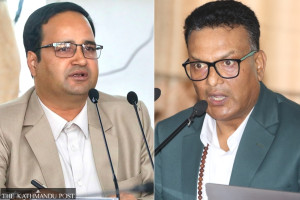
Despite its pledge to tackle corruption, the government has yet to amend the CIAA Act to define ‘policy decisions’ and close a loophole that critics say shields high-level wrongdoing from probe. Rabi Lamichhane says the government must legally define “policy decisions” to ensure Cabinet decisions can be scrutinised for corruption without discouraging legitimate policymaking. Photo: Nepal Photo Library
Nearly five months after taking office on a promise to deliver good governance, the Rastriya Swatantra Party-led government has yet to move ahead with a long-pending amendment that could bring corruption concealed as Cabinet “policy decisions” within the jurisdiction of Nepal’s anti-graft agency.
Lawmakers frequently ask what actually constitutes a ‘policy decision’, Rabi Lamichhane, the RSP chair, told the State Affairs and Good Governance Committee of Parliament on Thursday. “We must clarify this.
“Otherwise, how can the Cabinet function? Which prime minister can work effectively? If we are afraid of making policy decisions, how will the country move forward? How can we achieve good governance, development, and prosperity?”
The ruling party chief’s remarks came as lawmakers and officials discussed a long-pending amendment to the Commission for Investigation of Abuse of Authority (CIAA) Act, which would clarify the scope of Cabinet decisions that can be investigated for corruption.
The legal ambiguity has created a dilemma. While a broad definition could make ministers reluctant to take legitimate policy decisions, the lack of a clear definition has also allowed routine administrative decisions to be elevated to the Cabinet and potentially shielded from scrutiny.
“What is a policy decision? What matters fall under this category, and should they be subject to investigation? We must establish this in the law,” Lamichhane said.
Prem Kumar Rai, chief commissioner of the CIAA, who attended the meeting, said the anti-graft body currently lacks legal authority to investigate corruption arising from Cabinet-level policy decisions.
“Until we amend the provisions regarding policy decisions in Section 4 of the CIAA Act, Cabinet decisions will remain beyond our jurisdiction,” Rai said. “Because the law is unclear, we cannot file cases against Cabinet decisions.”
Section 4(b) of the CIAA Act bars the commission from investigating or taking action against collective policy decisions made by the Cabinet or its committees, as well as judicial proceedings.
Officials and ministers, critics say, have exploited that provision by taking routine decisions, including those concerning public procurement and contracts, to the Cabinet even when they have the authority to make such decisions themselves. Such a practice can allow decisions involving conflicts of interest or potential corruption to be presented as “policy decisions”.
An earlier attempt to close this loophole failed. Bills to amend both the Corruption Prevention Act and the CIAA Act were introduced in the earlier parliament. While the Corruption Prevention Bill was passed by both houses, the CIAA Bill stalled and eventually became inactive after the House of Representatives was dissolved on September 12, 2025.
A sub-committee led by then lawmaker Hridayaram Thani had approved a provision defining a “policy decision”. It said public procurement decisions would not qualify as policy decisions unless the law specifically required them to be made by the Cabinet. Decisions that bypassed the jurisdiction of competent authorities or were intended to benefit specific individuals or institutions rather than the public would also be excluded.
Despite RSP support, the provision was shelved when the bill reached the full committee.
At the time, KP Sharma Oli was prime minister of the Congress-UML coalition, while Sher Bahadur Deuba was president of the Nepali Congress. Both opposed giving the CIAA authority to investigate Cabinet decisions, according to those involved in the process. Their resistance was a key reason the CIAA Act amendment failed while the Corruption Prevention Act moved ahead.
In its nearly five months in office, the Rastriya Swatantra Party government has not advanced legislation to address corruption committed under the cover of “policy decisions”.
CIAA statistics show that more than 30 percent of corruption cases involve decisions made under the guise of policy, according to the commission. Rai has repeatedly argued that Section 4 must be amended to address the problem.
At Thursday’s meeting, committee chair Hari Dhakal said discussions were under way to introduce an amendment bill during the current parliamentary session. He acknowledged, however, that there had been no discussion on advancing the exact bill prepared by the previous parliament.
“The CIAA chief has urged us to expedite the amendment bill, and discussions have also taken place at the Ministry of Law,” Dhakal said. “We are pushing to introduce it this session. The law minister is reviewing it.”
The State Affairs and Good Governance Committee is currently discussing only a bill concerning the National Cadet Corps.
Thani, who led the previous sub-committee, said the Corruption Prevention Act and the CIAA Act were closely linked and should be amended together.
“If a government built on the foundation of good governance intends to catch the big fish and not just the small fry, it must amend the act by including the definition of policy decisions exactly as passed by the previous sub-committee,” Thani said. “If the CIAA remains barred from looking into policy-level corruption, the big fish will always enjoy impunity.”




 18.61°C Kathmandu