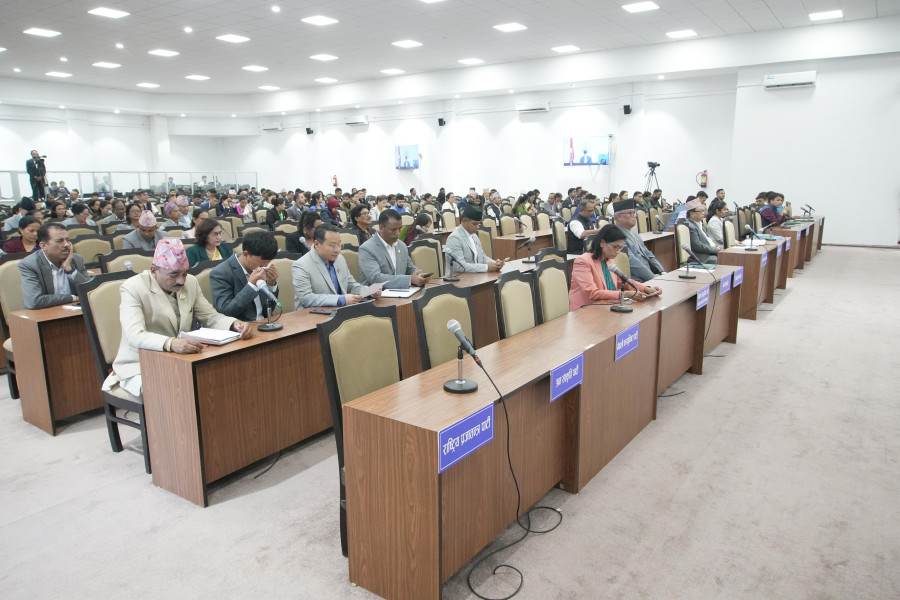
Nepal’s budget session produced 12 new laws, while 35 bills were registered with the Federal Parliament Secretariat, according to parliamentary data.
The government had projected that 64 bills would be registered during the session, with most of them advancing through the legislative process. The actual number was just over half that target, while only 12 bills became laws.
President Ramchandra Paudel ended theParliament’s budget session on Friday on the government’s recommendation, meaning no further bills will be processed until a new session. The government is expected to call the winter session after a couple of months, when more bills could be registered.
The government has set an ambitious target of enacting 166 laws in the current fiscal year. Law, Justice and Parliamentary Affairs Minister Sobita Gautam had announced the target while presenting an annual legislative calendar, including a list of bills to be tabled in Parliament under the Legislative Management Act 2025.
Federal Parliament spokesperson Ekram Giri said budget sessions generally devote more time to the government’s policies, programmes and budget than to legislation.
“Given that 12 bills became laws during the budget session and 20 are being discussed in various House committees, the session can be considered as successful in terms of legislation,” Giri said.
“For a government that was new and the Parliament that had to devote considerable time to the budget and its policies and programmes, this is an achievement.”
Opposition parties, however, described the session’s legislative performance as average.
Yubaraj Dulal, chief whip of the Nepali Communist Party, said both the government and Parliament had performed only moderately in terms of lawmaking. He attributed the slow pace partly to the transition to a new government and the arrival of many new lawmakers, as well as new presiding officials, including the Speaker and the deputy Speaker.
“Because the government was new and Parliament spent much of its time under its shadow, the number of new bills that should have been introduced did not come through,” Dulal said.
He said many of the bills tabled during the session were related to ordinances or amendments, with relatively few representing new legislative proposals. He expects the government to face greater pressure to introduce legislation during the next session and said the Speaker should work with the government while also pressing it to move bills forward.
The government had divided its annual legislative programme into three phases under the Legislative Management Act: August-November, December-February and March-July.
Under Section 3 of the Act, ministries must identify the bills they intend to draft for the coming fiscal year and submit them to the law ministry by mid-June, prioritised according to their urgency. The law ministry then consults the concerned ministries, determines the order in which bills should be presented to Parliament and prepares an annual legislative calendar.
In line with this provision, Gautam submitted to Speaker DP Aryal, on July 16, a consolidated list of bills the government planned to present to the Federal Parliament during the fiscal year.
According to the law ministry, 64 bills were placed in the first-priority category, 45 in the second and 57 in the third.
The first phase runs from August to November. The government ended the sessions of both houses about six weeks before that phase was due to end, resulting in fewer bills being registered than originally targeted, according to the ministry. It expects the number to increase once the next session is called.
Basana Thapa, chief whip of the main opposition Nepali Congress, said the session fell short in lawmaking terms.
“It is the government’s responsibility to prepare bills and provide Parliament with legislative business,” Thapa said. “The transition to a new government and the arrival of many new lawmakers may have caused some delays, but even laws that needed to be enacted were not passed during this session.”
She said the government should have prioritised laws needed to protect fundamental rights and facilitate implementation of the constitution. She also criticised the government for relying on ordinances to issue laws, in some cases without subsequently introducing replacement bills, and for giving lawmakers insufficient time to study bills that were tabled.
“Initially, the government could not introduce bills, while many were tabled only in the final month,” Thapa said. “That did not leave us enough time to study them properly. But that does not mean nothing constructive happened during the session.”
She said the government should increase the pace of legislation during the next session.
Minister Gautam, however, said the end of the parliamentary session would not stop the government from registering bills.
The first bill—the Nepal Rastra Bank (Third Amendment) Bill 2026— was registered on May 25. Two more bills were registered between mid-June and mid-July, followed by nine between mid-July and mid-August and two between mid-August and mid-September. The pace picked up in October, when the government registered 11 bills in the House of Representatives.
The National Assembly also received two bills in August.
The law ministry said the first phase of the government’s legislative calendar still has about six weeks to run and that it is working to bring the number of registered bills closer to the original target.




 14.69°C Kathmandu