



 9.89°C Kathmandu
Tue, Mar 3, 2026
Opinion
Drawing parallels
This World Cup season, football has many lessons to offer to our leaders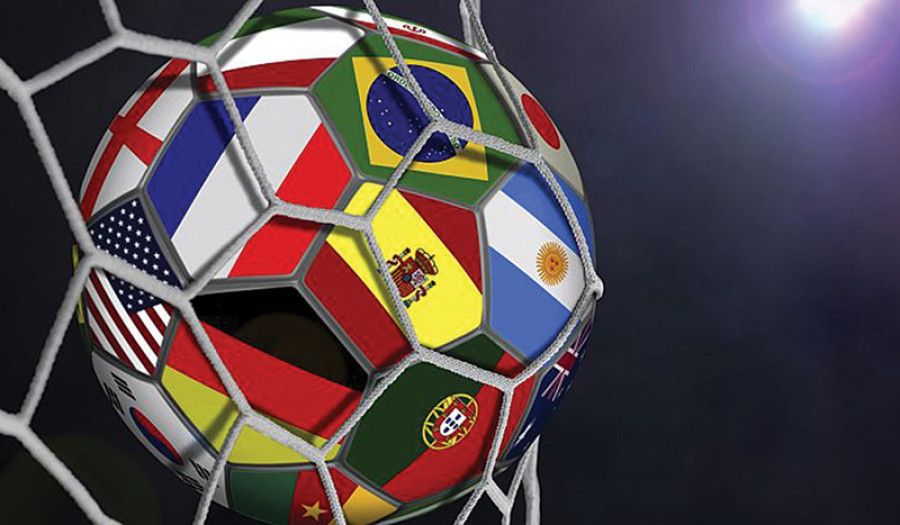
bookmark
Published at : July 1, 2018
Updated at : July 1, 2018 08:06
Glued to the television set in this holy month of World Cup, one cannot but think if this global event can offer insights into statecraft, politics and governance. From the matches so far, leaders in government and society can learn a thing or two about how they could deliver better.
Loyalty to the nation
As the games have started, many football players have returned home to play for their respective national team; be it stars like Ronaldo, Messi, or Neymar. Under specific contractual arrangements, they were playing for foreign clubs and will continue to play for them after the World Cup. But for the Word Cup, they have easily re-integrated themselves into a national team. Although too much of a stretch, but strangely enough for our government leaders, no one is questioning their loyalty to the nation, or nationalism, even if they have been playing for foreign clubs for a long time. In fact, experience with international clubs is much valued back home.
It is impossible to think of such an exchange of knowledge and experience in the design of governance arrangements in Nepal. The state is, for example, coming up with diktats that bar holders of public office from seeking, let alone using, opportunities for a residence permit abroad. The only reason seems to be the question of loyalty to the nation. The territorial (place-based) view of nationalism dominates other considerations such as belongingness. As Ernest Gellner, an acclaimed thinker on nationalism observes, nationalism is an elite-led phenomenon in Nepal too (but also in many other ‘illiberal democracies’): ‘it is orchestrated, controlled and coordinated’ by the state. When football fans cheer their teams in the World Cup, the least they may be thinking about is where they are based. It is the sense of belongingness that binds them together. Interconnections, not hierarchies, are central to nationalism.
If so, we can even approve of ‘personal nationalism’ (borrowed from Anthony Cohen’s essay on Scottish nationalism), which allows individuals to use a wide range of social facts for the construct of their own visions of a nation. Loyalty can be imagined in more concrete terms within an agreed framework of engagement. That is what ensures players’ loyalty to their nation or to their club. Those who do not operate within the framework of engagement betray their nation even if they are—territorially—in a country. The World Cup offers us with an opportunity to think about a more capacious vision of the Nepali nation.
Individuals versus the team
When Messi failed to score against Croatia, there was uproar in Argentina and around the world. What was wrong? While several explanations are being offered, Jorge Sampaoli, Argentina’s manager, said that Messi performed poorly “because his teammates were not good enough to play with him”. Strong individuals put together do not necessarily form a good team. They need to gel as Sampaoli wants us to understand. It is unrealistic to think of individuals delivering team or organisational goals regardless of how strong they are. Yet government leaders in Nepal keep placing a high premium on individuals rather than on teams. Individuals, however meritorious, are always too weak to overcome the complex challenges of today’s organisations. As the well-known essayist Joshua Shenk concluded in his recently published book The Powers of Two, “The days of the lone genius are over”.
Another important factor for institutional performance is the recognition for young talents. The French goal against Peru was made by Mbappe, a teenager. Moussa Wague, another teenager from Senegal, scored against Japan. These examples should show us that the (over-) emphasis placed on ‘seniority’ in Nepal’s politics and bureaucracy may have to be reviewed. What counts is performance, and only performance.
Respect for rules
All World Cup players possibly want to be called for a foul, preferably in the penalty area. An important part of their training is how to get fouled. Faking injuries is equally important. In a recent Brazil versus Costa Rica match, Neymar faked an injury caused by his opponent and had been awarded a penalty shot before the referee’s decision was withdrawn. Why be fouled? In football, any breach of norm will be dealt with strictly; a deliberate mistake can be suicidal. Essentially, therefore, you are trying to weaken your opponents by inducing them to flout the law. Once this happens, ‘hot-stove rules’ are applied: they burn you immediately and without regard for who you are.
This stands in great contrast to systems of governance in Nepal where selected application of laws and rules remain an ‘accepted’ practice. Law enforcement agencies must take special care in handling a ‘thulo manchhe’ involved in unlawful activities. If not, policemen will be fired; prosecutors hounded; and judges impeached. The idea of the infallibility of power holders has reached the legislature where its members have allowed themselves to continue in office even after indictment for a criminal case! The gullible public has been persuaded to internalise this. Learning from the World Cup, we could try to develop some ‘rules of the game’ (institutions) to address the anomie.
Granted, the beautiful game of football also has its ugly side: hooliganism and violence. It is not easy to forget the tragic death of 39 Italian fans in Brussels in 1985 just ahead of the European Cup Final between Liverpool and Juventus. Despite serious efforts of law enforcement agencies, the threat of violence remains. Studies have shown that violence started by fans is mostly associated with their sense of injustice to their teams or players. Strong identification with the team bolstered by underlying racial and ethnic tensions, also fuels violence. Perhaps, something similar to existing tensions in the global political arena. This is, then, another area for mutual learning between World Cup leaders and national politicians. However, despite its downside, the World Cup symbolises a peaceful coexistence of different states. And that should be the biggest takeway for our national leaders as well as international leaders.


Editor's Picks
Five and half decades of KP Oli in Nepali politics
How Facebook’s algorithm is amplifying one party over all others

Nepal’s IT exports near $1 billion. Can the momentum be sustained?
Parties’ lofty pledges on economy collide with hard realities
Upper house passes tourism bill with tougher Everest rules
E-PAPER | March 03, 2026

×