Thirty-six Nepali workers in Qatar unpaid for eight months
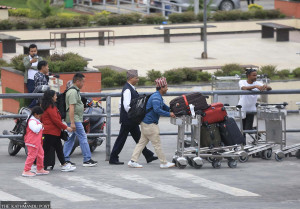
Workers say a Qatari company has withheld salaries and benefits for eight months, leaving them unable to return home as unpaid dues cross Rs20.5 million. The stranded workers say they have repeatedly sought help from the Embassy of Nepal in Doha and local labour authorities to recover their wages. Photo: Provided by the migrant workers.
At least 36 Nepali migrant workers in Qatar have been unpaid for the past eight months, with their combined outstanding dues exceeding Rs20.5 million, or around 540,000 Qatari Riyals.
The workers, employed by Intertectra Qatar WLL, say the company has failed to clear salaries, overtime payments, gratuities and food allowances. In protest, 85 migrant workers from different countries, including 36 Nepalis, have stopped reporting to work.
The stranded workers say they have repeatedly sought help from the Embassy of Nepal in Doha and local labour authorities to recover their wages.
Ram Dayal Raya, a worker from Siraha who has been employed at the company for seven years, said the workers have appealed to both the Nepali embassy and Nepal’s Ministry of Labour, Employment and Social Security for intervention.
“The company owes each worker between 15,000 and 40,000 Riyals in unpaid salaries and benefits,” Raya said. “Besides the eight months of unpaid wages, we have not received food allowances for 10 months and overtime payments for the past two years.”
He said the workers have already calculated their dues and filed a formal complaint with the labour office in Qatar, but the final hearing is still pending.
“Initial estimates put the total outstanding amount at around 540,000 Riyals, but the actual figure could be much higher once everything is finalised,” he added.
Another worker, Shri Khatwe, said the company gradually fell behind on payments.
“At first, the company paid one month’s salary every two or three months, even though work at the construction sites continued normally,” Khatwe said. “Later, after paying one month’s salary, they again made us wait another two months, saying payments from the project sites had not arrived.”
He said the company also stopped paying food allowances after making a few partial payments.
The workers said they had been deployed at some of Qatar’s major infrastructure project sites in Lusail, Ras Laffan and Doha.
“We worked on major government projects, but we are still being denied our wages,” Khatwe said.
According to the workers, officials from the Nepali embassy recently held discussions with company representatives. During the meeting, the company reportedly said it would clear the dues if the workers continued working for another two months.
The workers, however, demanded a written commitment, which the company refused to provide.
Shyamu Teli, another worker, said they had earlier approached the police over the non-payment issue.
“The company asked the police for two more months, and the police told us to continue working during that period,” Teli said. “We continued working, but even after two months and five days, we were not paid. When we returned to the police, they told us to go home if we were not getting paid. After that, we turned to the embassy.”
The workers have now taken the case to the labour office in Sanaiya, Doha. If the dispute is not resolved there, they plan to move the Labour Court.
The prolonged wage crisis has also left many workers struggling to afford basic necessities.
“We do not even have money for food,” Raya said. “We survived by borrowing from friends, and now the Non-Resident Nepali Association is helping us with meals.”
He said most workers had taken loans at high interest rates to secure jobs in Qatar and now fear returning home empty-handed.
“We cannot abandon the money we earned through hard work in this extreme heat,” he said. “Our families back home have survived on loans all these months. If we return without our wages, moneylenders will immediately come after us.”
According to the workers, the embassy has advised them either to hand over power of attorney to legal representatives to continue the case on their behalf or explore options to change employers in Qatar.
“We are discussing what to do next,” Raya said.
Qatar introduced the Wage Protection System more than a decade ago, requiring employers to pay workers through electronic bank transfers. However, international human rights organisations have repeatedly questioned the system’s effectiveness, citing weak enforcement and continued cases of wage withholding.
A report published by Human Rights Watch last December said delayed payments by Qatari government entities and large companies to contractors were contributing to unpaid wages for migrant workers employed by subcontractors.
“Clients at the top of Qatar’s contracting chains, including government bodies, often pass financial pressure down to subcontractors employing migrant workers,” Michael Page, deputy Middle East and North Africa director at Human Rights Watch, said in the report.
“Qatari authorities are failing migrant workers both as clients that delay payments and as regulators that fail to enforce labour protections effectively,” he added.
The rights organisation said mechanisms such as the Wage Protection System and the Workers’ Support and Insurance Fund had not been effective in preventing or resolving wage withholding.
Human Rights Watch has also criticised “pay-when-paid” clauses in subcontracting agreements, saying they contribute to wage theft by allowing contractors to delay payments to workers until they receive funds from higher-level clients.
The organisation has urged Qatari authorities to hold major companies and top-tier clients accountable for labour abuses committed by subcontractors and labour supply firms.
Hom Karki is a reporter with two decades experience covering migrant workers issues and the Nepali diaspora. He was previously based in the Gulf for Kantipur Daily.




 18.82°C Kathmandu