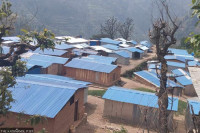
Three decades after fleeing Bhutan, refugees languishing in Jhapa and Morang remain unable to access jobs, banking, and professional opportunities, while repatriation and family reunification remain unresolved. More than 100,000 refugees were resettled in the USA, Australia, Norway among other countries by 2016-17. Those who were unable or unwilling to leave were left without a lasting solution. Partbat Portel/TKP
Thousands of Bhutanese refugees living in camps in Jhapa and Morang districts in eastern Nepal are still waiting for legal recognition that would allow them to work, study, and build secure lives in Nepal, more than three decades after leaving their homeland.
Local authorities have counted 6,365 such people, who have neither been able to return to Bhutan nor gained the rights enjoyed by ordinary residents of Nepal, where many were born and raised. Without government-recognised identity documents, they face obstacles to formal employment, opening bank accounts, registering businesses, pursuing higher education, and obtaining professional licences.
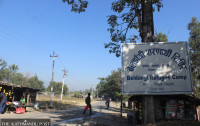
A recent report by Peace Initiative Bhutan (PIB), based on field visits and consultations in Beldangi in Jhapa and Pathari in Morang, has highlighted the uncertainty facing the remaining community. The delegation consulted more than 500 refugees and stakeholders.
“Having taken shelter in Nepal as refugees, they now have neither their previous status nor a new legal identity,” said Kumar Gurung, a representative of PIB in the United States. “The camps where they have lived have turned into settlements. They pay for services such as drinking water, electricity, and waste management like other residents, but they cannot access employment, business and professional opportunities.”
Gurung said refugees with qualifications and skills were unable to put them to use because they lacked identity cards and other legal documents. “Besides jobs, they face barriers to accessing banking services, registering businesses, pursuing higher education, and obtaining professional licences,” he said. Access to healthcare and travel across international borders were also difficult, he added.
The report says many now depend on monetary support from relatives, informal charity, and donations, leaving them with little prospect of becoming economically independent.
Sanchuhang Rai, secretary of the Beldangi camp, said repatriation and family reunification remained the community’s most serious concerns. “The problem is decades old, but there is still no clear way forward,” he said. “All three levels of government must take it seriously and work towards a solution.”
Nepal began hosting Nepali-speaking Bhutanese expelled in the early 1990s. Bilateral efforts failed, and a third-country resettlement programme began in 2007. More than 100,000 refugees were resettled in the USA, Australia, Norway among other countries by 2016-17. Those who were unable or unwilling to leave were left without a lasting solution.
DB Subba, general secretary of the Bhutan Swatantra Janamancha, said those remaining included elderly people, single women, people with disabilities, and families living in poverty, as well as children and young people born and raised in Nepal.
“The younger generation has a stronger connection with Nepal than with Bhutan,” said Subba. “But the lack of legal identity prevents them from moving ahead in life and making use of their skills and qualifications.”
For younger refugees, the question is no longer limited to whether they can return to Bhutan or resettle in another country. They want to know whether they can live with legal recognition in the country where they grew up. “Which country are we citizens of? What is our identity? Even we are confused,” said Tirtha Rai, a refugee youth.
The report attributes the crisis to the diplomatic dispute with Bhutan and the lack of legal arrangements for the refugees’ long-term stay in Nepal.
Local government officials who met the PIB delegation acknowledged the difficulties and said a long- term solution would require a clear legal framework, policy decisions, and direction from the federal government.
At a discussion in Damak on September 30, Jhapa’s Chief District Officer Shrawan Kumar Pokharel pledged to address matters falling within the jurisdiction of local governments and the district administration.
The PIB report calls for the immediate issuance of identity cards or equivalent documents to give refugees access to jobs, banking services, education, healthcare, birth registration, and professional opportunities.
For long-term residents, especially those born here, it proposes a fair, transparent legal route to permanent residence and, where appropriate, citizenship.
Writer and poet Dil Bhutani said humanitarian assistance alone could no longer address a problem that had persisted for more than 30 years, particularly as international support declined and former camps turned into settlements.
“With Bhutan refusing to accept responsibility and Nepal lacking a long term legal arrangement, more than 6,000 refugees are living in uncertainty between the two countries,” said Krishna Bir Tamang, coordinator of the National Reconciliation Committee Bhutan. “When will there be a legal basis for them to live with dignity in the country that has sheltered them for three decades, or to return home with dignity?”




 17.53°C Kathmandu