Foreign Minister Khanal gives Nepal a strong voice across UN General Assembly forums
With around 40 bilateral and multilateral engagements, the foreign minister has highlighted Nepal’s climate vulnerability and the concerns of developing countries. Foreign Minister Shisir Khanal Handout Photo
Prime Minister Balendra Shah opted out of bilateral meetings on the sidelines of this year’s UN General Assembly in New York. In his stead, Foreign Minister Shisir Khanal has stepped in to lead Nepal’s diplomatic push in New York, carrying out a broader range of engagements than his predecessor did in the previous gatherings.
At every UN General Assembly, the foreign minister’s contribution tends to get overshadowed by the prime minister, who usually delivers the national statement and handles the bulk of bilateral engagements on the sidelines. Even so, foreign ministers traditionally play a crucial behind-the-scenes role, laying the groundwork for the prime minister’s meetings once they arrive in New York. This year, that dynamic has been upended. Aside from meeting UN Secretary-General António Guterres and brief talks with Australian Prime Minister Anthony Albanese, Shah did not hold bilateral meetings with any other heads of state or government during his time at the Assembly.
In past years, when Nepali prime ministers travelled to New York for the General Assembly, they would personally take part in a range of groupings—the Group of Least Developed Countries (LDCs), the Group of Landlocked Developing Countries (LLDCs), the UN Economic and Social Council, G77 and China, SAARC and BIMSTEC—along with a full slate of bilateral meetings with counterparts. With Shah largely absent from that circuit this year, much of that duty has been carried out by Khanal.
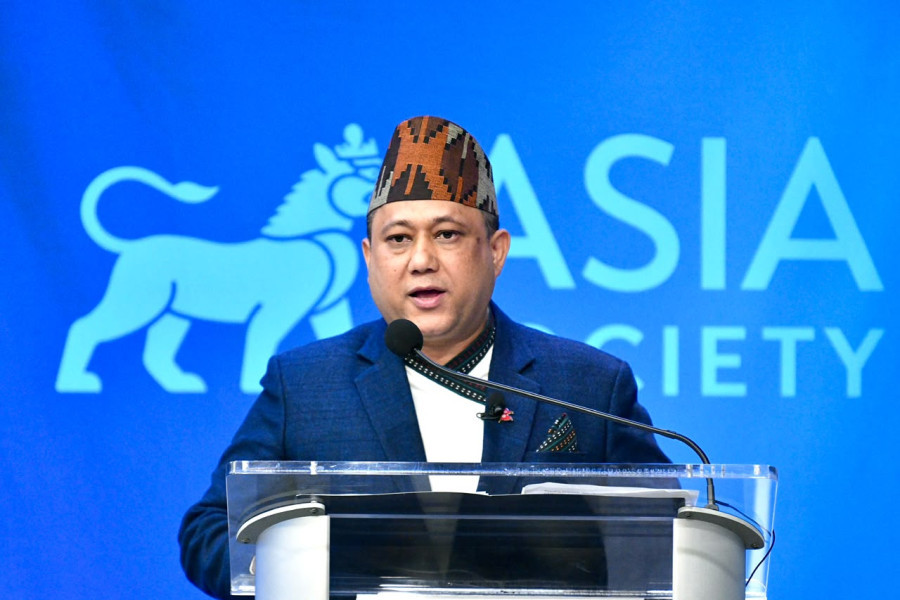
Since arriving in New York on September 21, Khanal has taken part in roughly 40 meetings—both bilateral and multilateral—in addition to Asia Society events, ceremonies marking the establishment of diplomatic relations between Nepal and other countries, and a range of other programmes. On the sidelines of the Assembly, he has met foreign ministers and senior officials from India, Australia, Poland, Portugal, Japan and the European Union to discuss bilateral relations and cooperation across multilateral forums.
Former chief secretary and foreign secretary Shankar Bairagi commended Khanal's handling of the moment, singling out his interventions on climate change and other pressing issues as particularly strong.
“Foreign ministers who arrive in New York ahead of their prime ministers are always busy. But this time, since the prime minister is not engaged in bilateral meetings and other events, the foreign minister is leading many of those engagements and has become extremely busy,” Bairagi said. “Ministers have to lead several meetings and events and meet their counterparts. This time, the way the foreign minister has addressed various events and conveyed Nepal’s message to the global community has been excellent.”
Foreign Minister Khanal’s agenda has kept the climate focus front and centre. Beyond attending the Assembly’s opening session, Khanal is scheduled to chair a Nepal-organised event titled “Sagarmatha to the Sea: A Call to Action for a Climate-Resilient Future”, which will examine the growing impact of climate change on the Himalayas and its broader consequences, while drawing international attention to the need for stronger climate action.
At a Global South ministerial meeting, Khanal argued that developing countries should have a greater say in shaping international rules and global institutions, rather than simply implementing rules set by others. He has also taken part in ministerial-level meetings of the LDCs, the LLDCs, the Non-Aligned Movement (NAM), and the G77 and China.
At a ministerial meeting of the UN Mediation Group, he emphasised dialogue, confidence-building and mediation as tools for conflict prevention and the peaceful resolution of disputes. In another programme, a UNGA-related meeting on the Right to Development, he stressed the importance of political will, international solidarity, technology and concessional financing for developing countries, while flagging the challenges facing progress on the Sustainable Development Goals.
Manjeet Dhakal, lead adviser to the Chair of the Least Developed Countries Group on Climate Change, who is also attending multiple events on the sidelines of the Assembly, said Khanal’s handling of Nepal’s agenda had been well received.
“After the prime minister’s statement, a tone has been set in New York, but how we proceed further and sustain this attention is important,” Dhakal said. “The performance of both the prime minister and the foreign minister was well regarded in New York.”
Dhakal said that the Nepali delegation has received increased attention in multiple forums and events.
“Whenever the foreign minister has attended, he has strongly presented Nepal’s case,” he told the Post. “Nepal’s concerns—the flooding in the Bhotekoshi and its call for climate justice—have been taken seriously by the global community.”
Anil Giri is a Chief Sub Editor covering diplomacy, international relations and national politics for The Kathmandu Post. Giri has been working as a journalist for more than two decades, contributing to numerous national and international media outlets.




 14.4°C Kathmandu