



 16.76°C Kathmandu

Sat, Oct 10, 2026
National
Why China wants to tell its own story
A dispatch from ten days in China: the country is determined to tell its own development story on its own terms — but the road for that story to reach the rest of the world is still narrow.
bookmark![]()
CGTN headquarters in Beijing. Reuters ![]()
An aerial view of a Beijing neighbourhood. Post photo
Daya Dudraj
Published at : September 8, 2026
Updated at : September 8, 2026 15:22
Beijing
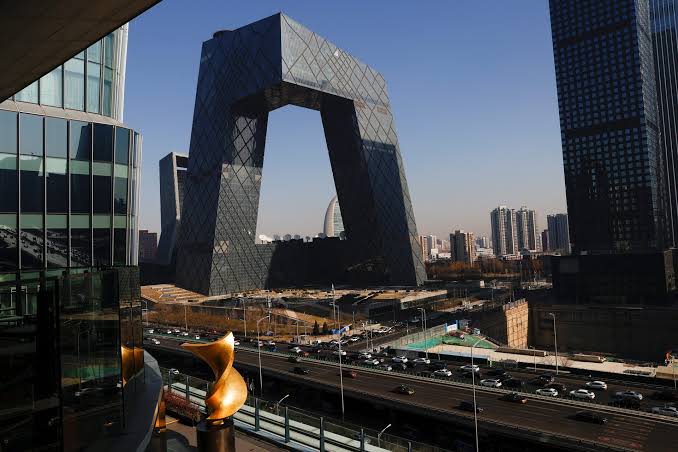
The first thing I thought, standing before the 51-story headquarters of China Media Group, was simple: do all media companies get to be this grand?
It turns out the group’s reach matches its architecture. CMG broadcasts in 85 languages across 51 television channels, 20 radio frequencies, three news websites, and a sprawl of mobile apps, with eleven international channels extending satellite access worldwide. Its content doesn’t just travel the old routes — cable, DTH satellite, digital terrestrial television, IPTV — it also moves through apps, fast channels, smart terminals, and OTT platforms, including live streaming. By their own count, that adds up to a presence in 210 countries, feeding outlets like China Global Television Network, China Central Television, and CCTV Plus.
I got a real sense of that scale during a ten-day training programme in the second week of July, co-hosted by the Global Development Promotion Centre and CMG, with journalists from more than 25 countries in the room. (Full disclosure: it was a fully sponsored trip, with no expectations to write anything.) The programme itself was brief, but it didn’t take long for one thing to come into focus: China treats communication as inseparable from technology, infrastructure and reach. CMG isn’t just in the business of producing and distributing news — it is also building out AI and other emerging technology.
The Chinese professors we met framed the country’s economic rise as inseparable from the Communist Party's history. Their account began with the Party’s founding in 1921, ran through the 1949 declaration of the People’s Republic under Mao Zedong — which laid down the earliest blueprint for development — and continued through Deng Xiaoping’s era, when that blueprint was reworked and pushed forward. Since Xi Jinping took the presidency in 2013, that same emphasis on physical infrastructure has been complemented by an equally aggressive push into science and technology. Renmin University professor Sang Xi Li put it plainly: China is now going head-to-head with American tech companies.
That equation has shifted further with the rise of DeepSeek, China’s homegrown AI company, which has forced its way into the global conversation. Even Elon Musk has weighed in on X, calling China a serious contender in the AI race.
At Tencent’s Beijing office, it was hard to miss how central WeChat has become — not a chat app so much as the infrastructure of daily life in China: payments, commerce, social connection, all routed through one platform. Tencent is pouring money into data centres to keep up, in some cases literally cutting into mountainsides to make room for them. We also heard the claim that roughly 70 percent of the merchandise tied to the 2026 FIFA World Cup — held across the US, Mexico and Canada — was made in China, offered up as one more marker of the country’s industrial muscle.
Taken together, it was hard to walk away with any impression other than this: China is no longer just the world’s factory. It has its own tech giants, its own social platforms, its own AI companies, its own self-contained digital ecosystem.
Talk of Western media kept resurfacing in our conversations with trainers and media professionals — specifically, how the West chooses to see China. Their contention was that Western coverage rarely gives China’s development the weight it deserves, that progress is never simply accepted as progress before questions of cost, human rights, political system or broader impact get attached to it.
They pointed to a 2019 BBC story on China’s development that posed its central question right in the headline: “But at what cost?” To the Chinese trainers, that headline captured something essential about how Western media approaches China — as if “at what cost?” had become a kind of formula, reflexively applied to all its coverage of the country.
There’s something to that critique. Western media does interrogate — not just China, but its own governments, its own development, its own leadership. But it’s equally true that Western coverage filters events through its own values and assumptions, a pattern that extends well beyond China to how the West covers the rest of the world, with American outlets in particular often carrying the imprint of American priorities and geopolitical interests.
The frustration among Chinese media workers was that international outlets, while claiming to cover the whole world, end up viewing China through one narrow lens — and that lens keeps China’s real achievements from reaching a global audience. I wouldn’t call their argument the full picture. But being inside China, it became much easier to see how that view took root.
None of which erases the questions aimed at China itself. If Western coverage really is distorted, can China make the case against every accusation levelled at it?
China’s own answer: “Yes, we can, and we’re doing it.” But the reality is more complicated than that answer suggests. Plenty of China’s digital platforms remain hard for outsiders to reach, and Chinese citizens themselves have only limited ways of connecting outward into the global digital sphere. The result is a kind of parallel structure: China narrates its own story on one side, while the rest of the world keeps hearing about China through entirely separate channels.
Maybe that’s exactly how two different Chinas have come to exist — the one China sees when it looks at itself, and the one the rest of the world sees looking in. The gap between those two versions might be the country’s steepest challenge yet.
Still, one thing was impossible to miss: China isn’t slowing down. Whatever doubts Western media raise about its trajectory, China hasn’t eased up on expanding its influence — not in manufacturing, not in infrastructure spending, not in technological development, not in the AI race, not in building out its digital platforms. On every one of those fronts, the momentum keeps building.
The real question isn’t whether China will keep developing. It’s whether the world will understand that development on China’s own terms.
That gap — that disconnect — has left a vacuum. And in that vacuum, other people are writing China’s story for it.
Perhaps that’s the challenge China faces now more than any other: how does it get others to tell the story of its development? Because in today’s world, developing isn’t enough by itself. Who gets to tell that story, how they tell it, and what lens the world uses to receive it — that matters just as much as the development itself.
Daya Dudraj
Dudraj covers media, ICT and youth issues for Kantipur Daily.




Most Read from National
Balendra Shah UN speech: Full transcript of Nepal prime minister’s address to the 81st UN General Assembly
Heavy rains cut off key roads to Kathmandu
The speech Nepal — and the world — had been waiting for
For 26 years, India has searched passengers at Kathmandu airport. Nepal can’t say why

14 Nepalis missing on Himlung after avalanche as bad weather hampers rescue
Editor's Picks

Constitutional Bench caught in seniority, ‘pick and choose’ dispute

A Dom boy’s long road to becoming a doctor

From blankets to handmade dolls, two foreign women bring comfort to flood survivors

News Analysis: When institutional defence exposes institutional fault lines

It’s a bird … it’s a plane … it’s the Indian ambassador’s farewell tweets
E-PAPER | October 10, 2026

×