Late rescues renew hope for survivors in deadly Nepal floods
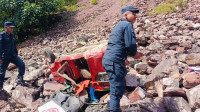
A 64-year-old woman was rescued alive from beneath her buried home as her family performed her death rites, while three others—including a Chinese national—were pulled alive from hydropower tunnels in Rasuwa. Chandika Shrestha, 64, a resident of Betrawati in Bidur Municipality-10, had gone missing alongside four members of her family on August 26, when the flash floods tore through the Bhotekoshi river basin, decimating entire settlements. Photo: Courtesy of Nepal Police
For 10 days since the floods, her whereabouts remained a complete mystery. Her relatives had all but abandoned hope of her return. On the eighth day, they started performing her death rituals. The family fashioned an effigy out of kush grass to represent her body and began the solemn rituals.
But on Saturday, the 11th day after the deadly disaster, footage began circulating online showing a frail woman being carried alive, out of the sludge from a flood-ravaged house in Betrawati, the historic market town in Nuwakot.
Chandika Shrestha, 64, a resident of Betrawati in Bidur Municipality-10, had gone missing alongside four members of her family on August 26, when the flash floods tore through the Bhotekoshi river basin, decimating entire settlements.
“When news reached us on the 11th day that an elderly woman had been rescued, we rushed to the hospital,” said Ramesh Man Shrestha, her relative. “Once we confirmed it was her, we couldn’t believe our eyes.”
Despite the grim statistics that define this disaster, the rescue of four individuals in two days, after one-and-a-half weeks since the floods, has renewed hope that other individuals trapped inside the buried houses and tunnels might still be alive. Shrestha’s miraculous survival follows the rescue of two workers—Sanjay Shah and Kabir Maharjan—from 170 metres inside a tunnel at the Upper Trishuli 3A project on Friday. Renowned tunnel expert Arnold Dix, who was remotely assisting in the tunnel rescue operation at Trishuli 3A and arrived in Nepal on Saturday, has said that people can survive underground much longer than expected.
Since the floods, Nepal’s worst disaster in a decade, as many as 1,338 people have been confirmed dead while nearly 5,000 people remain missing. Shrestha’s four family members staying at the same Betrawati home remain unaccounted for.
Shrestha’s survival was a matter of chance. On Saturday morning, an Armed Police Force team, originally deployed for road construction in Betrawati, heard faint cries coming from near the buried residence.
“We had previously searched and conducted rescue operations at this exact spot and heard no sound at all,” APF Inspector Suman BK told Kantipur. “While passing through the area again, we heard cries. We immediately began clearing the sludge.”
BK’s team smashed through a window to enter the debris-choked structure. “As soon as our officers crawled inside, she began speaking more clearly,” BK said.
Extracted from the ruins, Shrestha was medevaced to Kathmandu in a Nepali Army helicopter and admitted to the Birendra Hospital in Chhauni, Kathmandu, for urgent medical treatment.
Rescue officials said the floods had shifted the entire structure nearly 100 metres uphill. “Three and a half storeys were completely buried, and the fourth storey was half submerged in mud,” BK said. “Our team had to crawl through the smashed window into suffocating slush to find her.”
Shrestha’s brother-in-law Ishwari Lal Shrestha, who miraculously escaped the same home, remains desperate for news of his wife Sushma, sister Kumari Shrestha, and aunt Lekhamaya Shrestha, who remain missing. Nearby, police had used drone cameras to locate and retrieve 24 bodies from the surrounding mud.
“Search teams deployed drones over potential impact zones, leading to the recovery of 24 bodies,” said Deputy Inspector General of Police Deepak Regmi, head of the Bagmati Province Police Office.
Ishwari Lal recalled watching his wife Sushma get swept away by a torrent of mud and debris. “I had received an early warning about an approaching flood, so I woke her up while she was resting and asked her to come outside,” he said. “She told me she would join me after finishing her morning prayers. Meanwhile, customers arrived at my shop downstairs, so I got occupied.”
Moments later, as he stepped across the street to buy a phone charger, a deafening sound echoed through the valley. “It felt like a massive earthquake,” he said. “Looking back, I saw the house shaking like a swing. My wife was inside. Within seconds, the floods washed it away like a paper boat.”
Seeing his wife caught in the deluge, Ishwari Lal lost consciousness. When he came round roughly 15 minutes later, nothing was left. “I have already given up all hope for my wife—how could I disbelieve what I witnessed with my own eyes?” he said. “However, hearing that my sister-in-law has been rescued has brought us joy.”
In a parallel rescue operation on Saturday, the Nepali Army, supported by a specialised South Korean rescue team, pulled a Chinese national alive from 225 metres inside a tunnel at Upper Trishuli-I Hydropower Project in Rasuwa.
The survivor, identified as Lu Haitao, was given water by army personnel before being questioned. Disoriented, Lu eventually pointed to his drained-out phone battery and communicated using translation software on an officer’s mobile phone. He was airlifted to Birendra Hospital, Kathmandu, in a shivering but stable condition.
Nepali Army Spokesperson Rajaram Basnet confirmed that 551 people, including Chinese nationals, were initially unaccounted for at the project site. Rescuers also recovered two bodies from the tunnel complex; the bodies are being transferred to Bidur in Nuwakot.
Officials say around 1,000 people remain missing across various hydropower projects in Rasuwa district.
A total of 21,465 security personnel—comprising 9,287 from Nepali Army, 7,975 from the Nepal Police, and 4,203 from the APF—are deployed in search and rescue operations across the affected districts. Officials involved in the operations say their focus has remained singular—to keep clearing the sludge, to keep checking the tunnels and to never assume that silence is final.




 14.83°C Kathmandu