After nine days in darkness, two men walked back into the light
Rescuers pulled Sanjay Sah and Kabir Maharjan alive from the Trishuli 3A hydropower tunnel after more than 72 hours of painstaking search, but dozens of people remain unaccounted for. The two were found about 40 metres inside the tunnel, raising hopes that others believed to be trapped there might also be alive and prompting rescuers to intensify their search.
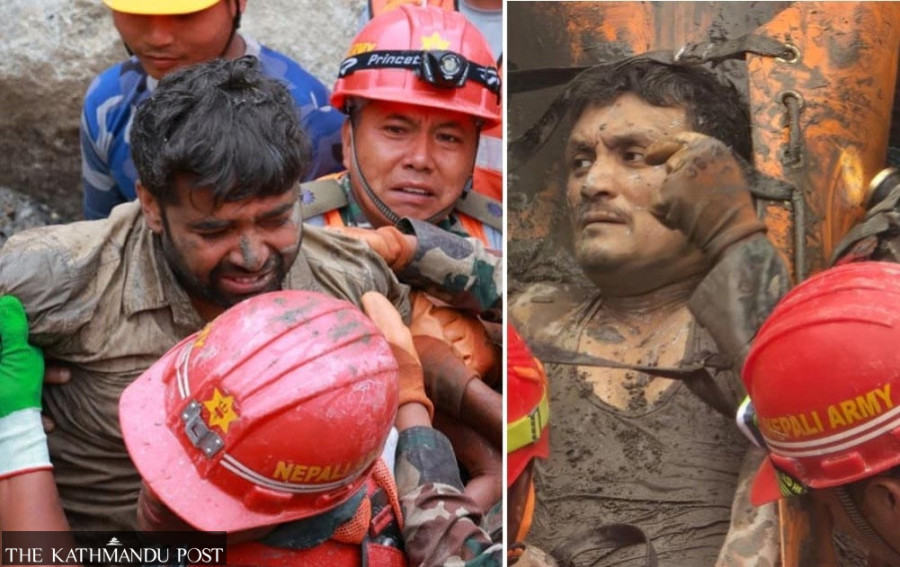
Kabir Maharjan looked up, tears blurring his vision, and nodded from the stretcher. He was unable to speak. He folded his hands and greeted the rescuers with a namaste.
Suddenly, people clapped. Rescuers who had not smiled for more than a week wept openly and embraced one another.
The tunnel walls echoed with joy. A crowd gathered within minutes. A miracle had happened. Within seconds, the news travelled around the world.
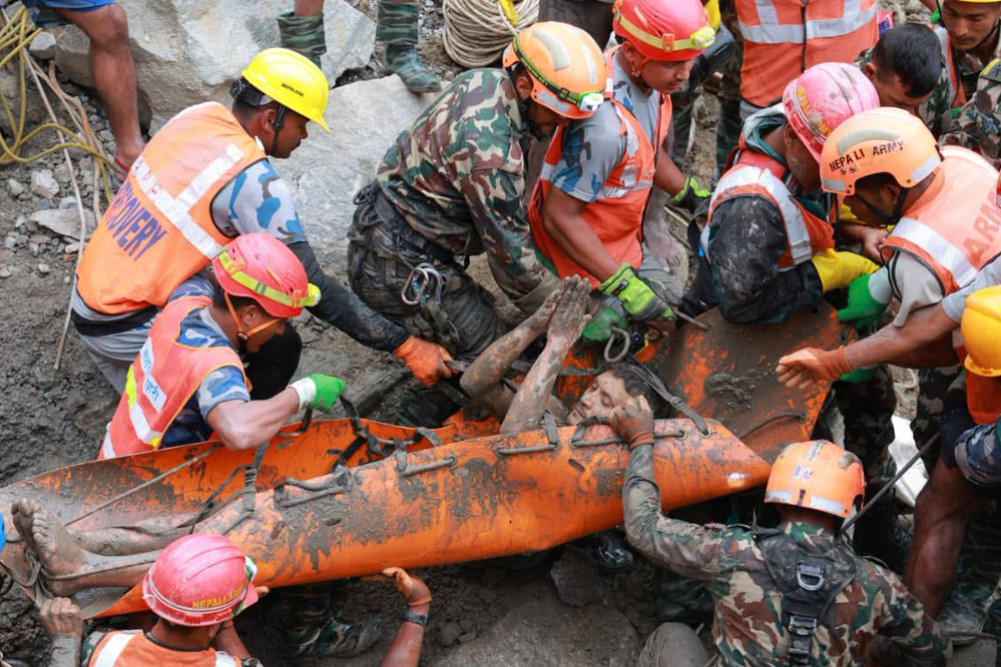
On the 10th day of the Rasuwa floods, after more than 72 hours of gruelling work inside a dark, muddy and dangerous passage, rescuers pulled Maharjan alive from the tunnel of the Upper Trishuli 3A hydropower project on Friday morning.
Before Maharjan, Sanjay Sah had also escaped a life-and-death situation after spending nine days trapped inside the tunnel.
The two were found about 40 metres inside the tunnel, raising hopes that others believed to be trapped there might also be alive and prompting rescuers to intensify their search. The whereabouts of dozens others, however, remain a mystery.
In Tilathi, Saptari, Sanjay’s mother, Kapur Devi, was overjoyed when she heard that her son was alive. The family had been living without sleep since Sanjay went missing, and they had not even cooked a meal since the day he disappeared.
As soon as relatives called to tell them that Sanjay had been rescued, Kapur Devi and his father, Ramphal, travelled to Kathmandu.
Sanjay is a mechanical foreman at the Nepal Electricity Authority, the state-owned power utility, and works in the control room of the 60-megawatt Upper Trishuli 3A project. He was on shift duty on the day of the incident, on August 26.
After emerging from the tunnel, Sanjay initially could not speak. A few minutes later, he indicated in a faint voice that there could still be four or five people inside. His voice was trembling.
After he was taken to the Nepali Army’s military training centre in Nuwakot, his condition stabilised somewhat.
There, he recalled the terrifying 10 days he had spent inside the tunnel. He told the army medical team that he had been chanting a mantra.
“I was working in the control room. My responsibility was to save everyone’s life,” Sanjay told Nepali Army personnel.
“I was the last to leave because I had been helping others escape after the accident, and ultimately could not get out myself.”
Asked how many people he believed could still be inside, Sanjay described a situation far different from normal working conditions.
“I worked in the control room. Normally, there would be only four, five or six people at other times. But during this period, there must have been around 40 to 45 people. Since I was in the control room, my responsibility was to save everyone’s life. After such an accident, I couldn’t just run away alone. I had to save everyone,” Sanjay mumbled through his oxygen mask as he lay under a blanket.
“I told everyone that there had been an accident at the main dam and asked them all to escape. By the time I did that, I lost my chance to get out. In the end, I couldn’t escape.”
“Perhaps not everyone managed to escape. The tunnel is long. Even if they were inside the tunnel, the force of the water may have carried them further inside,” he told the medical team.
“I was chanting a mahamantra [supreme verses].”
Sanjay last spoke to his family at around 7am on August 26, the day the disaster struck.
According to his sister, Sudha, the family had been frantic after he went missing.
“We went to the police station and filed a report. Dev dai [elder brother] went to Rasuwa and searched for three days. When he could not find him, he returned disappointed. We made many efforts,” Sudha said.
Sanjay is married and has a two-and-a-half-year-old daughter. His family had not slept properly since he lost contact after the flood.
On Friday, when a relative called to say that he had been rescued alive and sent a photograph, the family broke down in happiness.
“Our joy knows no bounds. Everyone worked together to rescue him. We are very, very grateful to everyone,” Sudha said.
Sanjay’s father, Ramphal Sah, said the family was overwhelmed with happiness.
“We were in tremendous pain. Now there is no limit to our happiness. I cannot wait to see him,” he said while travelling to Kathmandu.
Meanwhile, in Kirtipur, Hira Shobha Shrestha, who had spent 10 days waiting for her husband, suddenly shed tears of joy on Friday morning.
No one knew whether he was alive.
After waiting every day for news, Hira Shobha suddenly saw her husband being rescued alive from the tunnel.
“We were speechless upon seeing his face [on screen]. We cried tears of joy,” she said.
The Nepali Army, Armed Police Force and foreign experts rescued Sanjay and Kabir. Sanjay was brought out of the tunnel at around 9am, while Kabir was rescued at around 9:20am. Both were found approximately 40 metres inside the tunnel.
Later in the afternoon, rescuers recovered a body.
At around 2am, the rescue team heard a person shouting from inside the tunnel. Lieutenant Colonel Ganga Baral, who was leading the search and rescue operation, was inside the tunnel at the time.
After reaching a large cavity-like space, the team called out to see if anyone was there.
A voice from inside responded, “Help, help.”
Ganga and the team replied, “Don’t panic, we are coming.”
A voice from inside then responded, “Okay.”
Padam Bahadur Tamang, head constable of the Armed Police Force, said Sanjay was found sitting with his legs stretched out.
A few metres further inside, Kabir was found trapped between slabs and logs.
“When he was found, Kabir was wearing only his inner clothes,” Baral said.
Rescue workers and technicians outside the tunnel applauded when Sanjay was brought out. A medical team that arrived immediately after the rescue took him to the Nepali Army training centre in Bidur, Nuwakot.
After receiving first aid there, both were airlifted to Kathmandu for treatment and admitted to Birendra Army Hospital in Chhauni.
Hira Shobha visited Kabir in the hospital’s intensive care unit. Kabir gestured that he wanted water, and she gave him some.
“I asked him if he recognised me. He nodded to say that he did. He has not fully regained consciousness yet. He is still unconscious,” Hira Shobha said. Kabir has also suffered a fracture to his leg, according to her.
Kabir had travelled there from the Kulekhani Hydropower Project for regular maintenance work at the Upper Trishuli 3A project. He works as a mechanical supervisor under the hydropower automation project.
Kabir had last spoken to Hira Shobha at around 7:30am on August 26, barely an hour before the flood struck.
“We are having breakfast and going underground to work. The mobile phone may not work,” he told her.
When the family learned at around 9am that the Bhotekoshi had flooded, they were gripped by fear.
“After hearing about the flood on Wednesday morning, we tried calling my brother, but his phone was switched off,” Kabir’s brother said. “We went to the Nepal Electricity Authority headquarters on Thursday and informed them. They told us the rescue operation had already begun and gave us hope.”
Nine days without word from Kabir had left Hira Shobha deeply distressed. His family repeatedly appealed for intensified search efforts.
A security personnel team rescues Kabir Maharjan from the Trishuli 3 ‘A’ tunnel, nine days after the Bhotekoshi flash flood. Photo: Courtesy of Nepali Army
A poster circulated on social media describing him as missing said: “We are still waiting. We still have hope. We are still praying.”
Kabir’s sister, Bidya Dangol, was at the military hospital compound in Chhauni on Friday afternoon sharing her happiness with relatives over her brother’s return.
“My brother is very sensible. No one is as fortunate as him. We are fortunate too,” she said.
Although she had not yet been able to meet him, she appeared delighted by the news.
“All of us sisters have come. We have not been able to meet him yet,” she said with a smile. “My brother got a new life on the day of Krishna Janmashtami. Millions of thanks to God.”
Hira Shobha believes that her husband has returned with a second life.
Remembering the rescue teams who risked their lives to save Kabir, she said, “Heartfelt thanks to all of them.”
Geotechnical engineer Uday Neupane, who was involved in the rescue, said the teams had been working inside the tunnel since Friday night—two days after the flood.
“We had entered the tunnel from the night itself. There are pockets at various places in hydropower projects. Perhaps Kabir and Sanjay were found quickly because they were young and could move forward more easily while searching,” he said.
But for families still waiting outside the tunnel, the rescue of the two men brought both renewed hope and painful uncertainty.
Shobhakanta Bhandari of Rupandehi was waiting near the tunnel in the hope that his son-in-law, Jeevanlal Adhikari, and his friend Surya KC would be found.
“They had come to repair the turbine. This disaster occurred while they were working,” he said.
He had spoken to his son-in-law at around 5:30am on the morning of the flood.
“Father, we are fine. We are inside. There are interns too. We are working,” his son-in-law had said.
Three and a half hours after saying they were fine, the situation changed.
“But we are still here because we believe my son-in-law is safe,” Bhandari said.
Navaraj Bhatta of Archale village in Nuwakot was also waiting in the hope that people from his village trapped inside the project would be rescued.
“Three people from our village are among those trapped. They are mechanical helpers,” he said. “They were supposed to operate the turbine that day. Apparently, they were working on the damaged turbine when the flood struck.”
Navaraj, who witnessed the Nepali Army arriving for the first rescue operation on August 27, said the initial search had progressed slowly.
“I and four other friends went ahead and followed them. After assessing the situation, they called for an excavator. There was some delay in the rescue operation for a day or two. Since August 28, the Army has been working round the clock. They have been working with great care and compassion,” he said.
However, according to security personnel who entered the tunnel, apart from the two people rescued alive and one body, nothing else has been found.
Armed Police Force personnel Ambar Mahat told Kantipur that a seven-member team, including him, had reached all parts of the tunnel. Apart from those rescued and a dead body, they found nothing else.
A seven-member team from the Armed Police Force’s Collapsed Structure Search and Rescue unit entered the tunnel under the command of Head Constable Padam Bahadur Tamang. A Nepali Army team also entered the tunnel and conducted searches.
The underground powerhouse is a 6-7-storey cavern housing the generation units and operational facilities.
“Everything inside is buried in mud and soil, and some places are filled with rocks,” he said. “We crawled inside for 15 to 20 minutes. Everywhere we found mud, soil and sludge.”
He said the force of the water had also caused the tunnel’s reinforced concrete lining overhead to collapse.
“The two people were rescued from the side of the building housing the powerhouse,” he said. “We didn’t hear any other voices.”
Armed Police Force spokesperson Netra Bahadur Karki also confirmed that the search and rescue team had reached the very end of the tunnel.
“We understand that only the top floor was intact, where a body was found. Nothing else was found,” he said.
A Nepali Army official concurred.
Abhash Ojha, chief of the Upper Trishuli 3A project, said he had suggested stopping the search because the Army and Armed Police Force had not found anything else.
“We have said that we will go again with our employees and inspect the possible locations. Only after that will we make a decision,” he told Kantipur.
There were 42 people working at this hydropower project alone. A total of 576 people at Upper Trishuli 1, 122 at 37-MW Upper Trishuli 3B and 93 at 111-MW Rasuwagadhi hydro project have also been reported missing.
At Trishuli 3A, 75 Nepal Army personnel and 18 Armed Police Force personnel had been deployed for search and rescue from August 27, with additional experts and volunteers joining later.
The rescue team stopped its search on Friday.
“We searched everywhere…we found just one body and nothing else, and came out,” said Padam, an Armed Police Force head constable involved in the search and rescue.
“We have taken an oath to serve the people. Being able to carry out this rescue operation has made me happy and proud,” he said.




 18.54°C Kathmandu