Silence underground does not mean death, says tunnel expert Dix
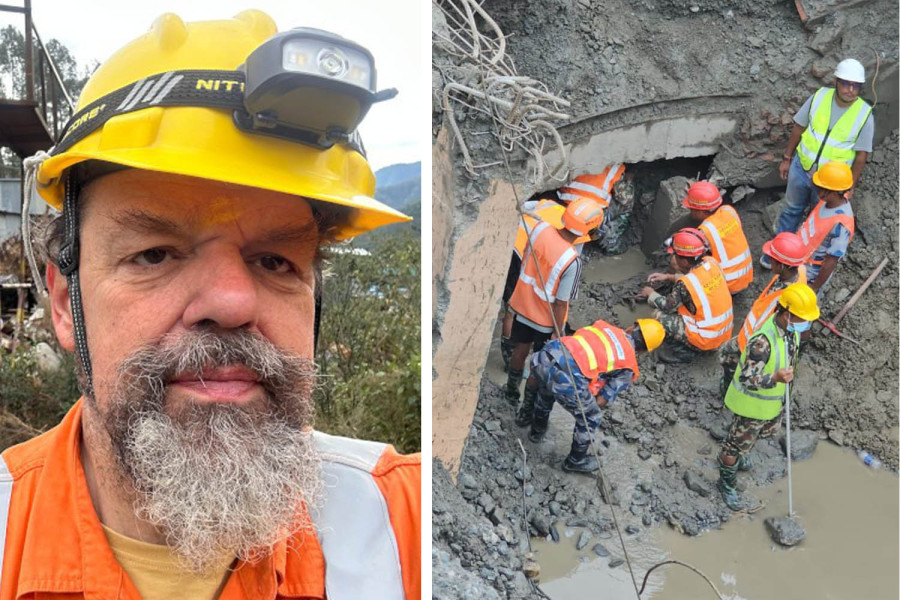
The renowned tunnel expert says underground environments can remain survivable for a long time after devastation above ground, citing past rescues in Chile, Thailand and India. Photo: Courtesy of Monash University/Nepali Army
As rescue operations continue in Nepal’s flood-hit hydropower plants, renowned tunnel expert Arnold Dix, who is remotely assisting in the rescue operation at Trishuli 3A, has said that people can survive underground much longer than expected.
“A tunnel is an engineered environment: sheltered from weather, comparatively thermally stable, and potentially capable of preserving breathable air and survivable refuge after everything above has been devastated,” he wrote in LinkedIn on Thursday.
As of Thursday afternoon, police have confirmed the death of 1,252 people after a massive flood lashed districts in central Nepal on August 26. Over 4,000 remain missing and over 2.5 million people downstream of the Nepal-Tibet border where the flood originated have been affected.
Hundreds of workers are missing inside over a dozen hydropower tunnels along the Bhotekoshi river after the devastating floods.
“The operation at Trishuli 3A is proceeding as a rescue, not a recovery,” Professor Dix wrote on the social media platform, highlighting the difference between the two operations. “Recovery operations may now have begun elsewhere under the broader UN response but tunnels are different—and that difference matters.”
Dix attached a video to his post. “Footage recorded at 9:18 above Trishuli 3A shows around 30 more people moving toward and seeking shelter in the tunnels,” he wrote. “That matters. It is evidence of people heading toward the one environment that may have offered them protection.”
Dix, who became widely known in India for his role in the 2023 Silkyara (Uttarakhand) tunnel rescue, has described the search operation around Nepal’s flood-ravaged hydropower projects as being like “23 Silkyaras going on at the same time.”
“History proves why we must not give up,” he added in his post.
“In Chile in 2010, 33 miners survived 69 days underground in the San José mine—the first 17 days with no contact. In Thailand in 2018, 12 boys and their coach were found alive after nine days inside Tham Luang cave. All were brought out.”
Once water is drained and access established, rescuers will excavate towards the powerhouses, which Dix compared to the Silkyara of India when 41 workers were brought out alive after being trapped for 17 days.
“Silence is not evidence of death,” Dix wrote. “It is only the absence of a signal. Every one of those rescues began in silence.”
Dix has now been assigned to oversee the rescue operation in the Trishuli 3A hydropower plant, where dozens of people are feared trapped.
Speaking with the US-based Kera News, Dix has said that in the past few days, rescuers have dug down into the entrance of the tunnel, which was once open to the air. “It’s now underneath the river,” Dix said. “We found there were huge boulders, thrown right into our tunnel and mud.”
Dix explained that while usually “it's a no-no to use explosives” when extricating people from tunnels, “we had to call the army in to blow up the rocks.” He added that the rescue team tried to prevent water from rushing in by creating “an artificial drain for the tunnel so that we can let the water out.”
At the end of his LinkedIn post, Dix once again highlights the difference between a rescue operation and recovery process.
“We may not hear their voices. But if they are there, we will find them,” he said. “This is, and continues to be, a tunnel rescue.”




 16.09°C Kathmandu