Rescue teams struggle to reach workers trapped in underground powerhouses
Families are demanding answers as mud and debris block access to hydropower plants where dozens of workers are feared trapped after the Bhotekoshi flood. 947 people remain unaccounted for at hydropower projects across flood-hit northern Nepal. Photo: Courtesy of Nepali Army
A week after a devastating flash flood swept through northern Nepal, rescue teams still cannot reach workers and employees believed to be trapped inside underground powerhouses and tunnels at several hydropower projects.
Families of the missing say the rescue effort has been too slow, raising growing anger at the government and project operators.
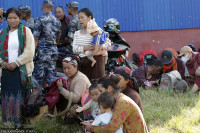
Narayani Joshi has spent the past week waiting for news of her husband and about 40 other people believed to be trapped inside the underground powerhouse of the 60-megawatt Upper Trishuli-3A Hydropower Project.
“Many people, including my husband, have been trapped inside the hydropower plant for a week. We still have no idea what condition they are in,” Joshi said. “We have been told the powerhouse is intact, so we are clinging to the hope that they are still alive. How can the government be so slow to respond to something this serious? Why aren’t better equipment and pumps being used to get the water out?”
Data released on Tuesday by the Independent Power Producers’ Association, Nepal (IPPAN), showed 947 people from various hydropower projects remained unaccounted for. IPPAN said it was not yet clear how many were trapped inside underground powerhouses or tunnels and how many had been swept away by the floods.
Home Minister Sudan Gurung said the state was using all available resources to rescue those who may still be alive.
“We have not lost hope yet. There is still a chance they could be alive, perhaps surviving on the water inside the powerhouse,” Gurung said at a news conference organised by the National Disaster Risk Reduction and Management Authority. “Our security teams are still working at the site. We are also looking at whether we can drill down from above and find a way to reach them.”
More than 557 people are reported to be missing from the 216-megawatt Upper Trishuli-1 Hydropower Project alone. Although 254 people were safely rescued from around the project site, the whereabouts of the missing remain unknown.
The government has recently begun involving technical teams from hydropower projects in the rescue efforts, saying this would make operations more effective.
Families, however, have demanded that searches inside the tunnels be intensified.
Relatives of missing workers went to the PowerChina office in Satdobato, Lalitpur, on Tuesday to press the company to speed up the rescue effort, leading to a dispute with employees. The families and company representatives later held discussions at a police station.
Govinda Giri, whose relative is among the missing, said a dispute had arisen over sending technical personnel into the tunnels. Nepali Army and Nepal Police teams have been deployed around the tunnel area, he said, but rescue efforts have been held back by the absence of key technical specialists.
Giriraj Adhikari, managing director of the Upper Trishuli-1 project, said a joint team involving the Nepali Army, Chinese specialists and Sherpas was searching.
“A specially trained search-and-sniffer dog team was sent from Pokhara to the site on Tuesday to help with the search,” he said. “We need to get excavators in. The tunnel is packed with mud and debris, and that has to be cleared before we can get any further.”
Adhikari acknowledged that the project developer’s technical team should have been mobilised sooner.
“We should have had the developer’s technical team on the ground from the outset,” he said. “We only began working as a joint team on Monday.”
At the 60-megawatt Upper Trishuli-3A project, 42 people, including experienced Nepal Electricity Authority technicians, engineers and specialists brought in from other hydropower projects, are believed to be trapped inside the underground powerhouse.
The government has given the rescue effort high priority, but teams have yet to reach the powerhouse. The Nepali Army said a joint team was drilling through the tunnel from the outlet in an attempt to gain access.
Dirghayu Kumar Shrestha, acting managing director of the Nepal Electricity Authority, said the army and other teams were working with technical support from specialists.
“Forty to 50 people are working at Upper Trishuli-3A, including five or six of our technicians,” Shrestha said. “Everyone is working together, and excavators are being used.”
He said Nepali, Indian, Chinese and South Korean technical teams were involved in rescue operations at different projects.
“Families of those still missing are coming to us every day, and the pressure on us is growing,” he said.
At the 37-megawatt Upper Trishuli-3B project, 191 people are also unaccounted for. Nepali Army’s Bhairab Nath Battalion, Nepal Electricity Authority personnel and other technical teams have been searching tunnels and buried structures. The army said it stepped up excavation from Monday using excavators.
At the 111-megawatt Rasuwagadhi Hydropower Project, an army team has managed to enter the tunnel but has yet to reach the underground powerhouse.
The company said rescue and relief efforts have also been hampered because access to the project site has been restricted to authorised personnel under its security protocol.
Naranath Neupane, secretary of Rasuwagadhi Hydropower Company, said part of the tunnel had been cleared but the passage was found to be completely blocked before reaching the powerhouse. The company said signs had been found indicating a route from the main tunnel towards the level of the powerhouse, but further excavation was needed to reach the control room.
Ninety-three people are reported to be missing from the project.
At the 20-megawatt Langtang Khola Hydropower Project, a technical team is due to join the rescue operation on Wednesday. Forty-one people are feared trapped there.
“Until Monday, we had only one representative at the site. We were not allowed to send everyone,” said Vijay Mohan Bhattarai, a promoter of the Langtang Khola project. “Now we have agreed to work jointly. We have a team of engineers and other specialists. They should have been mobilised earlier.”
The team had already arrived in Battar, Nuwakot, with equipment and was expected to begin joint operations on Wednesday, he said.
At the 22-megawatt Chilime Hydropower Company project, eight workers are feared trapped. Babaraj Maharjan, the company’s managing director, said essential equipment had still not reached the site.
The floods that struck northern Nepal last week caused widespread destruction along the Bhotekoshi and other rivers, damaging roads, bridges and hydropower infrastructure and cutting off several remote project sites. Rescue teams have struggled to reach underground facilities, while families continue to wait for information about relatives whose fate remains unknown.
Hom Karki is a reporter with two decades experience covering migrant workers issues and the Nepali diaspora. He was previously based in the Gulf for Kantipur Daily.




 19.24°C Kathmandu