Man-made water hazards are becoming a deadly monsoon trap for children
Across Madhesh and Lumbini, children are drowning in roadside excavations, construction sites, ponds and canals, exposing a preventable danger created by poor infrastructure and weak safety measures. 608 children have drowned in Madhesh over the past seven fiscal years.
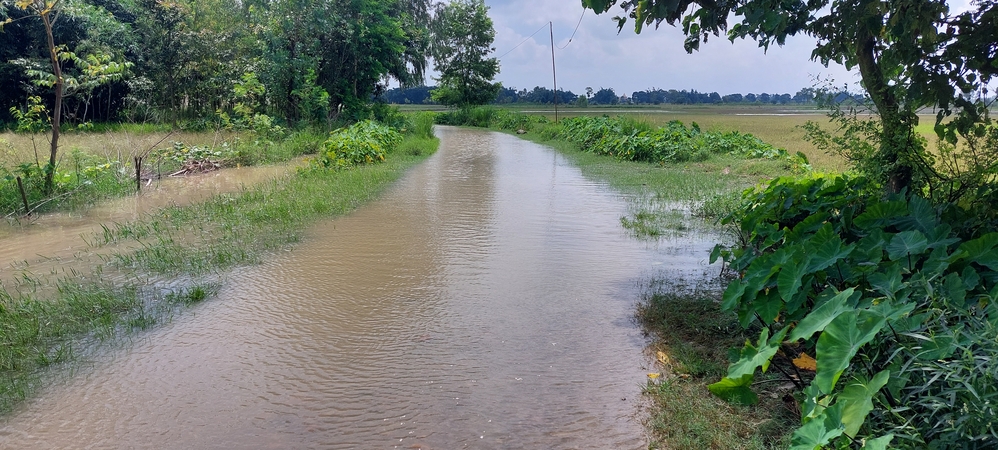
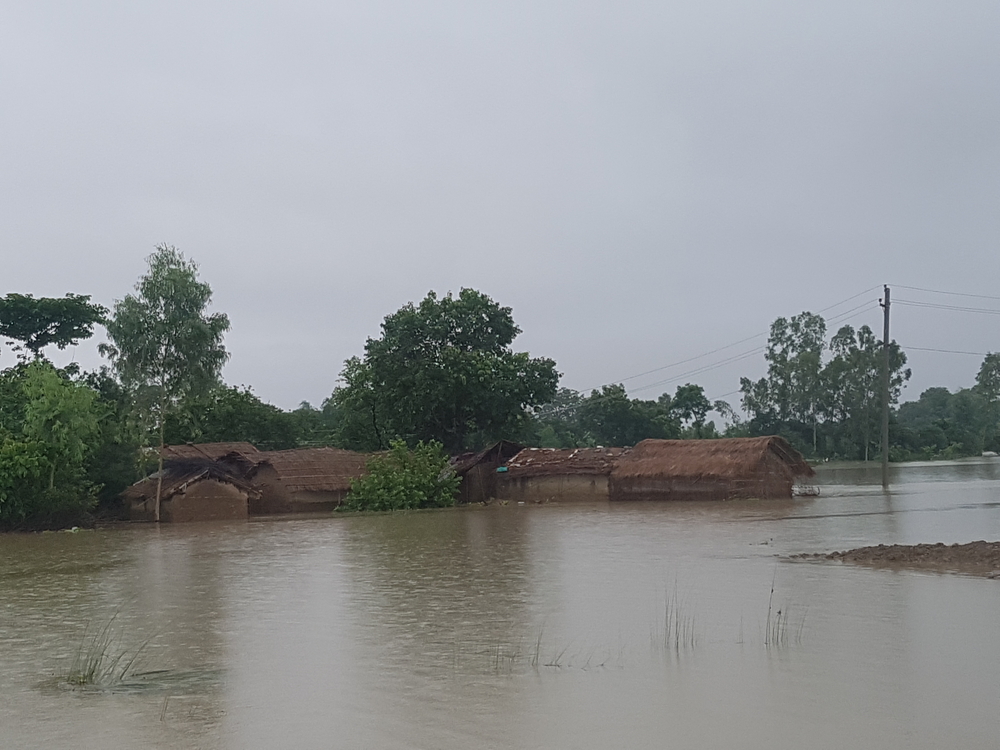
The monsoon brings the familiar threat of floods and inundation to Nepal’s southern plains. But for children, another danger is often closer to home: water collecting in pits, construction sites, open drains and unfinished infrastructure.
Roadside excavations, holes dug for brick kilns, ponds, irrigation canals and trenches around culverts and bridges can become deadly traps once filled with rainwater. The danger is often invisible. Children may have no way of judging how deep the water is before stepping in to play, bathe or swim.
Last Friday, 7-year-old Khushi Alam drowned in a water-filled pit beside a culvert in ward 5 of Yamunamai Rural Municipality, Rautahat district.
Khushi had gone to play with four or five friends at a culvert about a kilometre west of his home. His friends returned in the evening, but Khushi did not. When he failed to come home late into the night, relatives and neighbours began searching for him. His father reported him missing at a police post in Bamanhar.
Police eventually found Khushi’s body in a pit about 20 feet south of the culvert along the Satbamba road.
Ward chair Shivendra Sah said the pit had existed for years and had filled with rainwater.
“It is an old pit beside the road,” Sah said. “It is difficult to fill it, and it cannot simply be left as it is. Children are attracted to such water-filled pits, but the consequences are becoming serious.”
The ward has since conducted awareness programmes at schools and urged children to stay away from stagnant water.
Khushi’s death was far from an isolated case in Rautahat or the wider Madhesh province.
On July 28, two sisters, 5-year-old Puchki and 3-year-old Ghaghari, drowned in a water-filled excavation near an under-construction bridge in Chakradaha, in ward 26 of Birgunj Metropolitan City, Parsa district.
The girls, daughters of Prabhu Thakur of Sughauli, had gone to a field with their grandfather, Kishori Thakur. The family arrived at about 11am. Their grandfather left the children briefly while he went to call their grandmother. When he returned, the girls were gone.
Their family searched nearby and contacted relatives. Their mother, Antima Devi, reported them missing to the Sughauli Area Police Office that night. Police found both girls dead the following morning in the flooded pit near the bridge.
In Siraha district, three children from the same family died in another water-filled excavation on July 12.
The children, 12-year-old Sabnam Khatun, 10-year-old Rubina Khatun and 7-year-old Saiful Sheikh, drowned while bathing in a pit at a livestock market in Choharwa, ward 7 of Golbazar Municipality. Residents and security personnel pulled them from the water and took them to the hospital, where doctors pronounced all three dead.
Golbazar Mayor Shyam Kumar Shrestha said the pit had been there for years and was used as a water source for livestock.
“We never imagined such an incident could happen,” Shrestha said. “We will fence the area rather than fill the pit, as it is used like a pond for animals.”
He said the municipality would also run awareness campaigns.
Authorities repeatedly call for fencing, warning signs and safer construction sites, but enforcement remains weak.
In Mahottari district, three girls drowned on May 22 in the village of Sarpallo in ward 7 of Manarashiswa Municipality. The victims were 12-year-old Sneha Kumari and 6-year-old Shivani Kumari, daughters of Birendra Bhandari, and 12-year-old Afsana Khatun, daughter of Aziz Nadaf.
Police said the girls had gone swimming at the confluence of the Ankushi and Jangha rivers. They slipped while bathing and were swept into deeper water.
That same day, 2-year-old Deepika Kumari, daughter of Naresh Mahato, drowned in rainwater that had collected in a field near her home in Rajkhor village, ward 4 of Gaushala Municipality.
Mahottari Assistant Chief District Officer Sanjay Kumar Pokharel blamed a lack of public awareness for the recurring deaths.
“We repeatedly tell local governments at every disaster-management meeting to fill dangerous pits,” Pokharel said. “We even make policy decisions on the issue. But it is unclear whether elected representatives are ignoring them or what is happening.”
The incidents show that children are not drowning only in rivers, streams and natural water bodies. Water collecting in roadside pits, culverts, construction sites, farmland and old excavations around settlements can be just as deadly.
A recurring seasonal tragedy
The scale of drowning deaths among children in Madhesh is stark.
According to the Madhesh Province Police Office in Janakpur, 608 children have drowned in the province’s eight districts over the past seven fiscal years, from 2019-20.
Rautahat recorded the highest number, with 110 child deaths. Dhanusha reported 102, Siraha 81, Saptari 75, Mahottari 71, Bara 66, Sarlahi 60 and Parsa 43.
Police data show that many of the deaths do not occur in major rivers or natural lakes. Children are frequently killed in culverts, irrigation channels, deep pits excavated for brickmaking, ponds and roadside trenches.
The pattern points to a problem that extends beyond parental supervision.
Former Madhesh provincial assembly member Dhan Lal Thokar said poorly managed infrastructure and unsafe excavation were major contributors.
“Brick kilns, soil excavation sites and roadside culverts are routinely left open after construction,” Thokar said. “Villages often lack safe places for children to play, so they end up around water-filled pits and culverts. This is not simply an unfortunate accident or a failure of parental care.”
The problem is particularly acute around brick kilns, where deep pits are dug to extract soil and can later fill with rainwater.
Rautahat Chief District Officer Dinesh Sagar Bhusal said local units had repeatedly been asked to fill dangerous pits or secure them with fences and warning signs.
“We have told elected representatives again and again,” Bhusal said. “We are tired of repeating ourselves. Yet they simply do not act. It is becoming a serious problem.”
He said brick kiln operators often excavate soil deeper than permitted and leave the pits exposed.
“Such pits are much deeper than ordinary ponds and are therefore particularly dangerous for children,” Bhusal said. “Contractors working on roads, bridges and culverts also leave excavations open, either during construction or after the work is completed. Soil is removed during road widening, but the pits are not filled or secured.”
The risk is compounded by poverty.
Police investigations indicate that many children who drown in pits, culverts, brick kiln sites and ponds come from poor or low-income households. Parents who have to work long hours to support their families may be unable to supervise young children closely, leaving them free to wander into ponds, canals and construction sites.
Madhesh Finance Minister Yuvaraj Bhattarai said child safety should be treated as a responsibility shared by families, communities and the state.
“Pits dug in the name of development must no longer take the lives of innocent children,” he said. “The Madhesh government is serious about this.”
On July 5, the secretariat of Janamat Party chair CK Raut said more than 450 children had drowned in ponds and pits in Madhesh over the previous four years. The party argued that the deaths should not be treated simply as natural disasters because many could have been prevented.
It called for open pits in villages and neighbourhoods to be filled or fenced, warning signs and barriers to be installed around ponds, brick kilns and construction sites, and greater supervision of young children around water. It also urged schools and communities to conduct water-safety programmes and local governments to identify and regularly monitor dangerous sites.
The same danger in Lumbini
The problem extends beyond Madhesh.
In the western province of Lumbini, ponds, rivers, irrigation canals and reservoirs are important sources of water, but they also pose a growing drowning risk, particularly during the hot months and monsoon.
In Dang district, an average of about one person dies each month from drowning or being swept away by water, according to Superintendent of Police Dipak Shrestha, chief of District police in Dang. Last fiscal year, 29 people died in such incidents.
Some deaths occur when people who cannot swim enter the water carelessly. Others happen during floods or accidents. Victims have drowned in natural rivers and lakes as well as artificial reservoirs built for irrigation or recreation.
In November 2024, three 12-year-old girls drowned while bathing in the Rapti river.
In June 2024, floodwaters in the Rapti river swept away 62-year-old Maniram Chaudhary of Lamahi Municipality. Seventeen-year-old Raj Kumar Yadav of Rajpur Rural Municipality also drowned while returning home after selling milk. Two teenagers died after being swept away by the Babai river in June.
The broader provincial figures show how widespread the risk is. Lumbini recorded 553 disaster incidents in the past four months, killing 90 people. Sixty of those deaths were caused by drowning, and four people remain missing. Twenty-three of the drowning victims were children.
Last fiscal year, the province recorded 1,837 disasters that killed 297 people. Drowning accounted for 190 deaths, with 14 people still missing.
In Rupandehi district alone, two children and one woman drowned within three months, according to the Butwal Area Police Office. On July 11, 15-year-old Pragya Gautam of Tilottama drowned in a fishpond. She went into the water at about 6pm and was not pulled out until around 9pm.
On May 17, 18-year-old Umakanta Chaudhary of Butwal drowned while swimming in the Tinau River.
Police Inspector Thamman GC said drowning incidents increase during periods of extreme heat, when children and teenagers go swimming in rivers, canals and ponds.
“Children, particularly those aged 11 or 12 and above, often go swimming in groups to escape the heat,” GC said. “They may not know how deep the water is, and that can lead to drowning.”
Rautahat recorded the highest toll, with 110 child deaths.
He said victims were often from low-income or working-class families, or households where parents were away at work.
Last fiscal year, 17 people drowned in Rupandehi, including nine men and eight children. Seven of the children were boys, and one was a girl.
Lumbini authorities have called for stronger safety measures around water infrastructure.
Chief Minister Chet Narayan Acharya, who also chairs the provincial disaster management council, said the government was stepping up awareness campaigns during the monsoon.
“Fencing irrigation canals, ponds and other dangerous water bodies and putting warning signs around public ponds and dams can reduce the risk,” Acharya said. “Local governments have also been instructed to conduct awareness campaigns around canals, ponds, irrigation channels and rivers and to discourage children from swimming in them.”
Prevention remains the missing link
Despite repeated warnings, dangerous sites remain scattered around settlements.
The problem is not limited to natural hazards. In many cases, the danger is created by development itself.
A contractor digs a trench for a culvert and leaves it open. A brick kiln extracts soil and abandons a deep pit. A road project removes earth without restoring the site. A pond or canal is left without a fence or warning sign. Rain then fills the excavation, turning it into a hidden hazard.
“The common factor in Madhesh and Lumbini is the failure to identify water and excavation hazards in places children can reach,” said Dang police chief Shrestha. “In some places, construction pits are left open. In others, there are deep excavations made for brick kilns. Elsewhere, canals, ponds and rivers have no warning signs. Sometimes parental supervision is weak. In other cases, local units and construction companies have failed to do their part.”
Madhav Narayan Municipality Mayor Baijnath Yadav said local units, landowners, industrialists and brick kiln operators all have a role in preventing deaths. Deep excavations should be fenced and marked with warning signs, while old pits that cannot be filled should at least be secured.
Every ward, he said, should map dangerous sites and arrange immediate safety measures. Municipalities should also create safe spaces where children can play instead of turning to construction sites and water-filled pits.
Yadav said his municipality plans to expand public awareness campaigns and provide training on emergency rescue and first aid for drowning victims.
Civil society leader Kedar Thapa of Rautahat said children’s safety must be built into development projects from the beginning.
“Development should improve people’s lives, not become a trap that takes their lives,” he said. “If the authorities do not act in time, more children will continue to disappear into water-filled pits.”




 14.83°C Kathmandu