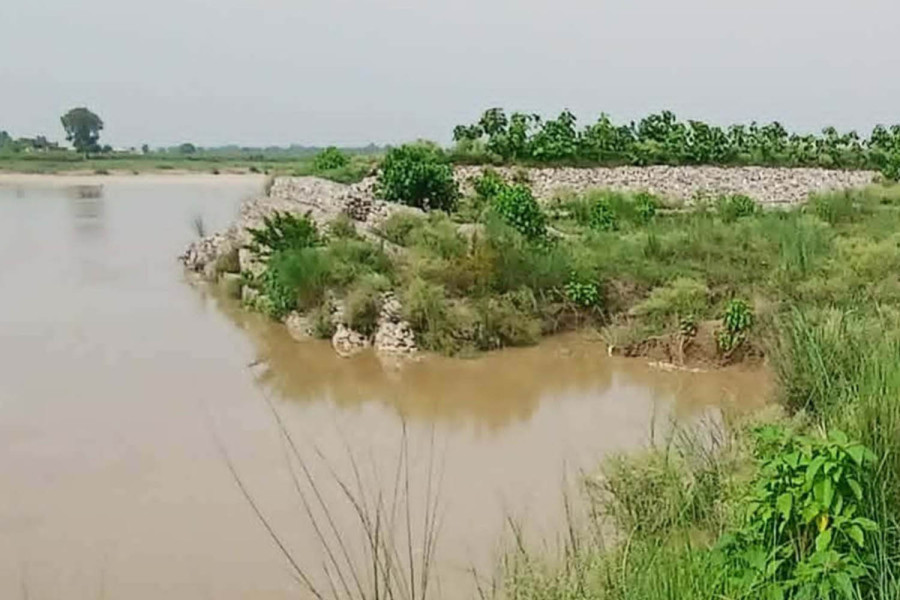
Five villages in Gulariya Municipality-10 in Bardiya district have been placed at high risk after rising water levels in the Babai river triggered fresh erosion on Tuesday.
As the river level receded, it began cutting into the banks, putting Ratnapur, Jhagarupur, Rangipur, Nayapur and Mahajadiya villages at increasing risk. Residents fear that a major flood could inundate the settlements and destroy farmland if immediate measures are not taken.
The erosion has intensified at a site where embankment construction near the Nepal-India border was halted following objections from the Indian side, according to the then Babai, Bhada and Aurahi River Management Office, Bardiya.
Farmer Dipak Chaudhary of Ratnapur said the lack of progress on embankment construction allowed the river to change its course, exposing five villages to danger.
“As soon as a major flood hits, erosion will worsen, and the entire area could face inundation,” he said. “The concerned authorities must immediately build the embankment in this area.”
The southern embankments built by the Babai, Bhada and Aurahi River Management Office have also come under threat from erosion.
The office had planned further embankment work in the area, but the project was relocated to Dadeldhura last year, disrupting ongoing flood-control efforts. Following the relocation, work on the embankment has remained affected.
The Irrigation and Water Resource Management Project, formerly known as the Karnali River Management Project in Rajapur, is now overseeing the office’s responsibilities.
Project chief Sudin Muktan said he had not received any official information about the erosion but would visit the area and take preventive measures.
“Many people are unaware that the Rajapur contact office of the former Babai, Bhada and Aurahi River Management Office is responsible for the work,” he said. “That may be why we were not informed about the Babai river erosion.”
Local farmer Jagdish Lodha said the river had already washed away more than 40 bighas of cultivable land in the area over the past seven years.
With the monsoon season continuing until October, the threat to farmland remains high, said local resident Raghubir Mallah.
“The government made a serious mistake by shifting the Babai, Bhada and Aurahi River Management Project before completing its work,” he said. “Now we do not know when or who will build the embankment. Until support comes, the river may have already swept away our fields.”
The villages, located near the Nepal-India border, heavily depend on agriculture, producing paddy, mustard, wheat, vegetables, and maize. Residents have long been demanding a permanent embankment to control river erosion.
Although embankment construction was planned to begin in the last fiscal year, the project was left incomplete after the office was relocated.
Locals say the river has been gradually changing its course due to erosion on the southern side, increasing the risk to settlements. Five years ago, three boundary pillars along the Nepal-India border near the villages were washed away by the river.
A major flood has not yet hit the area this year, but residents fear a repeat of the devastation caused by floods in 2014 and 2017.
“If a flood like those years occurs again, the risk of major damage in Rangipur and Ratnapur will rise significantly,” said resident Naresh Godiya.




 13.87°C Kathmandu