Ride-hailing driver’s self-immolation sparks debate over municipal police’s jurisdiction, aggression
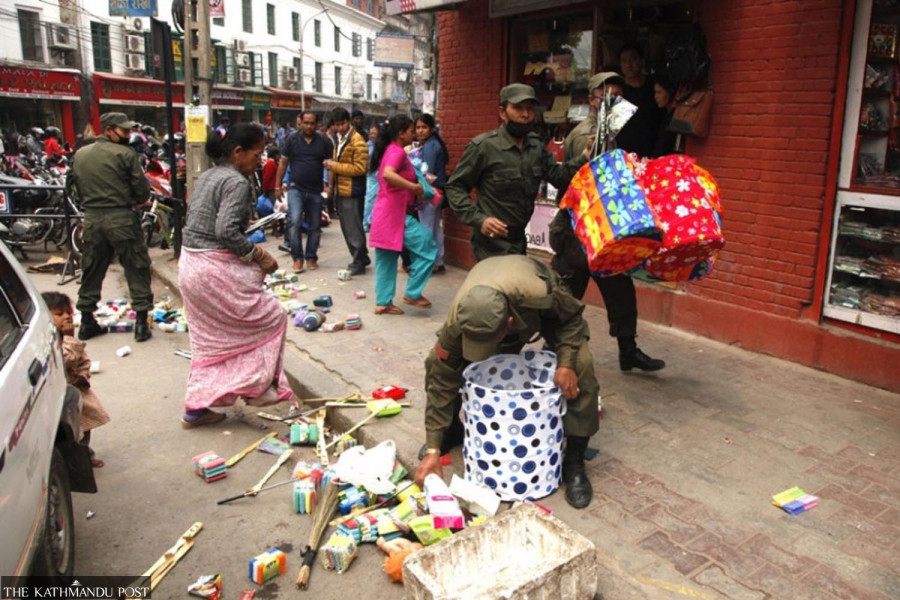
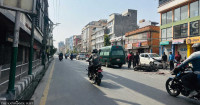
Experts say the municipality police’s legal mandate does not authorise physical coercion, detention or independent crowd-control operations. Kathmandu’s municipal police have faced repeated criticism over aggressive drives against street vendors, squatters and public performers under former mayor Balendra Shah. Post file photo
The death of a 25-year-old ride-sharing driver, who set himself on fire after city police locked his motorcycle wheel, has ignited a debate over the conduct, authority, and legal jurisdiction of municipal law enforcement.
The incident, which occurred outside the Department of Passports at Tripureshwar, has left the Kathmandu Metropolitan City’s police force facing intense public fury, forcing them to largely retreat from the capital's streets.
On Thursday afternoon, Ganesh Nepali was waiting for a client when municipal police officers approached and abruptly clamped a wheel lock on his motorcycle. In a desperate act of protest against what eyewitnesses described as aggressive high-handedness, Nepali poured petrol over his body and set himself ablaze. Despite being rushed to the hospital, he succumbed to severe burn injuries on Friday.
This tragedy has brought long-standing grievances against the capital's municipal police to a boiling point. Legal experts and former security officials argue that the local administration has consistently overstepped its constitutional boundaries, transforming a regulatory facilitation body into an aggressive force that mimics the tactics of the federal police force, the Nepal Police.
"The legal framework does not envision the municipal police as a force authorised to use physical coercion or riot-control tactics. Their primary mandate is to facilitate administrative functions within the metropolis through persuasion and community engagement," said senior advocate Raju Chapagain. “When issues arise regarding traffic or street obstructions, the matter should be referred directly to the traffic police. Instead, we have witnessed municipal officers relentlessly chasing vendors, confiscating private property, and physically assaulting citizens, which is entirely illegal."
The aggressive posture of the Kathmandu Metropolitan City police intensified significantly following the election of Balendra Shah as mayor in 2022. Running as an independent candidate, Shah’s tenure became synonymous with a hardline approach to urban management, particularly concerning the clearance of pavements and informal street markets. Numerous instances were documented where these drives resulted in violent confrontations, highlighting growing public anxiety over the lack of compassion shown to the city's poorest residents.
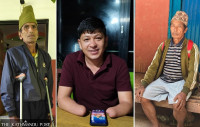
In March 2024, the brutality of the force was laid bare when a street vendor Badri Devkota was severely beaten by municipal officers. Devkota suffered bruising across his body before being detained and taken to the municipal police headquarters in Teku. This incident followed a clash in which ten municipal officers were injured during a violent standoff with roadside vendors, illustrating the increasingly combative nature of urban space regulation.
The Constitution of Nepal grants local governments the authority to form and manage municipal police forces. Under this provision, the metropolis enacted the Kathmandu Metropolitan City Municipal Police Act 2023. Ironically, this legislation, passed during Shah’s mayoral tenure, explicitly outlines the duties of the force without granting any power to launch baton charges or detain citizens. According to the act, the primary responsibilities of the municipal police are restricted to safeguarding municipal property, protecting public parks, monitoring sanitation compliance, and assisting in the management of local festivals and cultural processions.
Furthermore, the law mandates that any enforcement action must be carried out in close coordination with the mayor, deputy mayor, chief administrative officer, and respective ward chairs. It contains no provisions allowing the unilateral use of force against the public.
"There is absolutely no legal basis for the municipal police to use force," said Purna Chandra Joshi, a retired Deputy Inspector General of Nepal Police. "They are purely a facilitation mechanism. If a situation escalates into a public disturbance or requires physical intervention, the municipal authorities are legally obligated to call upon the Nepal Police. They cannot independently execute crowd control."
Despite these legal limitations, the municipal police under Shah’s administration frequently engaged in actions that went viral on social media, showing officers chasing down vendors and seizing their livelihoods. This model of aggressive urban governance quickly spread to other municipalities across the country.
"It was inevitable that other local governments would imitate the capital. The Kathmandu Metropolitan City generated approximately Rs6.7 million over eighteen months solely through the confiscation and auction of street vendors' goods,” said Chapagain. “This financial incentive helped institutionalise a deeply flawed and harmful practice nationwide."
The relentless campaign against informal traders prompted widespread demonstrations. In September 2023, youth activist Ishan Adhikari, who goes by Iih, and a group of advocates launched a high-profile protest outside the City Hall. After a continuous 199-hour standing protest, the metropolitan authority signed a four-point agreement promising to return confiscated goods to their rightful owners and to identify designated zones for informal trade. However, the commitments were never fully implemented, though the municipal police temporarily halted atrocities on street vendors.
The internal volatility of the force became evident when the municipal police department itself acknowledged the misconduct of its personnel, taking disciplinary action against twelve officers. Seven contract-based officers were dismissed from service, while five permanent personnel were suspended.
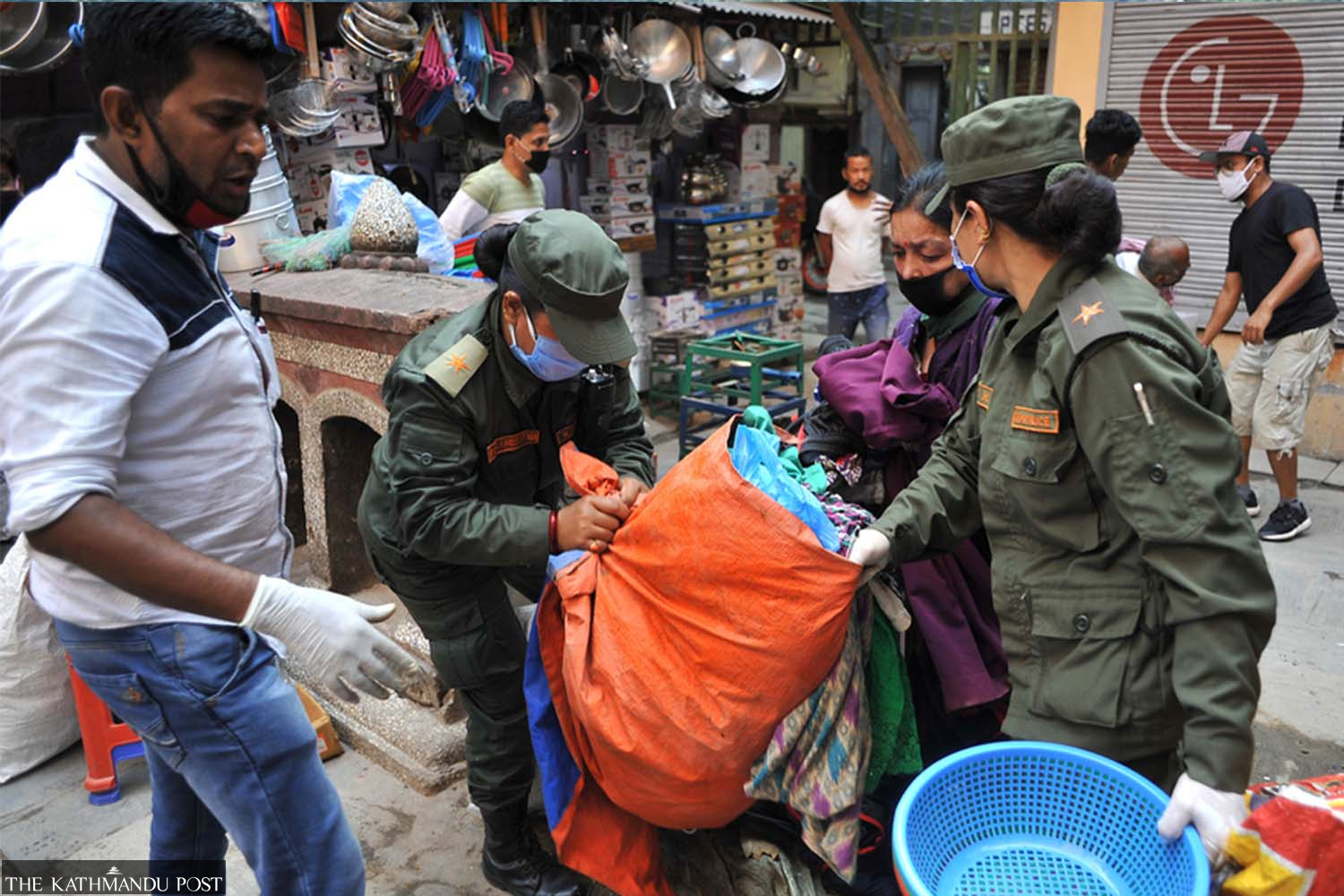
Despite these internal corrections, the aggressive campaigns shifted towards other sectors. Following the agreement with Adhikari and other groups, the metropolis launched a drive to evict scrap metal dealers from residential areas. This culminated in a violent clash in February 2025, when municipal police arrived with bulldozers to demolish a scrap collection facility. The labourers resisted, resulting in injuries to three scrap workers and two municipal officers.
Legal experts and former security officials say municipal police have exceeded their mandate, arguing that the force is meant for administrative support, not using physical force, detaining citizens or conducting crowd-control operations. Post File Photo
The high-handed tactics extended to cultural and public spaces. In September 2024, the municipal police detained street singer Manjadaras Tamang, who was performing at Basantapur Durbar Square to raise funds for medical treatment of a 13-year-old girl. Officers confiscated his microphone and loudspeakers before releasing him under intense public pressure, following a controversial municipal notice banning begging and unauthorised public performances.
The internal use of the municipal police force took a highly political turn during an administrative dispute between Mayor Shah and the Chief Administrative Officer Saroj Guragain. When Guragain attempted to enter the municipal office after a four-month dispute, municipal police officers physically blocked him at the gates under direct orders from the mayor, requiring the intervention of Deputy Mayor Sunita Dangol to de-escalate the situation.
The militarisation of the force is closely tied to its leadership transitions. Three months after taking office, Mayor Shah replaced the long-serving police chief, Dhanapati Sapkota, with Raju Nath Pandey. Under Pandey’s leadership, the force adopted tactical training and riot-control gear. When Shah eventually resigned as mayor to transition into national politics through the Rastriya Swatantra Party, Pandey also resigned to contest the federal elections.
Pandey, who was elected to the House of Representatives from Kathmandu Constituency No 3, defended his record.
"The municipal police act was brought in during my tenure to systematise the force, and it included clear guidelines on wheel-locking," said Pandey. "This matter was challenged in court, and the judiciary upheld the municipality's right to use wheel locks. Regarding our past actions, we were forced to acquire defensive gear because the federal Nepal Police refused to assist us during the high-profile squatter eviction drives at Thapathali, leaving our officers exposed to severe violence.” “My own head was injured during those clashes. This is a matter of self-defence, not political targeting."
The Thapathali squatter clearance drive in 2022 had exposed the deep divide between the federal government and the metropolis, as the home ministry repeatedly declined to deploy riot police to assist the city's demolition teams.
In August 2025, during the 33rd anniversary of the Municipal Police Force, Mayor Shah had openly praised the unit's aggressive methods, comparing them to Hollywood cinema.
"When I was younger, we used to watch Hollywood films showcasing the New York City Police Department," Shah remarked at the time. "We could only dream of having such a city police force in Kathmandu. Today, watching your operations feels exactly like watching a movie. It is a matter of great pride."
Following Nepali’s self-immolation, the capital's streets present a starkly different reality, with municipal officers conspicuously absent from their regular patrols.
Kathmandu Metropolitan City spokesperson Nabin Manandhar confirmed the temporary retreat.
"We are currently maintaining a low profile as negotiations with the deceased driver's family are ongoing. A definitive decision on future street enforcement and parking regulations will only be reached after these talks conclude,” said Manandhar.
Activists argue that the systemic issues remain unaddressed. Rakshya Bam, a Gen Z activist who participated in the protests supporting street vendors, claimed that while municipal police excesses were not new, they intensified significantly during Shah’s tenure as mayor.
"Other municipalities began copying Kathmandu's approach, causing the same aggressive trend to repeat across the country. In this context, the government must immediately enact clear laws to explicitly define and limit the jurisdiction of the municipal police,” she said.




 14.69°C Kathmandu