Floods at Kirtipur holding centre expose flaws in government’s squatter relocation plan
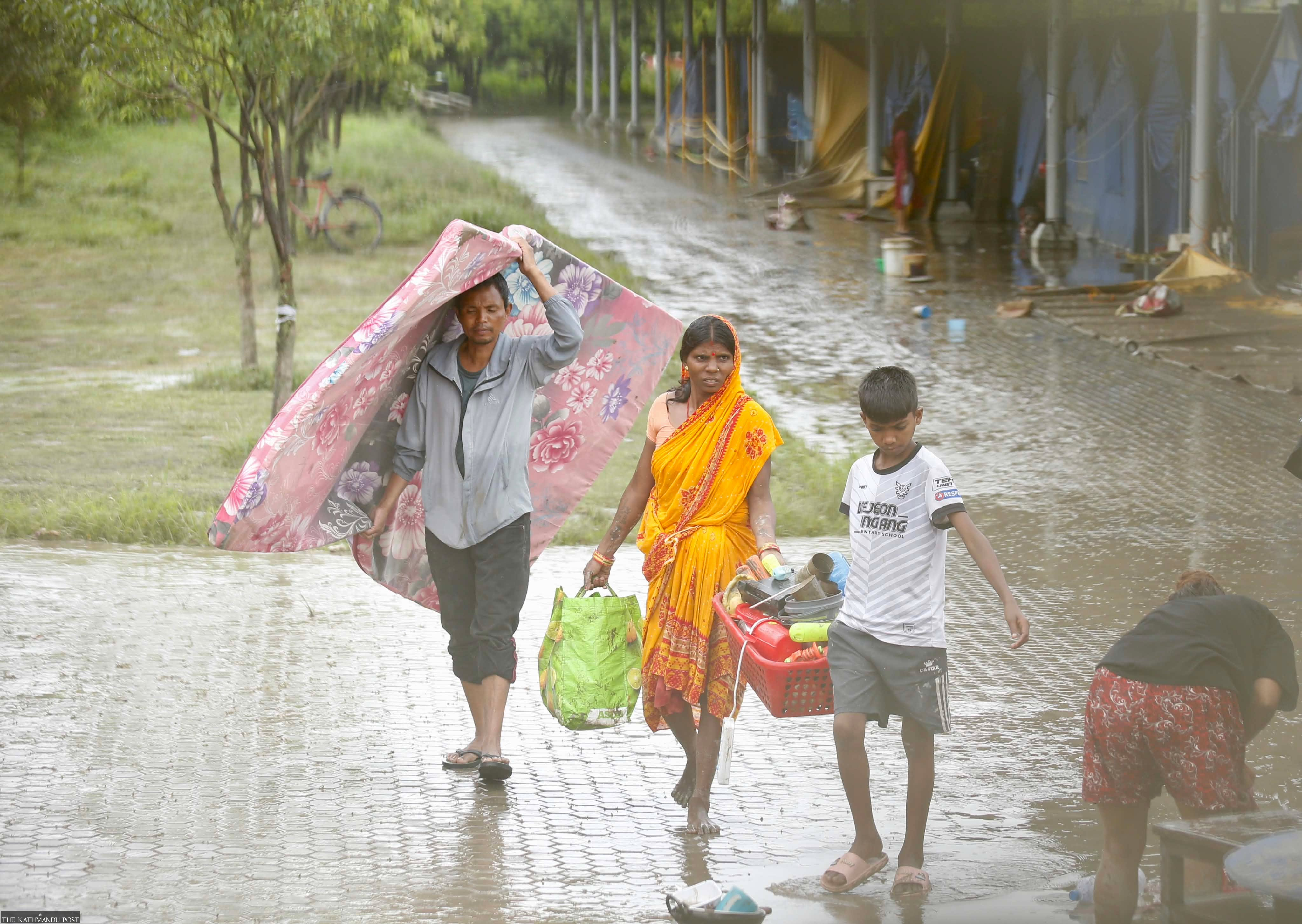
Families relocated from riverbanks lose their homes and belongings again as the government's holding centre floods. Landless squatters who were earlier evicted from riverside settlements prepare to leave the Radha Swami Satsang holding centre in Kirtipur, Kathmandu, on Saturday after floodwaters entered the facility overnight. They will be housed in a nearby facility until further arrangements. Dipesh Darshandhari/TKP
On April 24, Prime Minister Balendra Shah shared photographs of flooded riverside settlements on his social media page. He argued landless squatters living along the riverbanks were unsafe and needed immediate relocation.
“Whether you remember or choose to forget, every year thousands of people living on Kathmandu’s riverbanks have to flee for their lives during the monsoon, leaving all their belongings behind,” wrote Shah. “This is a perennial issue. I have repeatedly written and stated that we must securely relocate these residents before the next monsoon arrives.”
The following day, government bulldozers began demolishing the settlements. When opposition lawmakers questioned the aggressive eviction drive in Parliament on May 31, Shah reiterated his stance, stating that the administration was not expelling the citizens but simply moving them to safety.
However, the very holding centre designated by the government as a safe haven has proven to be equally perilous. On Saturday morning, the Radha Swami Satsang holding centre in Kirtipur was heavily flooded following torrential rainfall, leaving displaced families helpless and in a state of despair. By 5:00 am, the entire shelter was waterlogged, forcing the landless squatters to stand outside in the cold, staring blankly at the water.
The Bagmati river had been rising rapidly since Friday evening due to heavy rains. Around 00:30 am on Saturday, panic erupted inside the Kirtipur holding centre as water breached the compound.
Gayatri Shrestha, carrying two bags over her shoulders, held the hand of her four-year-old daughter, who was rubbing her eyes. Her daughter stood barefoot on the cold ground.
“We couldn't save her shoes, clothes, or schoolbooks. Everything was flooded,” said Gayatri, looking down at her daughter's downcast face. Gayatri, an evacuee, recounted waking up to chaotic shouts. “The water was already rising rapidly inside our tent. We woke up in a state of panic, grabbed two bags and a few identity documents, and rushed outside.”
For many, the flood swept away essential lifelines. Gayatri sighed deeply as she looked at her children. “My daughter is left with only the single dress she was wearing,” she said. “More importantly, my medical records from a heart surgery twelve years ago and all my prescription medications were left behind in the tent.”
The holding centre had been accommodating families evicted from the Thapathali and Shantinagar squatter settlements since April 25. These families had been living in temporary tents inside the complex.
“The government told us they brought us here to protect us from floods,” said Kamali Uraon, leaning against a concrete wall. “But the flood here turned out to be much larger than what we used to face along the riverbanks.”
Pramila Rai expressed bitter disappointment regarding the prime minister’s public promises. “So this is the safe place he promised us,” she said. “If the prime minister knew we were unsafe by the river, how did he fail to realise that this location was equally dangerous?”
Security personnel arrived at the scene around 2:00 am after the floodwaters entered the facility. By morning, security forces were using boats to help displaced residents salvage their submerged belongings.
Kamala Rai, 51, called out to the rescue teams, asking them to find her daily medications. The responders informed her that the medicines were completely ruined by the muddy water.
“I take regular medication for high blood pressure, thyroid, and cholesterol every morning,” Rai said. “Now I have no medicine and no clean drinking water.” Diagnosed with diabetes after moving to the holding centre, Rai expressed financial anxiety. “I bought these medicines just a few days ago. Where will I find the money to buy them all over again?”
Upama Magar, 30, described the terrifying speed of the deluge. “When I first noticed the floods, the water was only ankle-deep,” she said. “Within minutes, it rose above our knees. Our immediate priority was to carry the young children out to higher ground. The police only arrived after everything was completely submerged.”
For young students, the disaster has disrupted their education. Rijan Lama, a fifth grader, had received new textbooks and uniforms two months ago. “I was fast asleep when the water came and couldn’t save anything,” he said. “My notebooks with my homework are gone now.”
Manoj Mahato, looking over the flooded compound, noted grimly, “The few belongings we saved from the bulldozers are now destroyed by the floods. People usually go searching for water, but water keeps hunting us down.”
The conflict surrounding the Thapathali squatter settlements has been a major socio-political flashpoint in the capital city since late 2022. The Kathmandu Metropolitan City repeatedly attempted to clear the banks of the Bagmati river to execute its urban beautification projects and river corridor development plans.
Past eviction attempts led to violent clashes between municipal police and settlement residents, who argued they could not leave without a proper rehabilitation plan. While the federal government previously hesitated to provide security backing for forceful evictions, the government push in April led to the current temporary relocation policy, which has now faced severe operational failures during its very first monsoon test.
The National Disaster Risk Reduction and Management Authority issued a statement on Saturday morning, confirming that 54 out of the 154 individuals sheltered at the Kirtipur holding centre had been successfully rescued and moved to the Smriti Bhawan building at Tribhuvan University. Security forces were mobilised to distribute food, clean water, and emergency relief supplies.
By 3pm when Kantipur’s scribe reached the site, the floodwaters had receded, leaving behind thick layers of debris and mud. Girvanika Thapa, holding her ten-month-old son, showed her mud-stained clothes drying in the sun. “The children are exhausted and crying constantly,” Thapa said. “We were given some beaten rice and curd, but it is difficult to eat in this state of distress.”
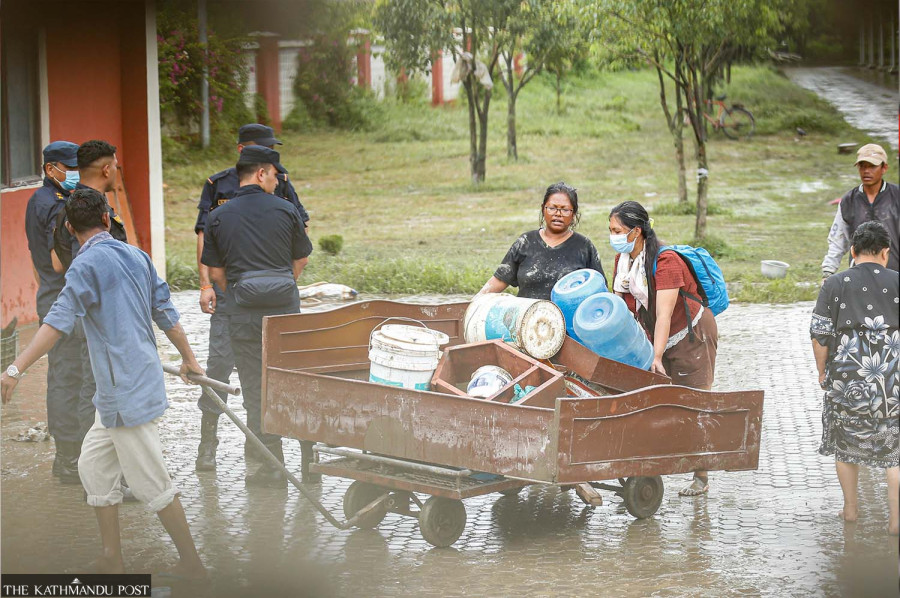
Squatters take out their belongings from their shelter at the deluged holding centre in Kirtipur, Kathmandu on Saturday. Dipesh Darshandhari/TKP
The government is currently preparing to transfer the remaining displaced families to the Nepal Electricity Authority training centre in Kharipati, Bhaktapur. Ojaswi Thapa, an official from the Prime Minister's Office who has been managing the disaster response on-site since 2:00 am, confirmed the plan. “We are working to coordinate immediate relief and are preparing to transport the families to a much more organised facility in Kharipati,” he said.
However, the displaced residents are strongly resisting the move to Bhaktapur. Punam Devi Paswan pointed out that her children are about to begin their school examinations. “If we move to Bhaktapur, their classes will be disrupted entirely,” she said.
Pradip Bista, the lawmaker elected from Kathmandu-10 as Rastriya Swatantra Party candidate, visited the shelter to reassure the families. “The government will take full responsibility for your welfare,” Bista told the displaced families. “There are schools available in Bhaktapur as well, and your children’s education will not suffer. Please board the vehicles; the arrangements in Kharipati are far better.”
Despite assurances from officials, residents remain skeptical. “Our children's education is already ruined,” said Anjali Paswan. “The government will simply evict us from Kharipati after a few months anyway.”
According to Bibek Bastola, personal secretary of Infrastructure Minister Sunil Lamsal, 154 individuals from 65 families were formally registered at the Kirtipur facility. Among them, 35 families accepted a cash grant of Rs25,000 provided by the government for voluntary self-management and left. However, 27 families refused to fill out the application forms.
“How can a family of seven or eight members manage to rent a house and survive on just Rs25,000?” said a displaced woman who refused the grant. “So we have not filled the form.”
Machakaji Maharjan, project chief of the High Powered Committee for Integrated Development of the Bagmati Civilisation, said that moving the remaining families to Kharipati is the only immediate alternative. “They were initially moved here because the riverbanks were dangerous,” Maharjan said. “Now that the monsoon has created problems here, Kharipati offers a secure environment until we find a long-term solution.”




 16.49°C Kathmandu