Joint security patrol steps up monitoring along Bajhang’s northern border
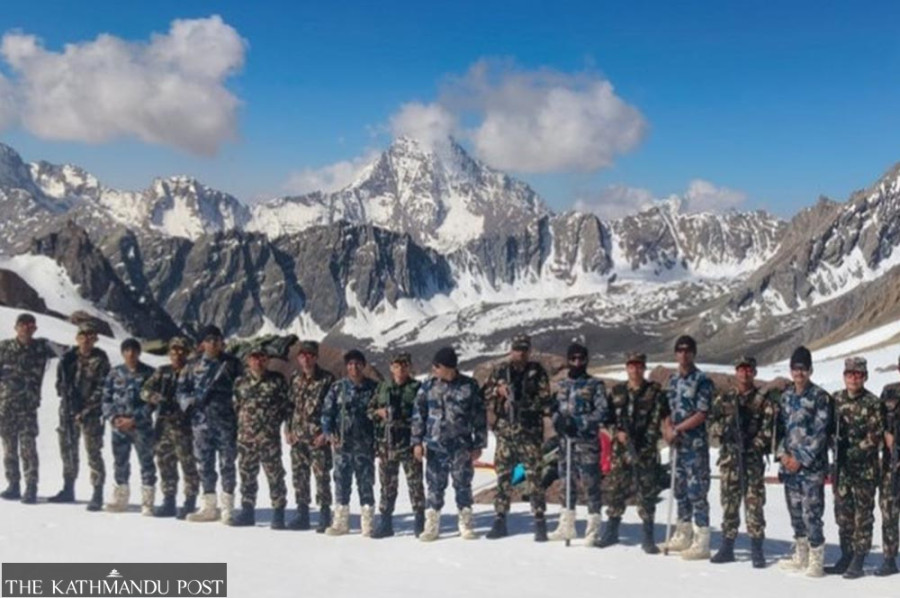
Eight-day patrol to the Nepal-China border found growing dissatisfaction among border residents over Chinese restrictions on grazing, cross-border trade and pilgrimages to Lake Mansarovar. Post Photo
A joint team of the Nepali Army and the Armed Police Force (APF) has conducted an eight-day patrol along the Nepal-China border in Bajhang district to monitor illegal cross-border activities and assess concerns raised by local communities.
The patrol covered Urai Bhanjyang, a border crossing long associated with the smuggling of medicinal herbs and wildlife parts, and reached Border Pillar No. 2 at an altitude of 5,220 metres.
The team comprised 20 Nepali Army personnel led by Captain Nirmal Kumar Khadka and nine APF personnel under APF Bajhang chief DSP Ujjwal Lamichhane.
According to Lamichhane, the patrol was part of routine border surveillance aimed at curbing illegal activities and strengthening the security presence in the remote northern region.
The team also visited villages across Saipal Rural Municipality, where security personnel met local residents and elected representatives to discuss issues affecting border communities. They conducted an anti-drug awareness programme at Dhuli Secondary School in Saipal Rural Municipality-4.
The patrol distributed food, medicines and oxygen cans to residents of Dhuli, the northernmost settlement in the district, and to herders at Kalanga near the border. It also organised a safety awareness programme for medicinal herb collectors at Igaldar and demonstrated a fire-response drill for local representatives, municipal staff and residents.
During the security team’s patrol, the local residents told the personnel that restrictions imposed by Chinese authorities had disrupted traditional grazing, cross-border trade and religious practices.
Lamichhane said locals complained that tighter controls at Urai Bhanjyang had prevented them from using a route traditionally used for the Bhot-Aul trade, seasonal grazing and pilgrimages.
“Locals said they have been unable to perform their ancestral deity worship because they cannot collect sacred water from Lake Mansarovar,” Lamichhane said. “We are working to facilitate a meeting with our counterparts across the border to discuss these concerns.”
Since China restricted access to Lake Mansarovar in Tibet after the Covid-19 pandemic, residents of Bajhang have been unable to carry out clan rituals that require water from the lake.
Herders also say they have stopped taking sheep, goats and chauris (yak-cattle hybrids) into Tibetan pastures during the monsoon after repeated restrictions and alleged mistreatment by Chinese security personnel.
Traditional clan worship in the area requires sacred water from Lake Mansarovar, making the restrictions particularly significant for local communities.
Mukesh Kumar Keshari, chief district officer of Bajhang, said the district administration has repeatedly raised concerns with Chinese border authorities but has yet to secure a resolution.
“Bilateral agreements between Nepal and China recognise the rights of border residents to continue traditional activities, including pilgrimages and grazing,” Keshari said. “The lack of regular bilateral dialogue has created serious difficulties for people living in this district.”
He said the Ministry of Foreign Affairs is coordinating a meeting later this month between officials from Bajhang and China’s Purang County in an effort to restore traditional cross-border movement.
“The date is almost finalised following coordination between the ministry and the Chinese Embassy,” Keshari said. “The objective is to restore border activities to the way they functioned before the pandemic.”
Meanwhile, an APF Border Outpost approved by the Ministry of Home Affairs for Urai Bhanjyang last year has yet to be established as the land has not been identified. The outpost is intended to curb the illegal trade in medicinal herbs, wildlife parts and other contraband.




 13.15°C Kathmandu