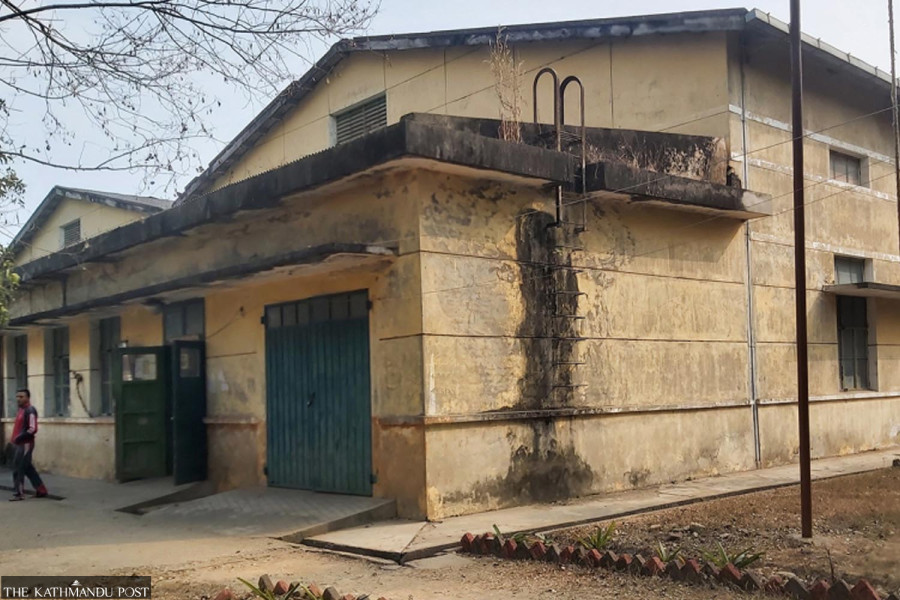
Army begins feasibility study as government explores restarting the defunct state-owned factory after 26 years. The government plans to first conduct trial production using existing machinery before deciding on further investment. Post file photo
The government is preparing to revive the Hetauda Textile Industry nearly three decades after it shut down, assigning the Nepali Army the responsibility of conducting a feasibility study and carrying out preliminary preparations.
The Ministry of Industry, Commerce and Supplies said preparatory work to restart the state-owned factory would begin soon. The government has included the revival plan in its 100-day roadmap, with work underway on preparing a study report, cleaning the premises and carrying out maintenance.
The ministry has already released funds requested by the Army for cleaning the factory, inspecting machinery and conducting trial production, according to joint secretary Netra Prasad Subedi, spokesperson for the ministry.
“An initial budget of Rs3.3 million has been provided for preparations,” Subedi said. “The Army has said it will assess the available resources, inspect the condition of the machinery and prepare a report on whether the factory can be brought back into operation.”
The government plans to first conduct trial production using existing machinery before deciding on further investment.
“If the old machines are functional, we will test production,” Subedi said. “Once that is successful, the long-term plan is to produce uniforms for the Nepali Army, Armed Police Force and Nepal Police.”
He said the trial production would provide a clearer picture of the factory’s viability.
“We can decide whether new machines are required and how the factory should operate after the trial production,” he said. “In the long run, we also have a plan to revive the Butwal Yarn Factory, promote cotton farming and develop an integrated textile industry.”
The government also aims to expand production beyond security agencies and supply uniforms and other textile products required by public institutions.
The Hetauda Textile Industry was previously considered for revival in 2008 during the tenure of then finance minister Baburam Bhattarai. At the time, the government had planned to produce clothing required by the security forces and civil servants domestically.
In 2015, the Nepali Army submitted a proposal to the government stating that it could operate the factory. A subsequent study concluded that the industry could be revived if modern machinery were installed, a reliable market secured and professional management introduced.
Established with financial and technical assistance from the Chinese government, Hetauda Textile Industry was one of Nepal’s earliest state-owned industrial ventures. It was established on August 1, 1975, and began commercial production on November 25, 1978. The factory was shut down completely on February 13, 2000.
The Army is currently studying the feasibility of restarting the factory and assessing the condition of existing machinery, said Brigadier General Rajaram Basnet, spokesperson for the Nepali Army.
“Our technical team is preparing a report after examining the machinery and assessing its textile production capacity,” Basnet said. “We will submit the report to the government as soon as possible.”
Although successive governments have included plans to revive the factory in annual budgets, efforts to restart operations have repeatedly stalled. The industry currently owns 166 ropanis (about 8.4 hectares) of land.
Garment industry representatives have welcomed the government’s move but stressed that private sector involvement would be necessary for long-term sustainability.
“The revival of a sick industry is a positive step. It can create jobs and boost industrial activity,” said Pashupati Dev Pandey, president of the Garment Association Nepal. “But private sector participation is essential if the industry is to succeed in the long run.”
Pandey said the government must also focus on developing domestic sources of raw materials.
“Plans to produce raw materials such as cotton and animal-based fibres should move forward alongside the factory’s revival,” he said. “Modern technologies that consume less electricity are now available, and adopting them can help reduce production costs.”
He also said the government should ensure market demand by replacing imports.
“If the factory is expected to produce millions of metres of fabric annually, there must be a clear plan for consumption,” Pandey said. “Apart from supplying the Army, police and other government agencies, the products must also reach civilian markets.”
During its initial years, the factory had an annual yarn production capacity of around 2,300 tonnes. When operated in three shifts, it could produce up to 11 million metres of fabric annually.
At its peak, the factory used domestically produced cotton and helped Nepal become self-sufficient in cotton textiles. When fully operational, it employed around 1,200 people.
According to a preliminary study conducted by the Nepali Army in 2023, the factory would need new machinery capable of producing around 2.6 million metres of fabric annually to meet the requirements of all security agencies. The study recommended operating the plant in two shifts daily.
The report estimated that machinery and plant equipment required for producing 2.6 million metres of fabric annually would cost around Rs700 million.
The revived factory could produce uniforms, shirts, trousers, bedsheets, blanket covers, aprons, daura-suruwal and other garments, according to the study.
The report estimated that around Rs250 million would be required for repairs and maintenance of factory buildings and perimeter walls, while plumbing and industrial pipelines would cost about Rs50 million. Including other expenses, annual operating costs, manpower and production expenses were estimated at Rs780 million.
The total investment required for revival was estimated at Rs1.93 billion.
“First, we need to know the current condition of the factory and the cost of operation,” Basnet said. “The Army is not going to operate the factory at this stage. It is only carrying out a technical assessment.”
Why Hetauda Textile Industry failed
After a successful start, the factory gradually fell into financial and operational trouble. Political interference increased, replacing professional management practices. The industry hired more employees than required, failed to control production costs and did not modernise its technology.
While global textile producers adopted newer technologies to manufacture cheaper and higher-quality fabrics, Hetauda Textile Industry continued to rely on outdated machinery. Problems with electricity supply, rising maintenance costs and a lack of fresh investment weakened its competitiveness.
As cheaper textiles from India, China and other countries flooded the Nepali market, the factory’s products became increasingly expensive. Administrative expenses grew faster than production, pushing the industry deeper into losses.
Despite repeated government attempts to keep it afloat through subsidies, the factory failed to recover and was finally shut down on February 13, 2000, after nearly two decades of operation.




 22.75°C Kathmandu