Seven sectors shrink in third quarter, dimming hopes of economic rebound
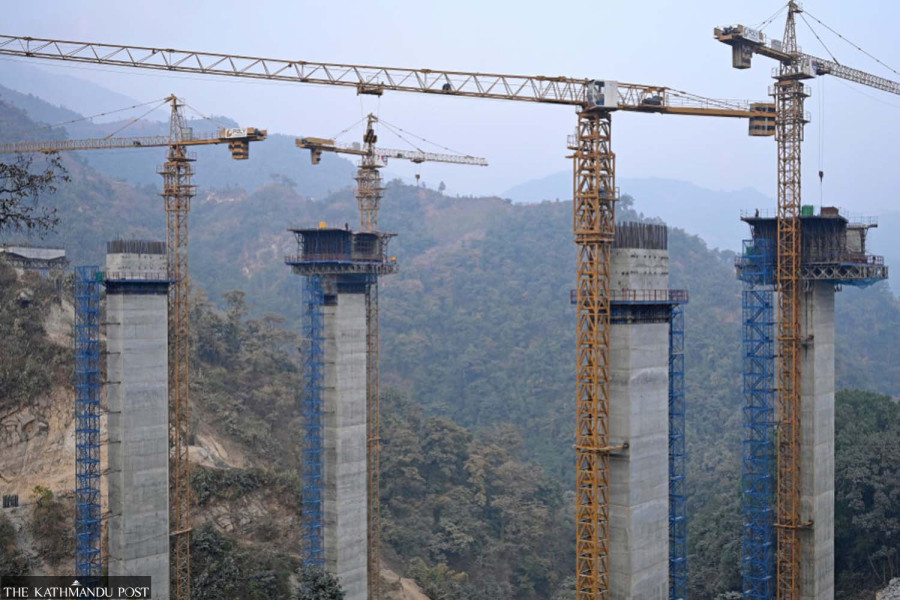
Sluggish agricultural output and a slump in construction materials weigh heavily on the latest economic performance indicators. Economists point to persistent political uncertainty and low capital expenditure following the post-protest transition as key factors dampening investor confidence. Post File Photo
The National Statistics Office says weak government spending, sluggish production and lower imports of machinery and construction materials have slowed economic activity, with annual growth projected at just 3.51 percent.
Despite expectations of a recovery in recent months, Nepal’s latest economic data show that momentum remains weak, with growth declining across seven major sectors in the third quarter of the current fiscal year.
According to a report released by the National Statistics Office on Monday, agriculture, manufacturing, accommodation and food services, information and communication, financial and insurance activities, education, and other services recorded negative growth in the third quarter compared with the previous quarter.
Economic activity grew by only 0.58 percent in the third quarter, covering the months of Magh, Falgun and Chaitra (mid-January to mid-April), compared with the second quarter covering Kartik, Mangsir and Poush (mid-November to mid-January). Growth in the third quarter of the previous fiscal year was higher at 0.92 percent.
Compared with the same quarter last year, Nepal’s economy is estimated to have expanded by 3.51 percent in the third quarter of the current fiscal year, according to the report. The growth was supported mainly by higher electricity generation and distribution, increased bank deposits and lending, growth in non-life insurance premiums, and expansion in trade-related services.
However, the pace remains slower than last year. The economy had expanded by 4.05 percent in the third quarter of the previous fiscal year.
Economists generally rely on year-on-year comparisons for assessing economic performance, as quarter-to-quarter comparisons can be affected by seasonal factors. But they say quarterly data still indicate the direction of economic activity.
“The quarterly accounts show that expected improvements have not taken place in several sectors of the economy,” said Dhundi Raj Lamichhane, deputy chief statistician and spokesperson at the NSO.
He attributed the weak performance to slower-than-expected agricultural growth, low government spending and a lack of significant growth in imports of machinery, equipment and industrial goods.
“The fact that seven sectors recorded negative growth compared with the previous quarter, while growth in many of the sectors that remained positive was modest, indicates that economic activity has not improved,” Lamichhane said. “Although annual comparisons provide a clearer picture, both annual and quarterly indicators show weakness in several areas.”
He said inadequate government expenditure had affected construction, manufacturing and related industries.
“On one hand, government spending has not increased. On the other hand, imports of construction materials have declined significantly, affecting the construction sector,” he said. “Although some sectors such as finance and transport have performed positively, growth has slowed in many others, showing that economic activity has not recovered as expected.”
The NSO report showed that 16 of Nepal’s 18 industrial classification sectors recorded positive growth in the third quarter compared with the same period last year. However, public administration and defence, as well as manufacturing, contracted.
The office said the overall growth rate remained modest due to a decline in imports of construction materials, lower paddy production and weaker domestic output of some goods.
Among major sectors, electricity and gas-related activities recorded the strongest annual growth, expanding by 24.88 percent in the third quarter compared with the same period last year. Financial and insurance activities, transport and storage, and wholesale and retail trade were estimated to have grown by 10.27 percent, 7.83 percent and 5.25 percent respectively.
Although paddy production declined, higher output of livestock, vegetables, fruits and forest products helped the agriculture, forestry and fishing sector maintain a positive contribution to the economy on a year-on-year basis.
Wholesale and retail trade, which accounts for the second-largest share of the economy, is estimated to have expanded by 5.25 percent year-on-year. The increase was driven by higher domestic production and imports of trade-related goods.
In contrast, public administration and defence is projected to contract by 1.59 percent, while manufacturing output is expected to decline by 0.54 percent year-on-year.
Ram Prasad Gyawali, head of the Central Department of Economics at Tribhuvan University, said economic activity had failed to improve not only compared with the previous quarter but also compared with the same period last year.
“Low capital expenditure and the inability of the manufacturing sector to recover remain Nepal’s fundamental structural problems. There has been no improvement in these areas,” he said. “The lower growth rate compared with last year also confirms that the economy has not strengthened.”
Gyawali said the new government would need to address long-standing structural problems to revive growth.
The NSO estimated that economic activity increased by only 0.58 percent in the third quarter compared with the second quarter of the current fiscal year. Of the 18 industrial classification sectors, 11 are projected to record positive quarterly growth, while seven are expected to contract.
Agriculture, forestry and fishing, which represents the largest share of the economy, contracted by 0.04 percent compared with the previous quarter. Wholesale and retail trade expanded by 2.02 percent.
Among the sectors showing positive quarterly growth, electricity and gas recorded the highest expansion at 6.87 percent, followed by mining and quarrying at 2.23 percent and wholesale and retail trade at 2.02 percent.
Meanwhile, accommodation and food services contracted by 2.30 percent, banking and insurance by 1.07 percent, and manufacturing by 0.83 percent compared with the previous quarter.
Economist Kalpana Khanal said political uncertainty, low capital spending and the transition following the Gen Z protests had prevented the economy from gaining momentum.
“The interim government had cut more than Rs100 billion from the budget. Capital expenditure was also low during that period,” she said. “The performance of the Rastriya Swatantra Party government, which came to power with nearly a two-thirds majority after elections held amid the Gen Z movement, remains to be seen.”
She said investor confidence had not improved during the period, limiting economic recovery.
The government had set a target of 6 percent economic growth for the current fiscal year, but the target is now unlikely to be achieved. The NSO’s preliminary projection made in May estimated growth at 3.65 percent at basic prices and 3.85 percent at consumer prices.




 14.81°C Kathmandu