Nepal bars political party members from school management committees
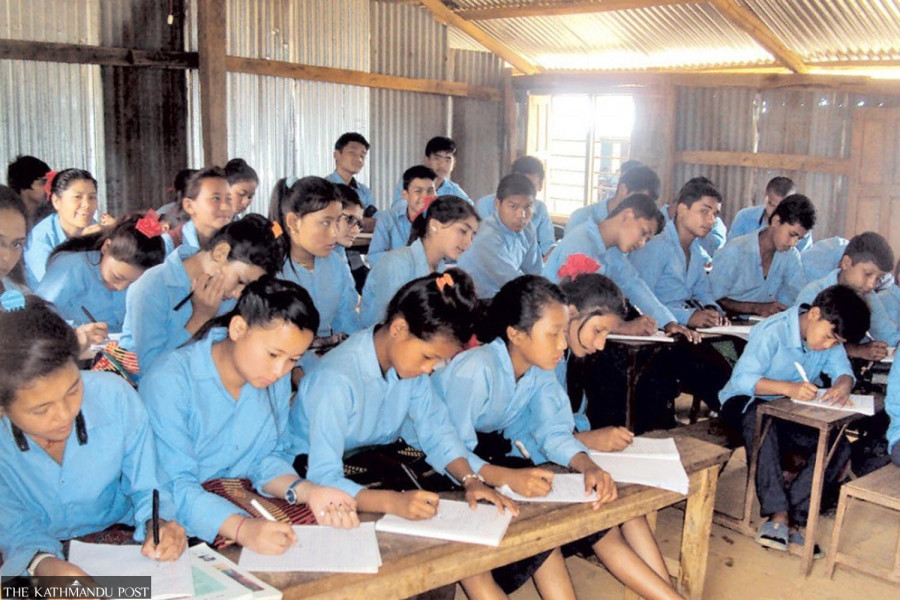
Revised education regulations expand local governments’ powers over schools, tighten teacher transfer rules, reform school governance and introduce stronger safeguards for students. Post File Photo
Nepal has barred members of political parties from serving on school management committees and handed local governments greater control over school administration under sweeping amendments to the Education Regulations approved by the Cabinet on Friday.
The revised regulations transfer key powers to local governments, including authority to approve new schools, authorise additional grades, regulate schools and appoint headteachers. They also introduce a new framework for teacher transfers, tighten eligibility for school management committees, strengthen protections for students and modernise several aspects of school administration.
The regulations will come into force after they are published in the Nepal Gazette.
Harish Prasad Bhatta, policy and legal adviser to Education and Sports Minister Sasmit Pokharel, said the amendments were introduced to address urgent problems while the government prepares a new Education Act.
“The Education Act will take time. We wanted to address immediate issues, implement the government’s governance reform agenda and comply with court orders,” Bhatta said. “The regulations are an interim measure. Our focus remains on introducing a new Education Act.”
Among the most significant changes is a restriction on teacher transfers. Permanent teachers must now complete at least three years of service at a school before becoming eligible for transfer, ending a long-criticised practice in which newly appointed teachers quickly sought postings closer to urban centres or their homes.
Basic-level classroom teachers may be transferred only to equivalent posts, while subject teachers may move only to vacant positions in their own subjects.
To improve transparency, schools must report vacant teaching posts to local governments and the federal Integrated Educational Management Information System (IEMIS) within seven days. Applications for transfers must be invited through online platforms or public notices.
The changes follow years of criticism that schools concealed vacancies and that political connections and administrative interference influenced transfers. Previously, teachers had to obtain approvals from multiple bodies, including schools, school management committees, local governments and Education Development and Coordination Units.
Pregnant teachers, teachers with disabilities and women with children under two years of age will receive priority in transfers.
Other teachers will compete under a 65-point evaluation system based on seniority, academic qualifications and professional training. Seniority accounts for 35 points, academic qualifications 20 and training ten.
Education expert Abhishek Ghimire said the mandatory three-year service requirement and transparent publication of vacancies would make transfers fairer. However, he criticised the government for amending regulations instead of introducing a long-promised Education Act despite commanding a near two-thirds majority in parliament.
The regulations also define transfer authority more clearly. Local governments will handle transfers within their jurisdictions, while transfers between local governments in the same district will require the consent of both local governments and will be processed by the Education Development and Coordination Unit. Teachers of the same level and subject may also exchange postings by mutual agreement, although they cannot seek another transfer for five years. Transfers involving headteachers will require approval from the concerned local government.
The Ministry of Education said the new system is designed to reduce irregularities and ensure transfers are based on institutional needs and qualifications rather than personal influence.
The amendments substantially expand the authority of local governments over school administration. They now have full responsibility for approving new schools, granting operating permission, approving additional grades and regulating schools, powers previously exercised by Education Development and Coordination Units, formerly District Education Offices.
Local governments have also been given responsibility for appointing headteachers. Previously, headteachers were appointed by school management committees.
To qualify, permanent teachers must hold at least a bachelor’s degree to lead a basic school and a master’s degree to head a secondary school. Earlier provisions allowed appointments largely on the basis of seniority.
Headteachers’ monthly allowances have also been increased. Headteachers at secondary schools will receive Rs3,000 a month, those at basic schools up to Grade 8 will receive Rs2,000 and those at basic schools up to Grade 5 will receive Rs1,000. Previously, the allowances ranged from Rs200 to Rs500.
Sudam Gautam, president of the Principals Association of Nepal, welcomed the amendments as a positive interim step but said broader issues such as teacher-post adjustment, teacher-student ratios, headteachers’ responsibilities and career development still require legislative reform through a new Education Act.
The regulations also seek to reduce political influence in school governance. Ward chairs, ward members, teachers and school employees will no longer be eligible to serve on school management committees.
Committee members must not have held membership of any political party during the previous five years.
Individuals convicted by courts of corruption, rape, human trafficking, arson, vandalism, drug trafficking, money laundering, illegal wildlife trafficking, organised crime, passport offences, caste discrimination and untouchability, kidnapping or other crimes involving moral turpitude will also be barred from serving on the committees.
School management committees will now be formed jointly by the local government’s education chief, a ward representative and the headteacher. Previously, schools themselves organised parent assemblies to constitute the committees.
The regulations formally recognise only two levels of school education: basic education, covering Grades 1 to 8, and secondary education, covering Grades 9 to 12. The previous classification into primary and lower secondary levels has been removed to align the regulations with Nepal’s constitutional school structure.
Combined winter and monsoon holidays have been reduced from 45 days to 30 days after concerns that additional public holidays, including Sunday closures, were reducing classroom teaching time. Schools must remain open for at least 220 instructional days each academic year.
The amendments also abolish deputation arrangements that allowed two representatives of theNepal Teachers' Federation to work at the Ministry of Education while retaining their teaching posts. Teachers may still receive temporary deputation, with approval from school management committees or local governments, to attend training programmes, seminars or official events.
The revised regulations also expand the criteria for merging schools. In addition to low enrolment and inadequate infrastructure, local governments may merge schools where improved road access, school bus services, residential or model schools, or declining population reduce the need for separate institutions. Schools within a 30-minute walking distance of each other, or reachable within 30 minutes by school bus, may also be merged. Schools with no enrolled students must be merged.
Financial requirements for establishing private schools have also been increased. New secondary schools must deposit Rs1 million as security, while basic schools must deposit Rs500,000. Previously, the required deposits ranged from Rs50,000 to Rs200,000.
The regulations also create permanent positions for special education teachers and provide a clearer legal framework for educating children with visual, hearing, intellectual and developmental disabilities, autism and severe physical disabilities. Nepal currently has 36 special schools, 380 resource classes and 36 integrated schools. Teachers already working in these institutions will be converted to permanent posts with the same service conditions and benefits as other permanent teachers, while future appointments will be made through the Teacher Service Commission.
New provisions also strengthen student protection by prohibiting any classroom practice that could harm students physically, psychologically or emotionally. Schools are barred from humiliating students, discriminating against them or imposing degrading punishments such as cutting their hair or forcing them to stand in the sun.
The regulations expand scholarship provisions by requiring that 20 percent of all scholarships provided by schools be awarded to talented athletes. Private schools must continue to reserve scholarships for students from poor, disadvantaged and academically deserving backgrounds.
The amendments also introduce an electronic pension system for teachers. The Department of Personal Records (Teacher) will issue digital pension certificates through an online portal, replacing a paper-based process that has long required retired teachers to travel repeatedly between district offices and Kathmandu. Teachers who have obtained permanent residency or Green Cards in foreign countries will no longer be eligible for government pensions.




 16.66°C Kathmandu