Minister’s actions kicked up a lot of dust in the education sector, clear picture yet to emerge
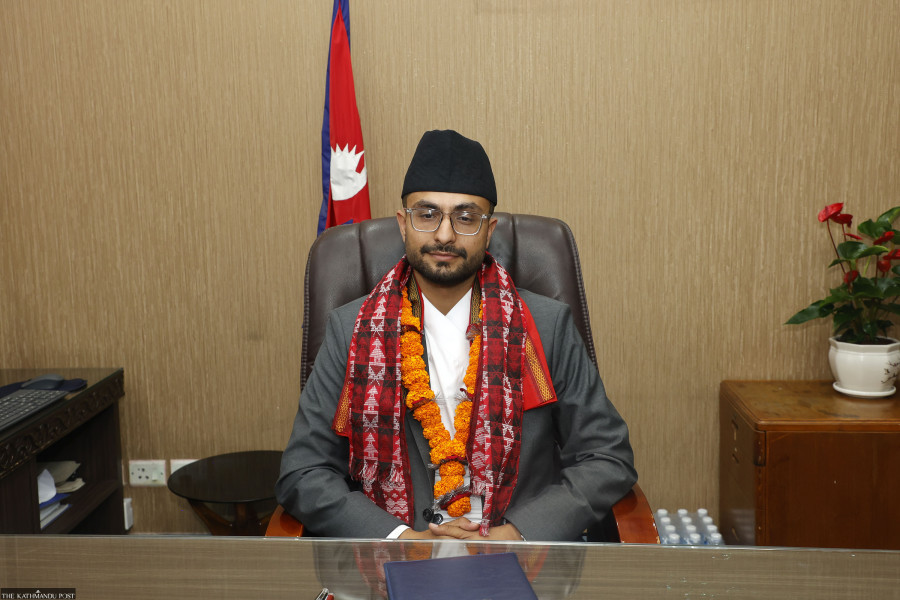
Sasmit Pokharel’s tenure has seen faster exam results, policy moves and curriculum reforms, but critics say weak coordination, contested decisions and limited progress on structural change marked his 100 days. Minister Pokharel has launched efforts to reform academic calendar and review curriculum. Post file photo
The first 100 days of Education and Sports Minister Sasmit Pokharel offer some early signs of reform while also serving as the first real test of his leadership.
The publication of the Secondary Education Examination and Grade 12 results earlier than usual, the launch of a curriculum review and the initiation of several policy reforms have been cited as notable achievements.
However, education stakeholders argue that the government has made little meaningful progress on long-term structural reforms, including legislation governing school and higher education, teacher management, university governance, federal coordination and broader improvements to the education system.
Pokharel, who also serves as the government spokesperson, has faced criticism over several decisions and public statements. Questions have been raised about his leadership and administrative competence. Critics say the ministry has prioritised crowd-pleasing announcements over the core agenda of education reform.
As a result, the minister’s first 100 days are increasingly being assessed less by what has been achieved and more by what they reveal about his leadership style, decision-making process and long-term vision for reforming Nepal’s education sector.
Stakeholders say the ministry should now shift its focus from headline-grabbing announcements to effective implementation, transparent decision-making and long-overdue structural reforms. While many believe it is too early to judge Pokharel’s tenure as either a success or a failure, they argue that his approach so far has favoured quick, visible outcomes over bigger institutional change.
Education experts say that in a sector as sensitive as education, the direction of reform matters more than the pace.
Pokharel, 31, was appointed minister on March 27. His first decision, banning “entrance preparation” and “bridge course” classes targeting students up to Grade 12, immediately sparked controversy. Since then, education stakeholders have accused him of making a series of hasty and poorly considered decisions without adequate consultation. Within 100 days, dissatisfaction has emerged across the sector.
It has also intensified over the recently published Grade 12 examination results, with thousands of students questioning the accuracy of the scores and demanding the minister’s resignation. While the government and the board have been praised for reducing the publication timeline from 70 to 90 days in previous years, the faster turnaround has raised concerns over the credibility of the evaluation process.
Supporters point to several accomplishments during his first 100 days, including education-related programmes announced in the national budget, initiatives aimed at systemic reform, the early publication of SEE and Grade 12 results, and the government’s commitment to establishing schools for children with autism in every province.
The minister has also launched efforts to reform the academic calendar and review the national curriculum.
His supporters have praised his decisions to abolish party-affiliated student organisations and dismiss office-bearers at universities and other educational institutions. However, many education stakeholders view these moves as rushed attempts to gain popularity rather than carefully planned reforms. They argue that the decisions have created uncertainty throughout the education administration.
Opposition parties, student organisations and elected leaders of Free Student Unions have opposed the government’s decisions. The legality of those decisions is currently under review by the Supreme Court.
According to the minister’s secretariat, work is also underway to bring foreign-affiliated colleges under a clearer legal framework, regulate educational consultancies and amend education regulations.
Diwakar Bhujel, an under-secretary at the minister’s secretariat, said the ministry had successfully implemented many governance reforms outlined in the government’s agenda, while several other initiatives were nearing completion.
He said the early publication of SEE and Grade 12 results had benefited hundreds of thousands of students and would help restore academic schedules across universities.
“The University Grants Commission will send the proposed academic calendar to universities. Admissions, examinations and results will now be completed on time. We have also instructed universities to publish examination results within two months,” he said.
Bhujel argued that the ministry had delivered significant achievements during the government’s first 100 days and said the completion of reforms already in progress would mark even greater success.
The ministry says it has advanced school and higher education bills, and begun reviewing the national curriculum while university vice-chancellors have been appointed through competition.
An expert committee led by Professor Bal Chandra Luitel has been formed to review the curriculum for Grades 1 to 12. The government has also announced that students up to Grade 5 will no longer sit formal examinations and will instead be assessed through continuous internal evaluation.
Education expert Tika Bhattarai argues that Pokharel has become embroiled in unnecessary controversies by focusing on issues that should not have been priorities.
Rather than attempting to defend mistakes made during his first 100 days, Bhattarai said, the minister must work harder to establish himself as a knowledgeable politician with a genuine understanding of education policy.
Officials within the ministry also describe Pokharel as someone who rarely consults colleagues or seeks professional advice before making decisions.
“Previously, there would be discussions before decisions were made. Now, instructions come first, and decisions follow,” said one ministry official, speaking on condition of anonymity. “The minister appears to have good intentions and a genuine desire to improve education, but so far his way of working has not been convincing.”
Bhattarai also questioned whether the government’s dismissal of university office-bearers appointed by previous administrations would simply be followed by appointments favouring individuals close to the ruling Rastriya Swatantra Party.
“The government removed office-bearers in line with the Rastriya Swatantra Party’s commitment to free education from partisan politics,” he said. “The real test is whether future appointments remain politically neutral or simply replace supporters of the old parties with supporters of the new one.”
For years, education experts have argued that universities should be insulated from political influence by ending the practice under which the prime minister serves as chancellor and the education minister as co-chancellor.
Instead, critics say, the government moved in the opposite direction by dismissing existing office-bearers while strengthening the authority of the prime minister in the role of chancellor.
On May 12, the government dismissed vice-chancellors at almost all universities, along with heads of autonomous educational institutions. More than six weeks later, seven universities, including Tribhuvan University, have only now received new vice chancellors.
In the meantime, before the new vice chancellors were appointed, their responsibilities were handed to officials whose appointments critics say lacked a legal basis. These included dismissed office-bearers, controllers of examinations, senior professors and administrative staff.
“At Purbanchal University, the dismissed vice-chancellor was effectively reappointed. At Kathmandu University, the controller of examinations was assigned the role of acting vice-chancellor. At Nepal Sanskrit University and Agriculture and Forestry University, senior professors were given the responsibility,” said an under-secretary at the Ministry of Education and Sports.
“Under the law, only a dean can be appointed acting vice-chancellor. These appointments violate the relevant university acts.”
Existing university legislation allows only a dean to assume the role of acting vice-chancellor.
The government has yet to appoint a chairperson to the National Examinations Board, a position that has remained vacant since before November 2025.
Pokharel has repeatedly been accused of failing to build trust and coordination with local governments. He might have deepened mistrust and conflict instead. Rather than working in collaboration with local authorities, critics say he has interfered in their jurisdictions, including the operation of the academic calendar, student enrolment, scholarships, fee regulation, oversight mechanisms, and even the introduction of a two-day weekend.
Bhattarai says the minister’s decisions reflect a Kathmandu-centric outlook that ignores schools in remote and rural areas. While Sunday holidays may suit urban centres such as Kathmandu, they are considered impractical in rural regions where schools often require more flexible scheduling due to seasonal agricultural demands and extended monsoon and winter breaks.
Local governments have expressed dissatisfaction, saying decisions on school operating days and curriculum adjustments were taken hastily without proper consultation. Some local units have even decided to keep schools open on Sundays despite the federal directive. Provincial and municipal associations also opposed the government’s decision to delay the academic session, which normally begins in the third week of April, by two weeks. Several local governments rejected the move and proceeded with enrolment and classes before the revised schedule took effect.
“Issuing directives without coordination with local governments has created unnecessary conflict,” Bhattarai said.
The minister also announced action against schools charging excessive fees. However, a helpline set up to address complaints received more than 5,000 cases, none of which were effectively resolved. As pressure from private schools increased, complaints were redirected to local governments on the grounds that enforcement falls under their jurisdiction. Parents say the ministry failed to provide coordination or facilitation in resolving these issues.
Bhattarai adds that the budget introduced several promising initiatives aimed at systemic reform and ecosystem development in education, but implementation has remained weak. He stressed the need to focus on execution rather than announcements.
A 3 percent tax on private schools introduced through the budget has received mixed reactions. Critics argue that it could widen inequality in education and increase the financial burden on parents. Overall, Bhattarai says the minister has remained preoccupied with minor issues over the past three months, failing to meet expectations.
“There is enough ground to question the minister’s performance,” Bhattarai said. “If such questions begin to arise within his own party, it could create further uncertainty.”
He also alleged that the minister has failed to make progress on major reforms such as teacher management, school governance, and long-delayed higher education legislation.
Instead of replacing the Education Act 1971, the ministry has focused on amending the Education Regulations 2002 for a tenth time. The government is currently seeking approval from the Ministry of Finance and the Ministry of Law for these changes. The secretariat said the revision also aims to bring foreign-affiliated colleges, which have operated without a clear legal framework since 2002, under regulation.
On May 24, addressing a public hearing in his federal constituency of Kathmandu–5, lawmaker Pokharel said growing complaints about foreign-affiliated colleges had prompted the move to regulate their operations here.
Until now, these institutions had been operating under directives rather than a formal legal framework. However, education experts argue that such institutions should be governed under a higher education act and brought under the University Grants Commission rather than directly controlled by the ministry.
According to the ministry, consultancy firms involved in educational counselling are also being brought under a legal regulatory framework.
Gen Z activist Monica Niraula said that while the education minister has initiated some notable measures, his overall working style remains unsatisfactory.
“It is still unclear whether his capacity is weak or his intent questionable. For both the education minister and government spokesperson roles, he appears inexperienced. There have even been instances where the government’s position seemed to involve covering up or misrepresenting facts,” she said.
She also said the minister has failed to ensure education for children displaced from informal settlements. “Many children who lived in squatter settlements have been unable to enrol in schools. The minister has shown little seriousness about it. This has effectively pushed children’s futures into uncertainty,” she said.
However, Niraula praised the decision to establish schools for children with autism in all provinces. “This has been announced in the budget. The focus now should be on its implementation,” she said.
SEE and Grade 12 results previously took between 70 and 90 days to become public. At Minister Pokharel’s directive, the National Examination Board published SEE results within 30 days of conducting exams. Grade 12 results were published in 40 days this year.
However, when applications for re-evaluation were processed, more than 5 percent of results came out altered. In Grade 12 alone, 32,000 students applied for rechecking. Following concerns by students over the credibility of the results, the minister formed an investigation committee comprising under-secretaries from the ministry and the Curriculum Development Centre.
Following the dismissal of university office-bearers, the minister was involved in the process of appointing their replacements. While Gen Z activists criticised the move, education experts have questioned the legitimacy of new appointments as a repetition of the same old process. The minister coordinates most of the selection and recommendation committees for vice-chancellor appointments.
“University appointments have not been transparent. There is no guarantee that politically affiliated individuals will not again be appointed again. It appears to be a replacement of old loyalists with new ones,” said Niraula.
On March 30, Minister Pokharel announced a ban on bridge courses and entrance preparation classes. When the decision became controversial, the ministry clarified that the restriction applied only to students who had taken the SEE and were enrolling in Grade 11. Coaching centres for MBBS, engineering and other higher education programmes went unaffected. The decision was eventually removed from the ministry’s website.




 12.64°C Kathmandu