NEA directs hydropower projects to cut output amid monsoon surplus and transmission constraints
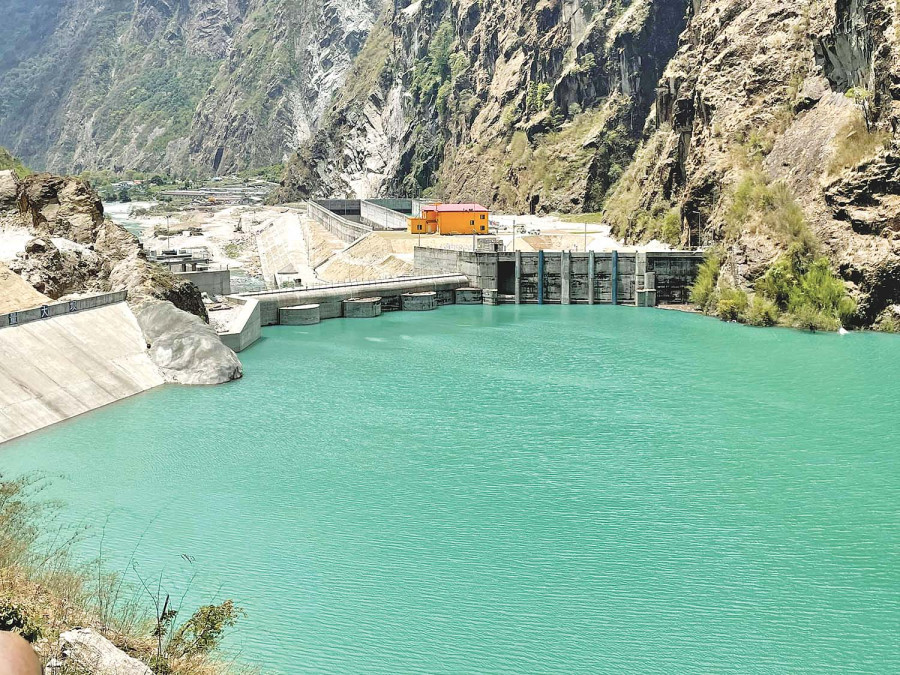
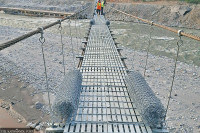
Rising river flows have pushed generation beyond domestic demand, forcing the power utility to curtail production as transmission bottlenecks and limited export capacity strain the grid. Photo: Courtesy of Upper Tamakoshi Hydropower Project
As water levels in rivers and streams rise with the onset of monsoon, Nepal’s hydropower generation has once again exceeded domestic demand, and the Nepal Electricity Authority (NEA) has instructed developers to reduce output.
The Load Dispatch Centre under the NEA has begun issuing regular curtailment instructions to hydropower projects, especially those classified under the “contingency” category, as surplus electricity builds up in the system. The practice is routine during the rainy season, when generation rises sharply but consumption remains relatively stable.
Hydropower developer Sujan Poudel said the instructions began arriving in late May and have continued into early monsoon weeks, with no fixed schedule.
“Sometimes we are asked to operate for four to five hours, sometimes for eight hours, and at times we are allowed full operation,” Poudel said. “Projects in contingency are always the first to be restricted.”
The pattern shows a structural mismatch in Nepal’s power system, where rapid growth in generation capacity has outpaced both transmission infrastructure and domestic consumption growth.
During the monsoon months, hydropower plants across the country operate near peak capacity due to increased water flow. While this boosts national generation, it also creates operational pressure for the grid operator, which must balance supply with limited demand and constrained export capacity.
NEA officials say the system enters a surplus phase during off-peak hours almost every monsoon season. However, the scale of surplus has increased in recent years as the total installed capacity has expanded rapidly.
Independent Power Producers’ Association, Nepal (IPPAN) president Mohan Dangi said the current situation reflects both progress and structural bottlenecks in equal measure.
“Nepal’s peak demand is around 2,200 MW,” Dangi said. “Even after exporting roughly 1,200 MW to India and Bangladesh, total demand reaches about 3,400 MW. But installed capacity has already reached around 4,300 MW.”
He said this creates a situation where nearly 900 MW of electricity may not be absorbed at certain times, particularly during high-flow monsoon periods.
“As soon as generation exceeds consumption, contingency projects are the first to have their output cut,” he said.
The NEA, however, does not describe the situation as “wastage”. It argues that surplus energy is managed within the system through load balancing, export scheduling and reserve management.
What ‘contingency’ means in practice
The NEA classifies hydropower projects under ‘contingency’ when they cannot be fully integrated into the grid due to transmission constraints, substation limitations or line capacity issues.
These projects are technically complete and capable of generation, but are prevented from operating at full capacity because the grid cannot evacuate their electricity consistently.
IPPAN says more than 30 hydropower projects are currently under this category. Dangi said the number fluctuates depending on seasonal demand, transmission availability and grid upgrades.
“My own 7.5 MW Upper Khorunga Khola Small Hydropower Project has been in contingency for seven years,” Dangi said. “There are many such projects. The exact number changes, but until recently there were around 30 to 32 projects in this status.”
For developers, contingency status directly affects revenue stability. Plants are forced to operate below capacity, sometimes unpredictably, depending on instructions issued by the Load Despatch Centre.
This creates cash flow uncertainty, particularly for projects that have already completed construction and are servicing bank loans.
NEA’s acting Managing Director, Dirghayu Kumar Shrestha, said the current surplus is a normal seasonal feature, but acknowledged increasing pressure on the system due to rising generation capacity.
He said installed capacity is about 4,300 MW, while actual generation during monsoon hours can reach around 4,100 MW.
“Internal consumption and exports account for about 3,200 MW,” Shrestha said. “During the monsoon, floods and landslides can also force shutdowns of projects generating 300 to 400 MW.”
He added that around 500 MW is effectively managed as reserve capacity to maintain grid stability during fluctuations.
“There is a surplus during off-peak hours, but it is managed within system limits,” he said.
The NEA maintains that curtailment does not necessarily mean energy is wasted. Instead, it is part of system balancing, ensuring frequency stability and avoiding overloading transmission lines.
However, developers argue that repeated curtailment still translates into lost revenue and underutilisation of national resources.
The financial structure governing hydropower projects is based on power purchase agreements (PPAs), which define obligations for both developers and the NEA.
Under standard agreements, developers must pay a five percent penalty if they fail to complete projects on time. Similarly, the NEA is liable for penalties if the transmission infrastructure is not ready to evacuate power.
Developers, however, say the compensation mechanism does not adequately compensate them for their financial losses.
“When a project is ready, but transmission is not, we still have to pay bank interest,” developers said. “The five percent compensation from the NEA does not even cover interest payments.”
As a result, many projects are forced into “take and pay” arrangements under contingency conditions, where full output is not purchased, and energy is effectively curtailed.
Developers argue that this structure places disproportionate financial risk on independent power producers, particularly smaller projects with limited financial buffers.
Despite the rapid rise in generation capacity, transmission infrastructure continues to lag, leaving multiple hydropower corridors bottlenecked.
Developers and NEA officials agree that transmission constraints are the single most important factor behind contingency status and curtailment.
In the Gorkha area, the delay in the construction of the Malekhu–Dhading 33 kV double-circuit transmission line had long affected several projects, including Ankhukhola-1, Richet Hydro, Bikas Hydro and Upper Richet Hydro. These plants collectively generate around 20 MW.
Previously, these projects supplied electricity to the Devighat substation via Dhading, but were unable to operate at full capacity due to line limitations and grid congestion.
Ankhukhola Hydropower acting chief executive officer Pratiksha Sharma said the situation has improved after the transmission line came into operation.
“Since mid-July last year, we have been able to generate at full capacity when water flow is favourable,” Sharma said. “The transmission constraint has largely been resolved for us.”
However, she added that issues remain in the downstream infrastructure leading to Devighat, which still requires strengthening to ensure stable evacuation.
In the Marsyangdi corridor, transmission constraints had similarly placed several projects, including Dordi-1, Upper Dordi ‘A’, Chepe Khola, Dordi Khola, Super Dordi and Nyadi Khola, under contingency for extended periods.
The NEA has announced that the 220 kV Markichowk–Bharatpur transmission line will undergo testing and begin operation next week. Officials expect this to significantly reduce congestion in the corridor.
Private sector involvement in transmission projects
The 28-kilometre section of the Markichowk–Bharatpur 220 kV line was completed in 18 months through private sector participation after earlier delays.
Seven hydropower companies jointly financed the project after it was handed over for execution following years of slow progress under NEA management.
IPPAN senior vice-president Uttam Blon Lama said this demonstrates the private sector’s capacity to contribute beyond generation.
However, he cautioned that improved transmission alone will not eliminate surplus electricity challenges.
Even with additional evacuation capacity, overall system balance depends on demand growth and export expansion.
“Transmission improvements reduce congestion, but low domestic consumption can still lead to a surplus situation,” he said.
Load reduction orders are not limited to contingency projects. Several plants outside this category also face periodic curtailment based on system demand and grid conditions.
The Middle Modi project has experienced intermittent load reductions.
“We are asked to reduce output when demand falls or there are grid issues,” said developer Pratap Kharel.
Similarly, Guru Prasad Neupane, developer of the 25 MW Kabeli B-1 project, said transmission limitations continue to affect even fully operational plants.
“Our project is not in contingency, but we are still instructed to reduce generation due to transmission capacity limits,” Neupane said.
He said such instructions have been recurring annually, particularly during peak monsoon inflows.
For the 54 MW Super Dordi project, curtailment began as early as May this year.
“Our project is in contingency, and the NEA has been reducing our load since late May,” said Arjun Prasad Gautam. “Once the transmission line becomes fully operational, we expect to move to a take-or-pay arrangement.” Under this arrangement, the NEA must pay projects for a minimum agreed amount of electricity, whether or not it takes delivery.
The Markichowk–Bharatpur transmission line project also highlights changing execution models in Nepal’s energy sector.
After years of delays, the project was transferred to private developers, who completed the remaining section within 18 months. Seven hydropower companies pooled their investment to complete construction.
The experience has been cited by industry stakeholders as evidence of private sector efficiency in infrastructure development, particularly in technically complex and time-sensitive projects.
Calls for power trading reforms
IPPAN has argued that Nepal’s surplus electricity problem could be eased if private sector participation in cross-border electricity trading were permitted.
The association has already signed an agreement with India’s Manikaran Power Limited for the potential export of up to 2,500 MW.
“If we had a trading licence, we would already be selling electricity,” IPPAN President Dangi said. “The NEA alone is handling limited export capacity, so the private sector should also be allowed to trade.”
He warned that as more projects come online, surplus management will become increasingly difficult unless export capacity expands.
“If generation reaches 5,300 to 5,400 MW next year, how will the NEA manage it alone?” he said.
Nepal currently has approval to export up to 1,200 MW of electricity to India and Bangladesh. However, long-term export expansion depends heavily on completion of the 400 kV Hetauda–Dhalkebar–Inaruwa transmission line.
The 288-kilometre project, initiated in 2012, has faced repeated delays due to land acquisition and compensation disputes, particularly in the Hatiya area of Hetauda.
While the 154-kilometre Dhalkebar–Inaruwa section has been operational for three years, the Hetauda–Dhalkebar segment has progressed slowly.
NEA officials said construction has now accelerated, with only two towers remaining in the Hetauda section. Project chief Shyam Yadav said progress is now steady.
“Work is moving forward quickly. Once completed, this line will make it much easier to export electricity from the Kaligandaki and Marsyangdi corridors to India, and import power during the dry season,” Yadav said.
Earlier, NEA’s acting Managing Director Shrestha warned that delays in completing the transmission line could lead to the spillage of around 800 MW of monsoon electricity, potentially costing the economy billions of rupees.
He said completion of the line would significantly improve export reliability and reduce the risk of surplus energy going unused during peak monsoon generation periods.




 14.4°C Kathmandu