The 139.5 MW Lower Manang Marsyangdi Hydropower Project obtained its production licence in 2018. Its Power Purchase Agreement (PPA) was signed in 2023, according to the Department of Electricity Development. However, the promoter, Butwal Power Company, has not yet been able to secure the investment needed to begin construction.
Uttar Kumar Shrestha, chief executive officer of the company, said the project is currently in the process of financial closure in accordance with the approval of the department.
"We will complete the financial closure [the process of securing funds] this year. We are still within the permitted timeline," he said.
Promoters say there is a regulatory provision allowing up to five years after receiving a production licence to secure investments. However, Section 14 of the Directives on Licensing of Hydropower Projects-2018 states that electricity production licences can be issued on the condition that both the PPA and financial closure are completed within two years.
Sub-section 1 of Section 16 of the directive mentions that if financial closure cannot be completed within the designated two years, and the promoter submits an application prior to the expiration of the deadline, an extension of an additional one year can be granted based on necessity and justification. If the work is still not completed within that period, an additional extension of up to two years can be granted based on the promoter's efforts and progress. However, it is also specified that the promoter must deposit an amount equivalent to the capacity royalty of the project's installed capacity at a rate of Rs100 per kilowatt per year.
Furthermore, the same sub-section states that for projects with a capacity exceeding 100 MW may be granted up to two additional years under special provisions. Whether it takes place before or after the PPA, the financial closure period is calculated from the date the licence is issued.
Similar to the Lower Manang Marsyangdi, financial closure has also stalled for the 440 MW Tila-1 and 420 MW Tila-2 hydropower projects. Both projects received their licences in 2018 and completed their PPAs in 2024, yet financial closure remains incomplete. According to the Licence Performance Dashboard of the department, 20 companies with combined capacity of 1,651.44 MW have failed to achieve financial closure (or secure investment) despite obtaining production licences and signing PPAs.
According to the department’s figures, some projects remain unable to raise investment even after concluding their PPAs. The PPA for the 9.14 MW Super Ghalemdi Hydropower Project was signed in 2018. It secured its production licence in 2023, but has not yet secured investment.
The 5 MW Seplikhola Hydropower Project obtained its production licence in 2021 and had its PPA signed a year earlier, in 2020. However, the project has yet to achieve financial closure. The 63 MW Chhujung Khola Hydropower Project concluded its PPA in 2022 and subsequently obtained its production licence, but due to the inability to raise investment, its physical progress stands at zero percent.
Energy Minister Biraj Bhakta Shrestha directed the establishment of a publicly accessible Licence Performance Dashboard to be updated on a monthly basis, according to the department. The dashboard is required to include project-wise milestone progress, compliance status, and details of regulatory actions. While the Ministry of Energy directed monthly updates, the department noted that details are being updated based on the progress reports submitted by the promoters.
The government has pointed out that progress on 108 hydropower and solar energy projects that received production licences is unsatisfactory. Out of 274 total projects that received production licences, 178 projects have a physical progress of less than 25 percent, the department stated. There are 65 projects with progress between 25 and 80 percent, and only 32 projects have crossed the 80 percent completion mark.
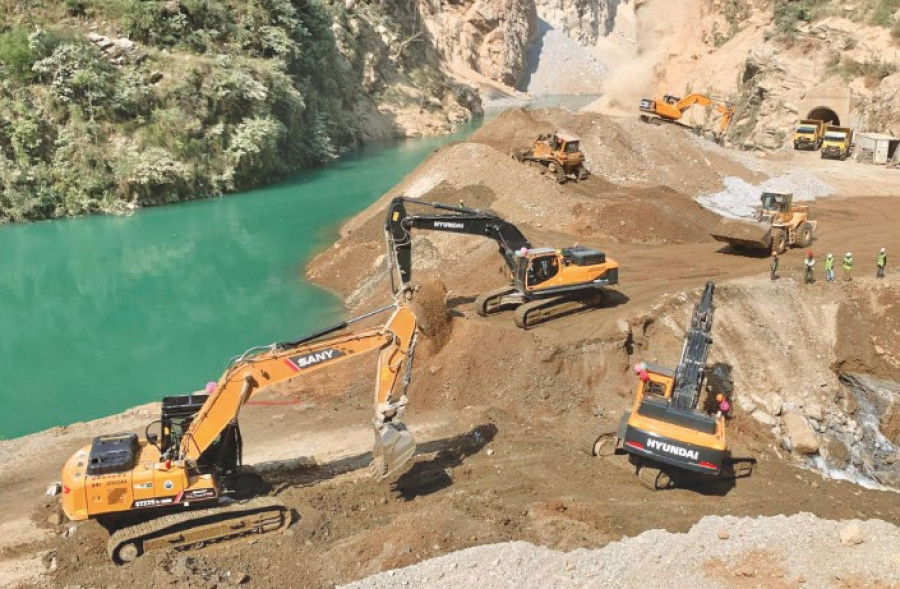
Reasons for unsatisfactory physical progress include poor management capacity among project promoters, delays in transmission line and substation development, court disputes, absence of cascade agreements for related projects, submergence issues (reservoir-based projects), delays in access road construction, forest clearance, land acquisition, securing right-of-way, and tree felling, as well as restrictions in protected areas and national parks, and various other factors.
Among the projects with unsatisfactory progress in construction, 42 projects have a capacity up to 10 MW, another 42 projects between 11 and 50 MW, 10 between 51 and 100 MW, and 14 hydropower projects above 100 MW.
Projects with poor progress also include the Upper Modi ‘A’ Hydropower Project of a Nepal Electricity Authority subsidiary, whose construction progress stands at just nine percent. The Upper Modi Hydropower Cascade Project has completed just 0.5 percent of construction, while the Tamakoshi V Hydropower Project, promoted by another subsidiary of the authority, has recorded only 5.2 percent of physical (construction) progress.
The 120 MW Rasuwa Bhotekoshi Hydropower Project, being developed by a company led by former energy minister Deepak Khadka in partnership with a Chinese company, has also not shown satisfactory progress. Its physical progress stands at 27 percent.
Badri Kuinkel, spokesperson for the Department of Electricity Development, said the physical progress figures are based on submissions made by promoters up to mid-January. “We have updated the physical progress submitted by promoters. Financial closure data has been updated based on information received up to mid-June.”
Meanwhile, the Nepal Electricity Authority issued a notice on June 20, instructing projects that have signed power purchase agreements (PPAs) to submit their progress reports within seven days. The notice states that if progress reports are not submitted to the Power Trade Department, action will be initiated. Hydropower and solar projects are required to submit progress reports to the authority at least every four months.
Prakash Chandra Duwal, vice-president of the Independent Power Producers’ Association Nepal, said developers are allowed up to five years to complete financial closure after obtaining production licences, including extensions with capacity royalty payments. He said projects are initially given two years to complete either PPA or financial closure, with a possible one-year extension, followed by an additional two years on payment of capacity royalty.
He said projects within these timelines cannot be labelled as unsatisfactory solely on their progress status. According to him, financial closure and preparation can take an additional two to three years, making a total project development period of seven to eight years typical, while large projects may take up to ten years. He added that delays in tree felling, local obstruction and transmission line construction also contribute to slow physical progress.




 13.77°C Kathmandu