Buddhism studies drawing international students to Kathmandu
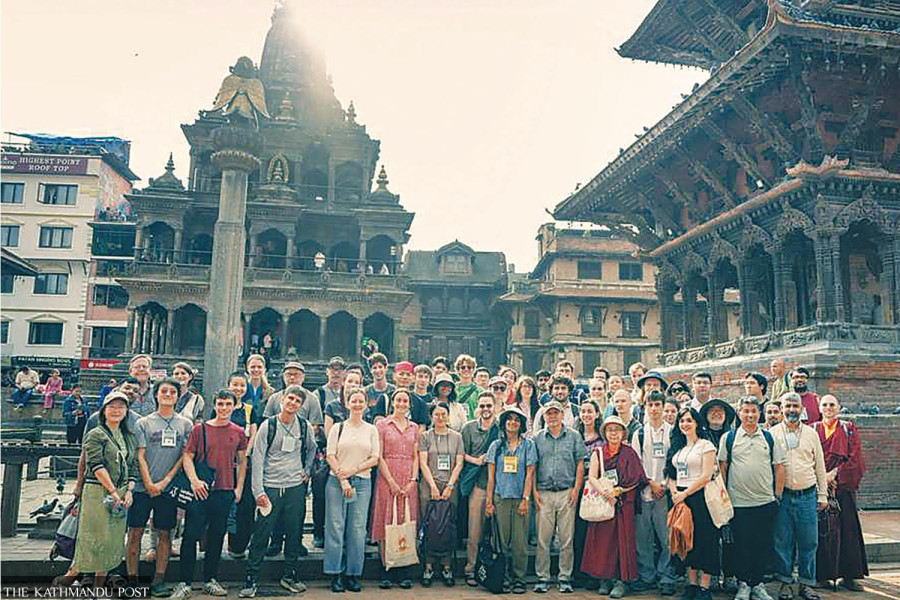
Foreign students are travelling thousands of miles to study Buddhism in Kathmandu, turning the national capital into a global centre of learning. Students from the Kathmandu University Centre for Buddhist Studies housed in the Rangjung Yeshe Institute, Bauddha, visit Patan Durbar Square. Post Photo
In Bauddha, Vera Hogg sits cross-legged on the floor of a monastery classroom, eyes closed.
Outside, monks in crimson robes hurry across the courtyard of Ka-Nying Shedrub Ling Monastery as pilgrims circle the nearby Bauddhanath Stupa, spinning prayer wheels beneath strings of prayer flags.
As bells chime in the distance, the room falls silent, and a Buddhist monk begins the day’s first lesson with meditation. Speaking in Tibetan, he pauses every few sentences for a translator to relay his words into English. Around Hogg, students from the United States, Germany, China, and Nepal sit quietly, following instructions passed down through Buddhist monastic traditions for centuries.
Only after meditation do the lectures begin. History is taught by a Canadian anthropologist, philosophy by Buddhist monks. By noon, students spill back into the monastery courtyard.
For Hogg, this has become an ordinary school day.
The 20-year-old dance and religious studies major from New York attends college in Ohio, where she has spent most of her degree studying Christianity. While the religion is not her primary academic interest, Hogg told the Post that her department offers only a few Buddhism courses, and that she has not been able to take any yet.
“I wanted to learn about the practice of a religion that I don’t know much about,” she said.
Searching for a summer study abroad opportunity, she came across the Kathmandu University Centre for Buddhist Studies at Rangjung Yeshe Institute (RYI), which offers intensive summer courses alongside its bachelor’s, master’s, and doctoral programmes. Hogg signed up right away.
While she expected to spend several weeks studying Buddhist philosophy before returning to the United States, she did not expect to find an entire community of students who had travelled halfway across the world for the same reason.
“I've been really surprised by how many American and international college students I’ve met here,” she said. "Not only at RYI, but just around Kathmandu.”
For decades, Nepal’s higher education story has been defined by departure. Every year, tens of thousands of Nepali students leave the country for universities in Australia, India, Britain, the United States, and elsewhere in search of degrees and opportunities unavailable at home.
But another, much smaller educational migration is moving in the opposite direction.
Every year, hundreds of international students travel to Kathmandu not to study engineering, medicine, or business, but Buddhism.
Some enroll in short summer intensive courses before transferring credits back to universities abroad. Others stay for semester exchanges. Many commit to full bachelor’s, master’s, and doctoral degrees in Buddhist philosophy, translation, and philology, with courses of Sanskrit, classical Tibetan, and contemplative studies, drawn by the opportunity to immerse themselves in one of the world’s oldest living Buddhist traditions. These international scholars are part of a wave of growing interest that is transforming Kathmandu into one of the world's leading destinations for Buddhist higher education.
Much of that transformation is taking place at the RYI located in Bauddha. Founded 30 years ago, the institute began as a small gathering of students who wanted to study under the Tibetan Buddhist teacher Chökyi Nyima Rinpoche. Its founders soon realised that if Buddhist education was to gain international credibility, it needed to exist within a university framework.
There are 169 students from 40 countries currently enrolled at Rangjung Yeshe Institute. Photo: Courtesy of Rangjung Yeshe Institute
In 2002, the institute formally partnered with Kathmandu University to establish the Centre for Buddhist Studies. At the time, there were just 36 students. Today, there are 169 students enrolled across its accredited degree programmes, with roughly another hundred taking summer intensive courses each year. Students now come from more than 40 countries, making it one of the most internationally diverse Buddhist studies institutions in the world.
“It took quite some years to gain an international reputation,” said Julia Stenzel, Director of Studies at the Kathmandu University Centre for Buddhist Studies. “Once students graduated from here and professors at universities abroad saw the level of education they had received, the word spread.”
Many graduates have gone on to pursue doctoral degrees at institutions including Harvard, Stanford, Berkeley, Hamburg, and Cambridge. Others have become translators for major international Buddhist projects, helping make ancient texts accessible to new generations of readers.
Yet Stenzel believes the institute’s draw cannot be explained by academic outcomes alone. “There is a richness here in Kathmandu that you cannot emulate anywhere else in the world,” she said.
Unlike most Buddhist studies departments in Europe and North America, where Buddhism is primarily encountered through translated texts and academic analysis, students in Kathmandu study philosophy with monks trained in centuries-old scholastic traditions, learn classical Tibetan and Sanskrit to read original texts, conduct research inside living Buddhist communities, and spend every day on the grounds of an active monastery.
“It actually makes more sense to study Buddhist studies here than in the West,” Stenzel said. “In the West, everything is usually done through books.”
That philosophy shapes every aspect of the institute. Rather than asking students to analyse Buddhist thought from a distance, classes encourage them to become what the institute calls “scholar-practitioners”—people who combine rigorous academic research with direct engagement in the traditions they study.
“Unlike Western academia, where people often study simply for the sake of knowledge, our students study wisdom traditions for personal growth,” Stenzel said. “The majority come not only for a degree. They also come because they want to understand themselves.”
The institute's approach differs from many Buddhist studies programmes overseas because it deliberately combines three traditions that rarely exist under one roof.
Students receive a traditional philosophical education from Acharya scholars trained in Buddhist monastic colleges, intensive language instruction in classical Tibetan and Sanskrit so they can work directly with primary texts, and a Western-style academic education that encourages historical analysis and inquiry.
“Sometimes those perspectives clash,” Stenzel said. “Students ask, ‘How much do you believe? How much do you question?’ That makes the classes rich.”
Language learning is also seen as more than a practical skill. Students quickly discover that mastering classical Tibetan or Sanskrit requires understanding the philosophical concepts embedded within them.
“A lot of students in our translation programme come first for the language,” Stenzel said. “But they realise very quickly that you have to study the philosophy in parallel to understand what the texts are saying.”
The emphasis on original source material has also helped distinguish the institute internationally. Master's students are expected to conduct original research, while students in the translation and philology programme work with texts that have never before been translated into English. Much of the institute's research also contributes to projects such as the “84000” initiative, a global effort to translate the Tibetan Buddhist canon into modern languages.
The result, Stenzel said, is that many graduates begin conducting research at a level usually expected only of doctoral students elsewhere.
For Hogg, the difference became clear almost immediately. She said the education she receives in Kathmandu bears little resemblance to a conventional university lecture.
One hour, she is comparing anthropological interpretations of Buddhist communities. Next, she is listening to monks explain philosophical concepts that have traditionally been transmitted through generations of oral teaching.
“I think it's a very valuable setup,” she said. “Everyone is thinking critically, and it’s really interesting to compare these different ways of learning.”
Yet, academic achievement is only one reason students make the journey to Kathmandu.
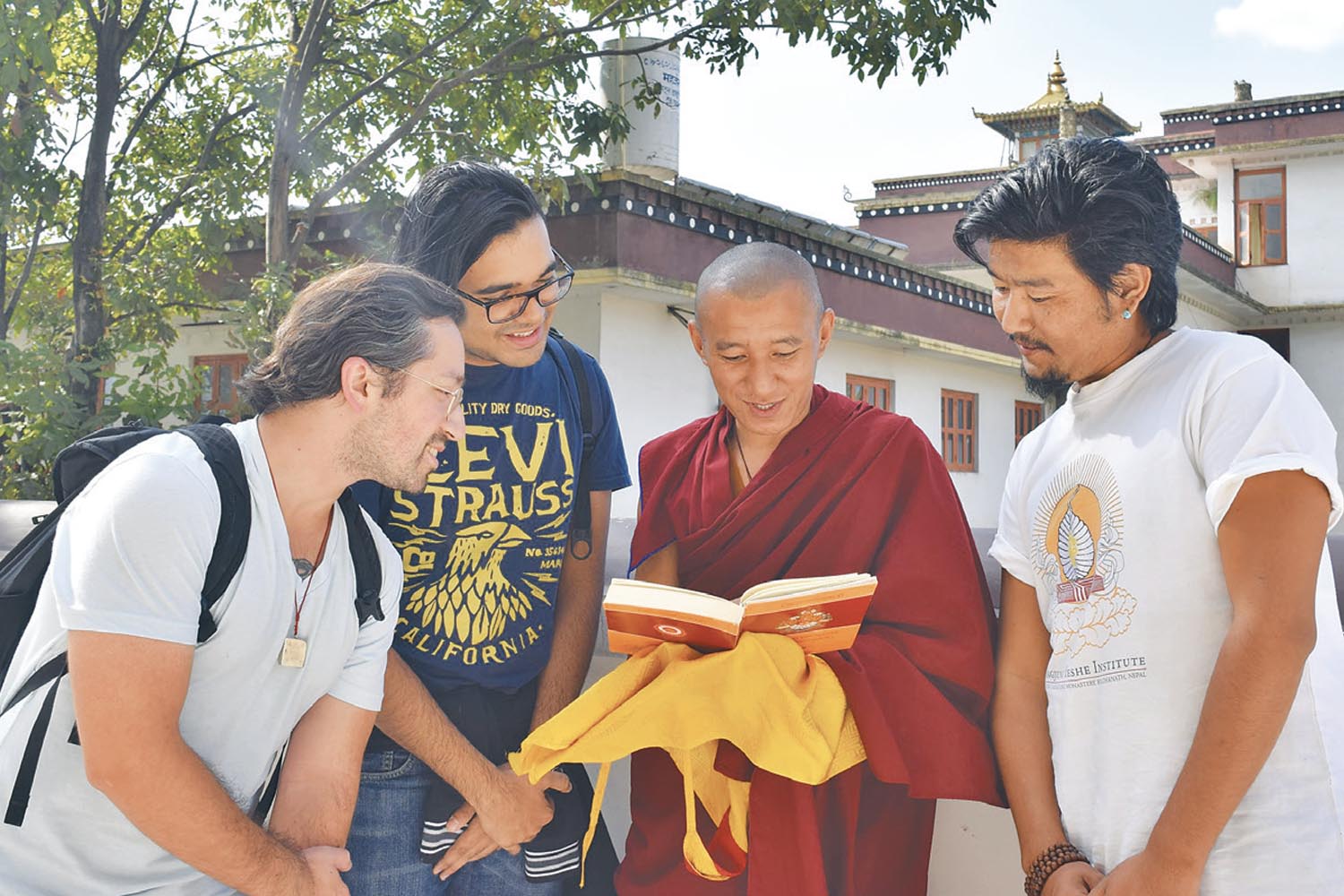
For Elijah Wilkins, a philosophy and kinesiology student from the University of Hawaiʻi, Nepal offered something impossible to replicate in an American classroom. Raised in both Christian and Muslim traditions, he spent much of his childhood reading religious texts from different faiths before taking an Indian philosophy course last spring. His interest deepened after a former Rangjung Yeshe Institute student visited his class to present research conducted in Nepal.
“I thought I could use Buddhist philosophy for my lifestyle,” he said. He soon decided to spend the summer in Kathmandu, where he is now researching different understandings of enlightenment while studying Buddhist philosophy.
While the academic programme drew him to Nepal, it is learning directly from practitioners that has left the strongest impression. “We don’t get a lot of that in the West,” Wilkins said. “Having teachers who are practitioners and not just people who study it theoretically is very important.”
Immersions also extend well beyond the classroom. Many students live with Nepali host families, participate in monastery rituals, attend public teachings, and carry out field research at Buddhist sites across the valley. Faculty members also organise excursions that encourage students to engage directly with the communities they are studying.
For Wilkins, visits to Swayambhunath, Patan, and monasteries across the Valley have become as important as the lectures themselves.
“They’re not just historical sites,” he said. “You can see that these traditions are still alive.”
He also believes that many people in the West misunderstand Nepal’s place in Buddhist history. “Buddhism is seen as an Indian thing in the West most of the time,” he said. “People don't really know the roots are in Nepal.”
As Kathmandu’s reputation grows, he expects that perception to change. “I think Kathmandu is on its way to becoming a major global centre for Buddhist education,” he said.
Fieldwork is also designed by the university to give students a similar appreciation of Buddhism as a living tradition rather than just as an academic subject. In one course taught by Stenzel, students each selected a monastery around Bauddhanath, interviewed monks, researched its history, and presented their findings to classmates during visits to each site.
“Some of our Nepali students said, ‘I’ve walked past this monastery all my life, but I’ve never actually gone inside to ask what they’re doing,’” she recalled.
For Svenja Sender, a student from Germany, that cultural context is exactly what keeps drawing her back to Nepal.
She first visited the country in 2017 while conducting ethnographic research at a Tibetan Buddhist monastery near Pokhara for her bachelor’s thesis. Since then, Buddhism has become both an academic interest and a personal practice, and she hopes to eventually pursue doctoral research in the field.
“It is the practices of Buddhism that we are studying in class and that I am trying to engage with personally,” she said.
She already considers Kathmandu one of the world’s leading centres for Buddhist learning. “I think interest in Buddhist education is quite spread out across the globe, but Kathmandu is definitely one of the important hubs already.”
However, Stenzel believes the institute’s growing reputation reflects more than Kathmandu’s unique setting. Once regarded largely as a niche discipline focused on monasteries and ancient texts, Buddhist studies is increasingly intersecting with fields ranging from medicine to artificial intelligence.
Graduates have gone on to become translators, educators, artists, and researchers. One of Stenzel's former classmates became a psychiatrist and later told her that “sometimes her Buddhist studies education helps her more in helping her patients than psychology does.”
Researchers at the institute also contribute to projects such as 84000, the international effort to translate the Tibetan Buddhist canon into modern languages, while Principal Thomas Doctor has explored how Buddhist ethics might help shape the development of artificial intelligence.
“The goal isn’t to produce more Buddhists,” Stenzel said. Instead, she argues, Buddhist philosophy offers ways of thinking that extend well beyond religion.
“Compassion is not found in Buddhism,” she said. “It’s a human capacity. Buddhism has developed very effective methods for cultivating it.”
The institute’s educational impact is not limited to international students. Stenzel said more Nepalis have begun enrolling in recent years, often with a different motivation.
“They say, ‘I’m familiar with the rituals, but I want to understand the philosophy behind my own tradition,’” she said.
For Stenzel, those conversations are what make the institute and the educational landscape of Kathmandu so unique. Students travel from around the world to learn Buddhism, while many Nepalis arrive seeking a deeper understanding of traditions they have known all their lives.




 20.73°C Kathmandu