Utility pole relocation delays hobble road widening projects
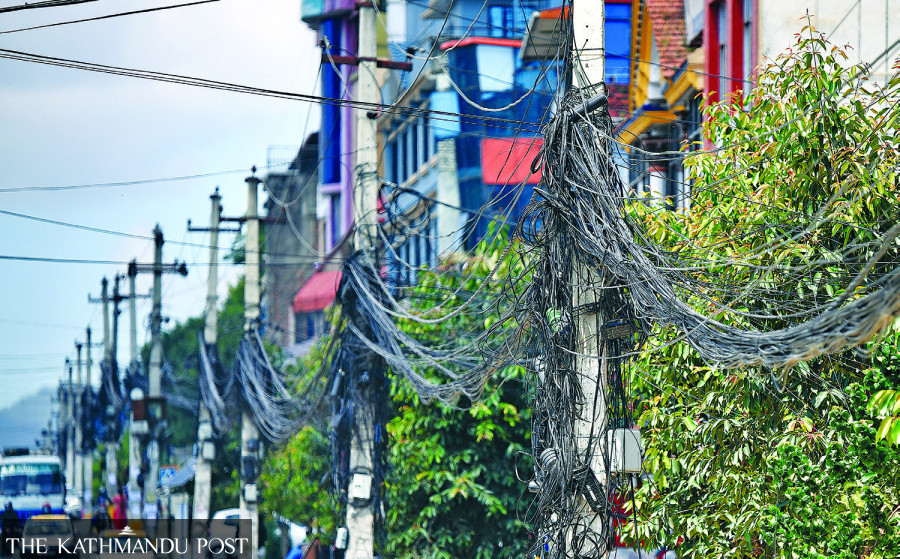
Hundreds of electricity poles remain along construction corridors and continue to hinder major highway projects nationwide. Hundreds of electricity poles remain along construction corridors and continue to hinder major highway projects nationwide. File Photo.
On June 14, Infrastructure Development Minister Sunil Lamsal was returning from Dhangadhi when he stopped at several sections of the Nagdhunga-Mugling road widening project to inspect the progress of work on one of the country’s busiest highways.
Along the route, local residents complained about construction delays. Project officials told the minister that road expansion work had been obstructed because electricity poles had not been relocated on time. In frustration, Lamsal instructed officials to summon the contractor and break his legs if work did not move ahead.
The remarks sparked criticism from all walks of life, drew objections from construction industry representatives and prompted questions in Parliament. Yet the controversy also highlighted a longstanding problem affecting major highway projects across Nepal: why do electricity poles remain standing in the middle of roads even after a large portion of road upgrade work has already been completed?
Kantipur interviews with officials involved in several major highway projects suggests that responsibility for the delays is shared among road agencies, contractors, the Nepal Electricity Authority (NEA), and firms hired to relocate utility infrastructure. The result has been repeated delays, cost overruns and extended deadlines on nationally important road projects.
Rajan Dhakal, spokesperson for the NEA, referred questions to Navaraj Ojha, deputy executive director at the authority’s Distribution and Consumer Services Directorate. Ojha said the authority follows established procedures when relocating electrical infrastructure.
“Contracts for pole relocation are awarded according to approved procedures. It is unfair to claim that road construction has been delayed solely because of pole relocation. Delays have not occurred everywhere,” said Ojha.
He argued that road projects themselves are sometimes responsible for slow progress because construction sites are not cleared and handed over to contractors on time.
“Contractors working on road expansion often make these allegations while seeking deadline extensions,” said Ojha. “In some cases there have also been problems on the part of contractors hired by the NEA as well.”
According to Ojha, one of the major issues is that the same contractors secure multiple pole-relocation contracts across several highways and struggle to manage all of them simultaneously.
Bal Krishna Karki, a representative of Sohan Construction, a company involved in relocating poles on several highway projects, said the work is more complex than many people assume.
“There are technical challenges in relocating electricity poles. Power shutdowns have to be coordinated, lines must be disconnected safely, and only experienced personnel can handle the work,” said Karki. He claimed that in some places his company had already relocated poles but road construction had still not progressed as expected.
“When we cut power to relocate poles, local residents often become angry because electricity service is interrupted,” he said. “Nevertheless, we are working to complete the job as quickly as possible.”
Asked how long it would take to relocate the remaining utility poles along major highways, Karki said the poles on the Malekhu-Mugling section can be relocated within a few days. “In the Kakarbhitta area, the work can be completed within three months if there are no complications, while the remaining poles in Kapilvastu along the Butwal-Gorusinghe-Chandrauta road can be shifted within four months,” he said.
One of the clearest examples of the problem can be seen on the 94.66-kilometre Nagdhunga-Mugling road project, a crucial gateway connecting Kathmandu with the rest of the country. The project has been divided into three sections: Nagdhunga-Naubise (12.26 km), Naubise-Malekhu (43.54 km) and Malekhu-Mugling (38.86 km).
Construction on the Nagdhunga-Naubise section has reached around 88 percent completion, with six kilometres of final asphalt already laid. However, progress has been much slower on the Naubise-Malekhu section.
Keshav Prasad Ojha, chief of the eastern section of the Nagdhunga-Mugling project, said delayed pole relocation remains a major obstacle.
“We signed a memorandum of understanding with the Nepal Electricity Authority in 2022 to remove the poles,” he said. “Even now, 75 poles remain to be relocated.”
The Naubise-Malekhu section, being built by the ZICG-Sharma-Lama joint venture, was originally scheduled for completion by mid-June, 2025. After missing the deadline, the project received an extension until mid-October, 2026. Progress currently stands at about 60 percent.
“Because the poles were not relocated on time, contractors have been forced to blacktop only within the available width,” said Keshav Prasad Ojha. “They have repeatedly complained that they cannot proceed with work in several locations.”
He warned that leaving poles standing beside partially completed roads also increases the risk of accidents.
“If the poles had been removed and work still failed to progress, we could blame the contractor,” he said. “But pole relocation has clearly become one of the causes of delay.”
More than 12,000 vehicles commute the Nagdhunga-Mugling road on a daily basis, making the project one of the country’s most important transport links.
The western section from Malekhu to Mugling faces similar challenges. Sajana Adhikari, chief of the western section, said construction has been affected because 107 poles have yet to be relocated.
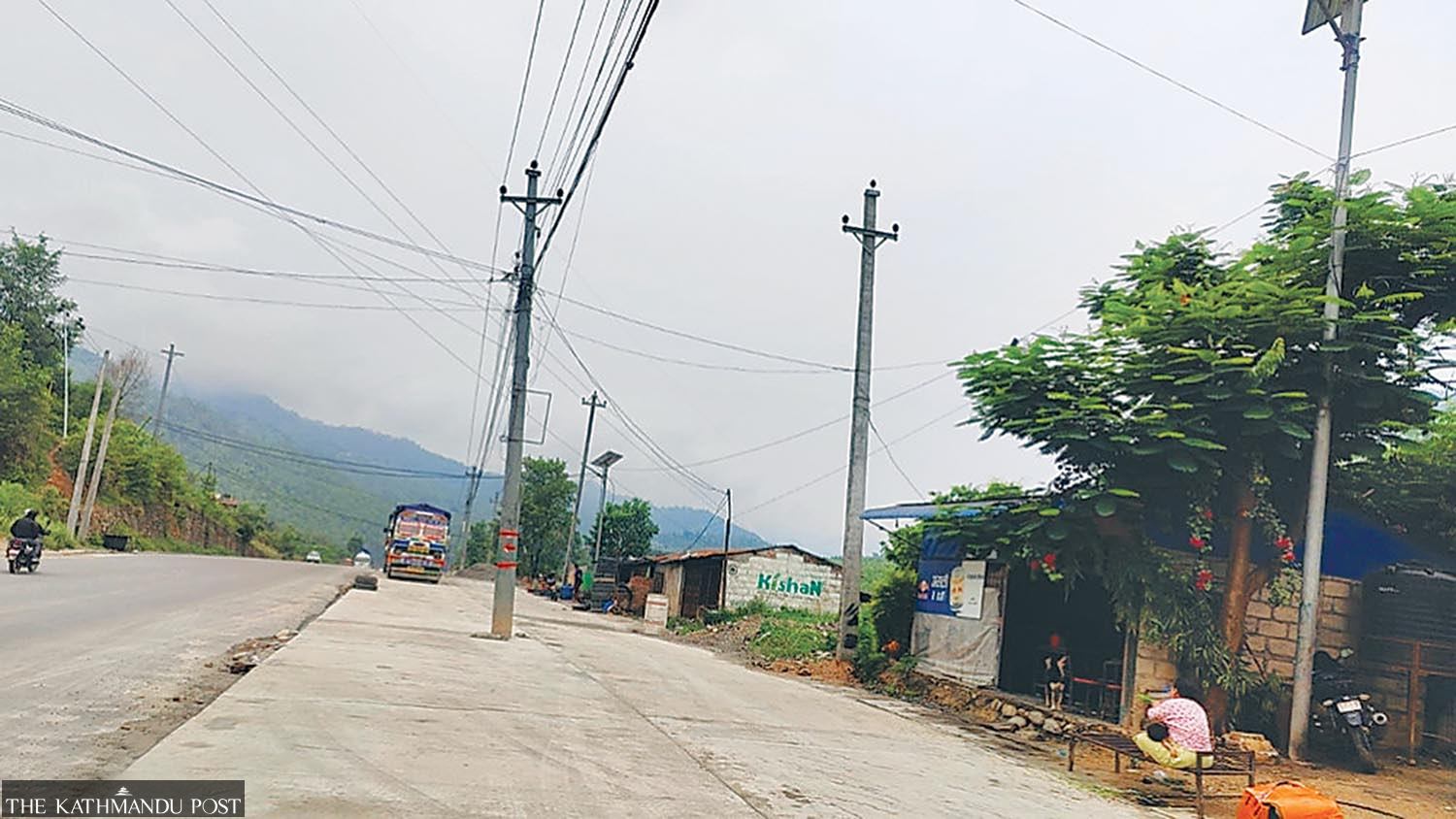
This undated photo shows an electricity pole standing in the middle of a widened road in a hill district. Post file photo
“In Mugling and Malekhu bazars, work cannot proceed because the poles are still there,” she said. “Malekhu market alone has a large number of poles, and there are also problems in the Fishling-Chumlingtar area.”
According to Adhikari, a recent meeting at the Ministry of Infrastructure Development concluded that the remaining poles should be relocated within seven days. However, the contractor responsible for the work had yet to begin work.
Project officials say the memorandum with the NEA does not specify a clear deadline for completing pole relocation, allowing contractors considerable flexibility. Sohan Construction is responsible to shift electricity police in this road stretch as well.
The same pattern is visible on the Kakadrhitta-Laukahi section of the East-West Highway, which forms part of the Asian Highway network. Stretching nearly 96 kilometres, the project has been divided into several packages with support from the Asian Development Bank.
Overall progress stands at just 37 percent.
On the first package between Kakarbhitta and Sitapuri in Jhapa, 914 of 2,422 poles have yet to be relocated. Sohan Construction is responsible for the work.
The second package between Sitapuri and Gothgaun of Morang has achieved only 42 percent progress. Although 1,122 poles have been moved, another 428 remain.
The third package from Gothgaun to Labipur in Sunsari is even further behind schedule, with progress standing at just 22 percent. Of the 668 poles requiring relocation, only 331 have been moved.
Chuda Raj Dhakal, project director at the ADB-funded project’s directorate, said poor coordination among stakeholders is largely responsible.
“In some places road contractors need to complete certain works first, while in others poles must be removed before road construction can begin,” he said. “Instead of coordinating, each side blames the other.”
Dhakal said merely installing new poles and mounting wires is not enough.
“The old poles must also be removed from the construction corridor. That has not happened in many locations,” he said.
The issue is not confined to eastern Nepal. Along the Prithvi Highway, the western section of the Anbukhaireni-Pokhara road project still has 21 poles awaiting relocation despite overall progress of 81 percent.
“Between Seti Bridge and Pokhara Airport, work remains blocked because the old poles have not been moved,” said Dhakal. “We have already paid all relocation costs to the NEA.”
According to project officials, an agreement regarding pole relocation was signed before the road contract itself was awarded. They argue that the work should have been completed long ago.
Under the current arrangement, road projects transfer funds to the NEA, which then calls tenders and hires contractors to relocate poles and power lines. However, officials across several projects say the same handful of contractors repeatedly win multiple contracts, spread resources thinly across different sites, which leads to slow progress.
The experience has prompted authorities to consider alternative approaches. For the Narayanghat-Hetauda road expansion project, which is also being implemented with ADB support, officials have already agreed that the road contractor will directly carry out relocation work under the authority’s supervision.
“We asked the NEA only to provide supervision, approve shutdowns and monitor quality. The project itself will bear the costs,” said Dhakal.
Meanwhile, the long-delayed Suryabinayak-Dhulikhel road expansion project has finally made progress in clearing utility infrastructure. Sohan Construction is the responsible contractor in this road section as well.
Bijay Kumar Mahato, chief of the project, said repeated follow-ups had helped accelerate relocation works. “Only 25 poles remain to be relocated on the Suryabinayak-Sanga section,” said Mahato. “The Sanga-Dhulikhel section has already been completed.”
The 15.8-kilometre project, a key section of the Araniko Highway linking Bhaktapur and Kavre, has reached around 61 percent completion overall.
Similarly, utility poles remain a major obstacle on the Butwal-Gorusinghe-Chandrauta road project.
Kushalata Neupane, chief of the project office in Gorusinghe, said progress has suffered because most of the required pole relocation has yet to be completed.
“Out of around 2,300 poles that need to be moved, nearly 1,900 are still pending,” she said.
According to Neupane, contractors have already installed around 1,000 new poles in Rupandehi and Kapilvastu districts, but old poles cannot be removed until power lines are fully transferred.
The project, being built by the Sansi-Girvan joint venture, has achieved only about 25 percent progress after more than a year and a half of construction.
According to Neupane, the contract to relocate utility poles from Butwal to Kothikhola was awarded to the Bhagwati-Renu JV while the section from Kothikhola to Gorusinghe is being handled by Sohan Construction.
Across Nepal, road expansion projects funded by the World Bank, the Asian Development Bank and government resources continue to face similar hurdles. While contractors, project offices and the NEA disagree over who is most responsible, they acknowledge that poor coordination has become a recurring problem.




 18.18°C Kathmandu