More than 2,000 Indian vehicles enter Nepal daily through six border points
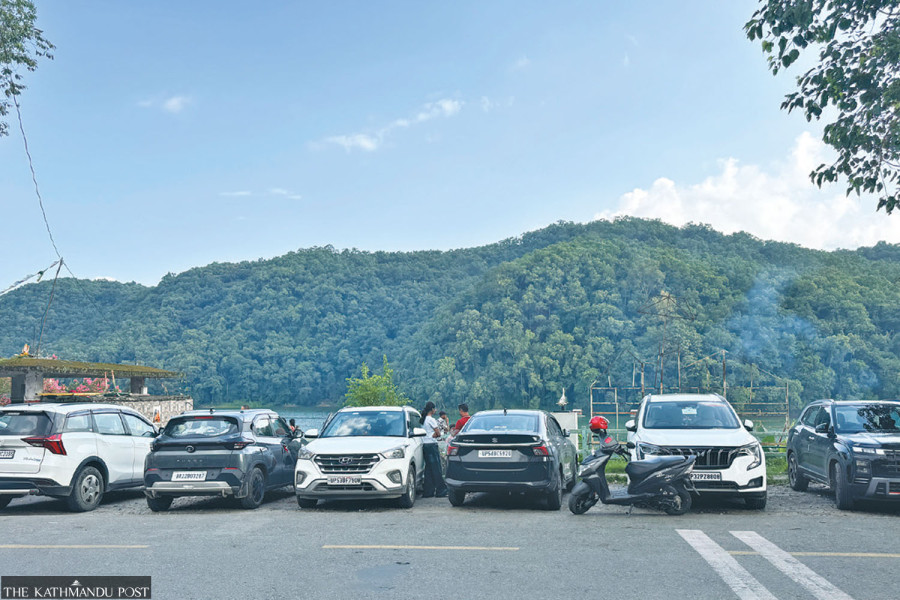
An unprecedented influx of Indian holidaymakers and pilgrims, even during the traditional off-season, is boosting business for hotels, restaurants and tourism operators across Nepal. Indian vehicles parked in Pokhara in this recent picture. Deepak Pariyar/TKP
Tourist arrivals at Nepal’s natural, cultural, religious and adventure destinations have surged in recent months, driven largely by visitors from neighbouring India. From east to west, major tourist hubs are witnessing an unusual influx even during what is traditionally regarded as the tourism off-season.
Tourism entrepreneurs, many of whom had struggled to recover investments made in hotels and other infrastructure, say business has improved significantly as visitor numbers continue to rise.
Data collected from six major border checkpoints show that more than 2,000 Indian vehicles enter Nepal every day carrying holidaymakers and pilgrims. The vehicles include cars, motorcycles and buses. Most motorcycles carry two passengers, while cars generally carry at least four people. Pilgrims mostly travel in buses.
As a result, vehicles with Indian registration plates have become a common sight on highways linking southern border crossings with destinations including Mustang, Pokhara, Kathmandu, Chitwan, Lumbini and Bardiya.
While religious pilgrimage remains a major reason for travel, tourism entrepreneurs say leisure travel has increased sharply in recent years. Until a few years ago, most Indian visitors travelled mainly to religious sites such as Pashupatinath and Muktinath. Increasingly, however, families and groups of friends are visiting Nepal for holidays, mountain scenery and cooler weather. Many also visit border towns to enjoy casinos and spas.
Indian tourists are also travelling in large numbers to Lumbini, Bardiya and Chitwan, while Palpa, Baglung, Mustang, Manang and Pokhara remain popular for their mountain landscapes and pleasant climate.
Border procedures eased as arrivals increase
According to Harihar Paudel, chief of the Bhairahawa Customs Office, around 600 Indian tourist vehicles enter Nepal daily through the Belahiya border point. During school holidays in India, daily arrivals rise to as many as 1,200 vehicles.
Paudel said the customs office has introduced an online system to simplify entry procedures following the increase in self-drive tourists.
“A large number of Indians are visiting Nepal, particularly during school holidays,” he said. “The main destinations for visitors entering through Bhairahawa are Muktinath and Korala in Mustang, Pokhara and Chitwan.”
Customs records show that most visitors arrive from Kerala, Madhya Pradesh, Delhi, Uttar Pradesh and Punjab. Some travel by train to Gorakhpur before crossing into Nepal through Bhairahawa. On average, Indian tourists stay in Nepal for three days, according to customs data.
Indian-registered cars are charged a customs fee of Rs600 per day, while motorcycles pay Rs200 per day. Overstay penalties are Rs2,500 per day for cars and Rs1,002 per day for motorcycles. Authorities now require all Indian vehicles to complete online registration with the necessary documents before entering Nepal.
Chandra Prakash Shrestha, a tourism entrepreneur in Bhairahawa and central committee member of the Hotel Association Nepal (HAN), attributed the growing number of arrivals to promotional campaigns conducted by Nepali tourism businesses in several Indian cities.
However, he said many Indian tourists encounter difficulties because they are unaware of Nepali regulations, particularly restrictions on carrying cash above the permitted limit, which can lead to seizure of money and legal action.
“Many Indian tourists face problems because they are unfamiliar with Nepal’s cash limits and vehicle regulations,” Shrestha said. “A help desk at every customs point would make travel much easier.”
Strong arrivals through central and western border points
In neighbouring Kapilvastu, the Maryadpur and Krishnanagar border points receive a combined total of around 500 Indian vehicles each day, including motorcycles, jeeps, cars and vans carrying pilgrims and tourists.
Kiran Bista, chief of the Suthauli Customs Office, said more than 250 Indian-registered vehicles clear customs daily through Maryadpur, with four-wheelers accounting for about 60 percent of arrivals and motorcycles the remaining 40 percent.
At Krishnanagar, more than 280 vehicles enter Nepal every day, evenly divided between motorcycles and four-wheelers. Mayank Karna, information officer at the Krishnanagar Customs Office, said about 60 percent of visitors travel to Supadeurali in Arghakhanchi and Swargadwari in Pyuthan for religious pilgrimage.
“The remaining 40 percent travel to Pokhara for holidays,” Karna said. “Both border points have witnessed a sharp increase in tourists and pilgrims over the past month.”
The increase is also evident at the Gaddachauki border point in Kanchanpur, where Indian nationals account for most incoming tourists. Owing to its proximity to Uttarakhand, the checkpoint also receives occasional visitors from third countries.
Tourism entrepreneurs say Indian visitors dominate local markets, casinos and sightseeing destinations.
“Those who come for casinos often also visit Shuklaphanta National Park for jungle safaris,” said Parmanand Bhandari, who has operated safari tours in the park for a decade. “Visitor numbers have clearly increased compared with previous years.”
Most visitors arrive from Uttarakhand, while others come from Delhi and Bareilly. Some also use the route while travelling to the Kailash Manasarovar pilgrimage, whereas others continue to Kathmandu, Pokhara and Lumbini.
The border town of Brahmadev also attracts large numbers of Indian devotees during the Purnagiri Mela. Pilgrims from Uttarakhand, Uttar Pradesh and Delhi begin arriving from Fagu Purnima onwards. The three casinos in Mahendranagar also attract significant numbers of Indian visitors.
According to the Gaddachauki Customs Office, around 70 to 75 Indian vehicles enter Nepal daily after paying regular customs duties, while about 300 vehicles enter under temporary short-stay permits.
Government focuses on spiritual tourism
Speaking at an Arogya Tourism Promotion programme in Bhairahawa on Friday evening, Minister for Culture, Tourism and Civil Aviation Khadak Raj Paudel said Nepal’s tourism industry should build on the country’s spiritual heritage.
“People travel in search of happiness,” the minister said. “The government is therefore working to establish a dedicated Pilgrimage Department.”
His remarks reflect the current trend, with Muktinath and Pokhara remaining among the most popular destinations for Indian visitors.
Birgunj visitors drive directly to tourist destinations
Birgunj, Nepal’s main overland gateway, also records heavy daily arrivals of Indian tourists. However, most continue directly to Kathmandu, Pokhara, Muktinath and other destinations, limiting the economic benefits for businesses in Madhesh Province.
According to the Birgunj Customs Office, between 600 and 700 Indian vehicles have entered Nepal daily since mid-June, following an even higher daily average of 800 to 900 vehicles between mid-May and mid-June. Motorcyclists obtain short-term permits, while car owners secure tourist permits valid for four to 10 days.
The extreme summer heat across many Indian states and school holidays have encouraged families from Bihar, Uttar Pradesh, West Bengal, Rajasthan, Delhi, Odisha, Maharashtra and southern India to travel to Nepal. Most drive directly to destinations such as Ghandruk, Poon Hill and Kathmandu’s Pashupatinath Temple without spending a night in Birgunj, Parsa or neighbouring Bara.
Mohan Sharma Lamichhane, president of the Madhesh Province chapter of the Nepal Association of Tour and Travel Agents (NATTA), said promotional campaigns by tourism entrepreneurs from Pokhara and Sauraha in Indian cities have produced positive results.
“Indian holidaymakers are looking for cooler destinations to escape the summer heat,” Lamichhane said. “Hotels from Chitlang to Muktinath are operating at full capacity, but Madhesh is missing out on the economic benefits. If tourism stakeholders developed packages encouraging visitors to spend at least one night at local attractions, businesses in the region would benefit directly.”
Social media fuels Pokhara tourism boom
Tourism entrepreneurs in Pokhara attribute much of the recent surge in Indian visitors to the growing influence of social media. Syed Shah, an Uttar Pradesh-based influencer known as “Vlogger Bhaiya”, has published more than 20 Instagram Reels on Pokhara, attracting millions of views. Other Indian content creators, including Aradhya Singh, Mohd Umar and Ronak Rider Ji, who recently rode from Varanasi to Mustang, have also produced popular videos on Pokhara, Muktinath and Ghandruk. Indian actor Ashish Vidyarthi's travel vlog has further boosted the destination's visibility.
Tourism entrepreneurs say the digital exposure, combined with the intense summer heat in India, New Delhi’s push for regional tourism spending and Bihar’s liquor prohibition, has encouraged thousands of Indian families to holiday in Nepal.
Pramod Agrahari, a businessman from Gorakhpur, arrived in Pokhara with nine family members after touring Butwal, Tansen and Rani Mahal. He said Facebook Reels inspired the trip. The Khurana family from Punjab chose Pokhara primarily for adventure activities, including paragliding, bungee jumping, visits to Gupteshwar Cave and boating on Phewa Lake.
The influx has pushed hotel occupancy to record levels. Pancham Lama, general manager of the five-star Pokhara Grande Hotel, said five-star hotels usually record occupancy of 40 to 45 percent during the summer season. This year, occupancy has increased by a further 20 to 25 percentage points, driven by extreme heat in India and the impact of social media promotion.
“Indian tourists are largely last-minute travellers whose bookings rarely come more than a month in advance,” Lama said, adding that more affluent visitors are increasingly reserving premium accommodation through online travel agencies such as MakeMyTrip, Expedia, Agoda and Booking.com.
Laxman Subedi, president of the Hotel Association Pokhara, described the trend as unprecedented, with hotel occupancy across the city remaining close to 90 percent until recently. He said high visitor numbers have persisted across Gandaki Province since mid-April due to aggressive digital marketing, Indian Prime Minister Narendra Modi’s call for citizens to explore neighbouring countries and Bihar’s alcohol ban.
Kishor Dahal, president of the Gandaki chapter of the Nepal Association of Tour and Travel Agents (NATTA), said travel subsidies provided by the Indian government for senior citizens have also strengthened Muktinath’s appeal. To build on the momentum, NATTA Gandaki organised a business-to-business networking event in Kolkata on June 12 under the “Pokhara-Nepal Promotion Campaign 2026”.
Mani Raj Lamichhane, Gandaki Province head of the Nepal Tourism Board, said school summer holidays in May and June had provided the foundation for the tourism boom.
“The Tourism Board launched the ‘Garmi se Behaal, Chalo Nepal’ campaign, while Pokhara's tourism entrepreneurs continued their ‘Chaliye Pokhara’ promotional campaign in Indian border towns,” he said.
Indian visitors sustain Chitwan tourism
The rise in Indian visitors has also boosted tourism around Chitwan National Park, offsetting declines in domestic and third-country international arrivals.
According to Avinash Thapa Magar, information officer at Chitwan National Park, 256,855 people visited the park during the first 11 months of the current fiscal year. The total included 153,874 domestic visitors, 83,071 visitors from countries outside the SAARC region and 19,855 visitors from SAARC countries, predominantly India.
Domestic arrivals peaked at 19,109 between mid-October and mid-November, followed by 18,046 between mid-April and mid-May. Between mid-May and mid-June, domestic visitor numbers fell to 16,628, while third-country international arrivals declined from 9,881 to 7,433. During the same period, however, Indian visitor numbers reached their highest monthly level of the year, helping maintain overall tourist arrivals.
Rishi Tiwari, a hotelier and jeep safari operator in Sauraha, said visitors from Uttar Pradesh and Bihar are driving the current demand.
“Indian tourists visiting Muktinath, Pokhara and Manakamana are increasingly extending their trips to Chitwan because of its natural environment and affordable accommodation,” he said.
Jamunaha records heavy cross-border movement
Around 16,000 people cross the Jamunaha border point in Banke district every day, but authorities do not maintain separate records of Indian tourists or their purpose of travel.
Janardan Paudel, chief of the Nepalgunj Customs Office, said the customs office does not maintain a dedicated database for Indian nationals entering Nepal.
“We do not keep separate records for Indian citizens or the purpose of their visits,” he said.
Vehicle permit records nevertheless indicate substantial tourist traffic. Ram Bahadur Khatri, a computer operator at the nearby Transport Management Office, said 275 Indian vehicles, including 50 motorcycles, obtained route permits over a recent Wednesday and Thursday. Under the existing cross-border vehicle movement guidelines, Indian motorcycles entering through Jamunaha are charged a daily customs fee of Rs600.
Palpa's resorts and homestays filled to capacity
The increase in Indian visitors has also benefited Palpa, where demand for rural resorts and community homestays has reached unprecedented levels.
The district has more than 100 hotels and restaurants, although only 15 are affiliated with the Hotel Association Nepal (HAN) Palpa chapter.
“Travellers now have highly diverse preferences,” said Laxman Basyal, president of the Hotel and Restaurant Association Palpa. “Many specifically look for rural resorts and village homestays, although Tansen itself remains an attractive destination.”
Basyal, who operates a resort four kilometres from Tansen Bazaar, said he has been forced to turn away more than 50 prospective guests on most weekends since the start of summer because the property is fully booked.
Srijana Farm Resort in Khasyauli, Ribdikot Rural Municipality-3, has experienced a similar surge. Manager Vishnu Adhikari said the resort's 14 cottages are fully booked several days each week, with Indian tourists accounting for around half of advance reservations. The resort, established in 2011 through a collective investment by local youths, combines accommodation with livestock farming and organic vegetable cultivation.
“Many guests come here to escape the pressures of city life and stay for several days,” Adhikari said.
Eco Farm House, locally known as “Gaun ko Ghar”, in Deurali, Tinau Rural Municipality-6, is also operating at full capacity. Located three kilometres off the Siddhartha Highway from Dumre, the property is run by Samundra Ghimire Chhetri of Butwal Sub-Metropolitan City-8. Chhetri said the resort is currently turning away more than 30 prospective guests every day because of overwhelming demand. Built with an investment of Rs5 million, the eco-friendly property occupies 17 ropanis and features traditional wooden architecture.




 12.97°C Kathmandu

1.jpg)
.jpg)
.jpg)