Kathmandu underpasses move forward as tunnel road plans stall
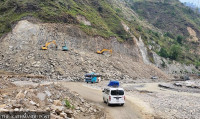
Work is set to start on underpasses at Satdobato and Ekantakuna next fiscal year, but most of Nepal’s planned tunnel roads are still awaiting feasibility studies. The Chiyabari–Khurkot section in Sindhuli, where a tunnel road has been proposed. Post file photo
The Department of Roads will begin construction of underpasses at two of the Kathmandu Valley’s busiest intersections, Satdobato and Ekantakuna, in the upcoming fiscal year, with the government allocating Rs124.6 million to launch the projects.
Feasibility studies for both underpasses have been completed, paving the way for construction after years of delays.
The government had first announced plans in the fiscal year 2022-23 budget to build overpasses or flyovers at Gwarko, Satdobato and Ekantakuna to ease chronic traffic congestion in the Valley. So far, only the Gwarko overpass has been completed. Following detailed studies, the government has opted to build underpasses, similar to the Kalanki underpass, at Satdobato and Ekantakuna instead.
According to the study, the Satdobato underpass will stretch 540.78 metres and cost an estimated Rs720 million. The four-lane structure will follow the design of the Kalanki underpass, officials from the Department of Roads said.
The proposed underpass at Ekantakuna will be 300 metres long and is expected to cost around Rs500 million.
Both projects will be procured under the Engineering, Procurement and Construction (EPC) model, according to the Quality Research and Development Centre under the Department of Roads.
The Department had planned to begin construction during the current fiscal year, but the projects were delayed due to a lack of funding.
Rajesh Prasad Paudel, director of the Quality Research and Development Centre, said construction on both underpasses will begin in the next fiscal year.
“The budget allocated for the Gwarko overpass is only for minor maintenance work, amounting to Rs2 million,” Paudel said. “We will proceed with calling for tenders for the Satdobato and Ekantakuna underpasses. Together, the projects are expected to cost around Rs1.5 billion.”
Construction is expected to take four years. Since the projects cannot be completed within a single fiscal year, the Department will seek multi-year funding approval from the Ministry of Finance before awarding contracts.
Paudel said the Department would take steps to minimise disruption to traffic during construction.
“We learned valuable lessons from the construction of the Gwarko overpass. This time, all necessary preparations will be completed before awarding the contract,” he said. “We will coordinate with all concerned agencies and adopt appropriate measures to ensure traffic movement is not severely affected.”
Dozens of tunnel roads studied, but only two under construction
Despite carrying out preliminary and feasibility studies for around two dozen tunnel road projects across Nepal, only two are currently under construction: the Nagdhunga-Sisnekhola Tunnelway and the Siddhababa Tunnelway.
The Nagdhunga Tunnel is in its final phase before operation, while the Siddhababa Tunnel remains under construction.
The budget for the upcoming fiscal year includes funding for studies of several new tunnel projects, including Tokha-Chhahare Gurje Bhanjyang, a proposed tunnel linking the Bheri river in Surkhet to Danuwa Lake in Bardiya, and studies for Dolalghat-Charnawati, Hattisar-Babai, Khurkot-Chiyabari, Shivapur-Bhalubang and Ranighat-Bhurigaun.
Paudel said a detailed feasibility study would be carried out for the Khurkot-Chiyabari tunnel.
“We will proceed only if the feasibility study confirms that the project is viable,” he said. “Although the budget mentions feasibility studies under the Tunnel Road Development Programme, it does not specify which projects will advance to detailed studies.”
The Department will prioritise projects from the beginning of the next fiscal year based on the outcomes of feasibility assessments, he added.
The fiscal year 2023-24 budget had allocated Rs1 billion for a tunnel linking Tokha in Kathmandu with Chhahare Gurje Bhanjyang in Nuwakot. The government had planned to complete the detailed project report (DPR) and environmental impact assessment before moving to construction.
However, no significant progress was made. No budget was allocated in the following fiscal year, while only Rs2.7 million was set aside in the current fiscal year without any meaningful work. The upcoming budget again limits the project to further study.
A 20-member Chinese technical team conducted a preliminary survey of the proposed alignment in January-February 2020, spending about a month on field inspections, data collection and studies of the Galchhi-Balaju corridor before returning to China.
Initially expected to be around seven kilometres long, the tunnel was later estimated by the Chinese team to be about four kilometres.
The project's total cost will only be determined after a full feasibility study.
The Department of Roads says it expects the tunnel to be financed through a grant from the Chinese government.
Suresh Paudel, senior divisional engineer at the Department’s Development Cooperation Implementation Division, said Nepal is requesting China to carry out the feasibility study.
“Once the feasibility study is completed and the project is found to be viable, we will proceed with a detailed study leading towards construction,” he said.
The proposed tunnel would shorten the journey between Kathmandu and Nuwakot.
The feasibility study for the Khurkot-Chiyabari tunnel on the BP Highway and the detailed feasibility study for the Dumkibas-Bardaghat tunnel on the Narayanghat-Butwal Highway have already been completed.
Local governments have been urging the federal government to begin construction, citing heavy daily traffic, but neither project has moved forward.
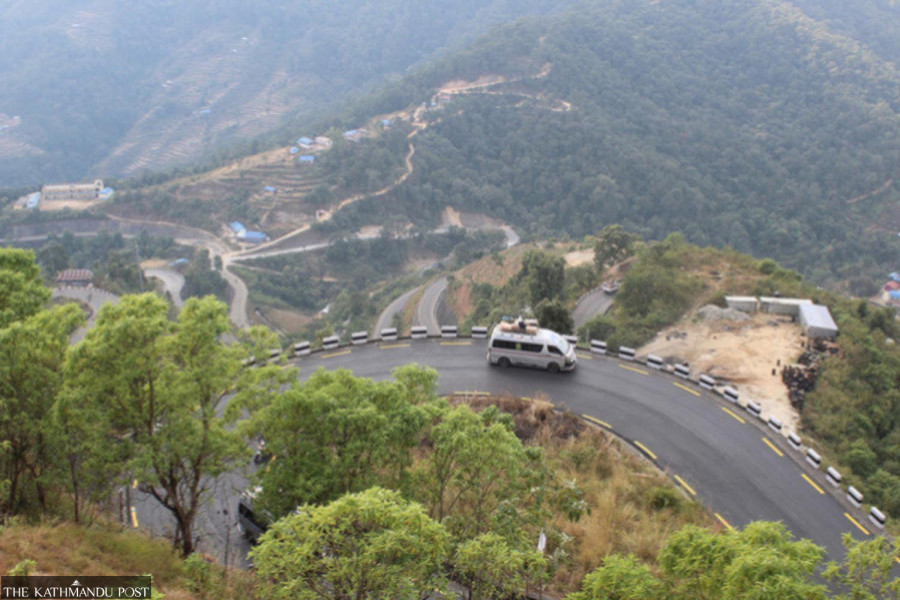
The Khurkot-Chiyabari section is notorious for its winding mountain road, prompting long-standing demands for a tunnel.
The proposed tunnel would begin near Chiyabari in ward 2 of Kamalamai Municipality in Sindhuli and emerge at Tallo Bara in ward 7 of Golanjor Rural Municipality.
Once completed, it would significantly shorten travel between the Tarai and the eastern hill districts of Ramechhap, Dolakha, Okhaldhunga, Khotang and Solukhumbu.
A feasibility study carried out in the 2019-20 fiscal year estimated construction costs at around Rs16.08 billion.
The existing 29.8-kilometre road would be reduced to just 8.5 kilometres, cutting travel time from between one and one-and-a-half hours to about six minutes.
Around 1,500 to 2,000 vehicles use the road daily, with traffic rising to between 7,000 and 10,000 vehicles during major festivals.
Despite earlier studies, the government has again listed the project for feasibility assessment in the upcoming fiscal year's budget.
The detailed feasibility study for the Dumkibas-Bardaghat tunnel on the Narayanghat-Butwal road section was completed in 2023.
According to the study, the proposed tunnel will be 5.3 kilometres long and cost an estimated Rs38.69 billion.
Although the detailed study has been completed, the project has yet to move into the construction phase.




 26.08°C Kathmandu