Awaiting resettlement, displaced squatter families struggle with life in holding centres
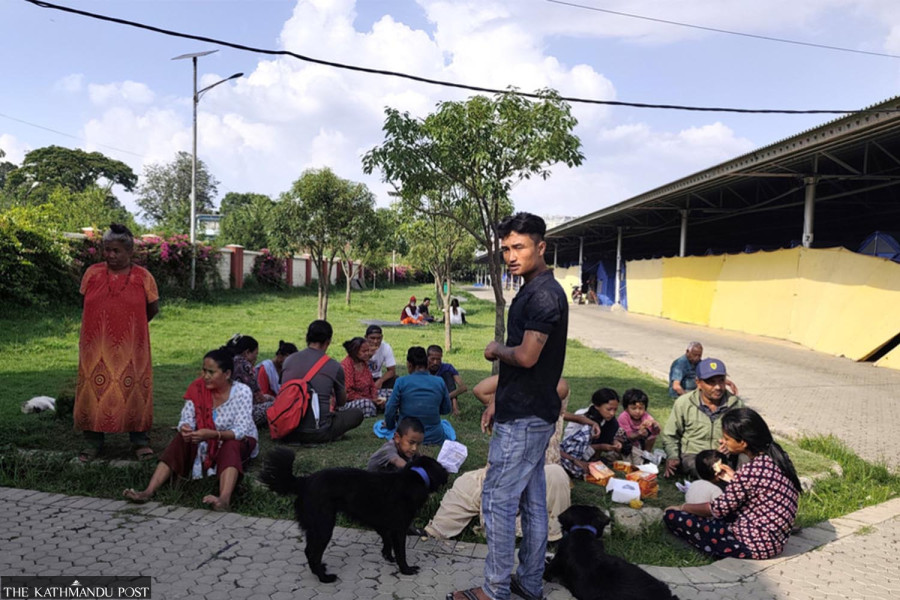
Young children are bearing the brunt of life in holding centres, where parents worry about nutrition, sickness and unsafe conditions. Samarpan Shree/TKP
Hundreds of displaced squatters in Kathmandu Valley are still awaiting permanent resettlement weeks after being evicted from informal settlements as part of a government campaign to clear encroachment on public land and riverbanks.
Although authorities have pledged to begin distributing land ownership certificates from early July, many families say daily life in government-provided temporary shelters remains difficult because of overcrowding, delayed relief payments and inadequate food for elderly people and young children.
Forty-five-year-old Smriti Majhi was waiting in line at Dasharath Stadium on Wednesday for digital verification, a requirement for receiving government assistance. Two days earlier, she had received a text message asking her to report to the stadium to complete the process.
Majhi lost her home when the government demolished the squatter settlement at Shantinagar on April 25. Unable to move into one of the government's holding centres because of the volume of belongings her family owned, she rented a room near the former settlement on the same day.
“We had too many belongings and couldn't take them to the hotel,” Majhi said. “Fortunately, we found a room nearby through someone we knew, so my husband, son and I moved there instead.”
After registering their names on the first day of the eviction, the family received no further information about how the government planned to resettle them.
“We survive on daily wage labour, and Kathmandu is expensive,” she said. “The government should provide us permanent housing as soon as possible.”
On Tuesday, the government resumed digital verification of displaced squatters living outside the holding centres. The earlier exercise had only recorded basic information at Dasharath Stadium. Authorities are now collecting detailed personal data, according to Anand Singh Bhat, executive chair of the High-powered Committee for Integrated Development of Bagmati Civilisation.
The committee has already completed digital verification of 1,488 individuals from 388 families staying in holding centres, out of the 2,608 displaced families previously recorded.
“This is not a new registration drive,” Bhat said. “It is a re-verification of people who were already on the government's list but have been living outside the holding centres.”
According to Khagendra Bista, a sociologist with the committee, 148 displaced people living outside the holding centres completed digital registration on Tuesday and Wednesday.
The government has decided to provide a one-time relief payment of Rs25,000 to verified and eligible displaced informal settlers. They are also expected to receive a monthly housing allowance of Rs15,000 for up to three months until permanent arrangements are made.
But many families say they have not received any information about the payments.
Majhi said she was unaware of the relief package or the requirement to open a bank account.
Those staying in holding centres have already submitted their bank details but are still waiting for the money.
“We have provided our bank account numbers, and we have been told the money will come,” said Girbanika Thapa, who is staying at the Radha Soami Satsang Beas holding centre in Kirtipur. “But nothing has arrived so far.”
Bhat said the government has approved the relief package, and the necessary budget is being released.
“People staying in the holding centres are expected to receive the relief within the next eight to ten days,” he said. “After that, those currently undergoing verification outside the holding centres who are found eligible will also receive assistance.”
Adding to the optimism, Minister for Land Management, Cooperatives, Federal Affairs and General Administration Pratibha Rawal told the House of Representatives on Wednesday that the government plans to begin distributing land ownership certificates to eligible squatters from the first week of July.
The announcement has raised hopes among displaced families, who say they want permanent housing rather than prolonged stays in temporary shelters.
“We just want to be settled as quickly as possible,” Thapa said. “No one wants to live under such miserable conditions.”
The government has established seven holding centres across Kathmandu, Bhaktapur and Kavre districts. According to official records, a total of 1,488 displaced individuals are currently sheltered across the seven institutional holding centres.
There are 294 people from 87 households at a lodge in Balaju; 277 people from 65 households at the Radha Soami Satsang Beas holding centre in Kirtipur; 355 people from 99 households at the Nepal Electricity Authority (NEA) Training Centre, Kharipati, Bhaktapur; 115 people from 24 households at the Agricultural Training Centre, Bode, Bhaktapur; 80 people from 21 households at the Water Supply and Sanitation Training Centre, Nagarkot; 195 people from 45 households at the Nepal Red Cross Society facility in Banepa; and 172 people from 47 households at the Ichangunarayan Housing Project in Kathmandu.
Despite having shelter, many residents describe life inside the centres as increasingly difficult.
Several families have complained about the quality and reliability of the food provided by the government.
At the Kirtipur holding centre, displaced families recalled an incident when they went without food for an entire day because meals had not arrived. Some schoolchildren were forced to miss classes as a result.
Meals are now being provided regularly by Shanti Sewa Griha, but parents say the food is unsuitable for infants and young children.
“The food isn't appropriate for small children,” Thapa said. “We have to borrow the gas stove kept for new mothers and cook food ourselves.”
She said residents are not allowed to bring protein-rich foods such as fish, meat or eggs into the centre because the facility follows a strictly vegetarian dietary practice.
“We mash rice and lentils into porridge because that's all we can manage,” she said.
Thapa also said the cold conditions and poor nutrition have made many children ill.
She recalled that a six-month-old baby at the centre recently had to be admitted to an intensive care unit because of illness linked to the cold and inadequate nutrition.
Chandra Kala BK, another resident of the Kirtipur holding centre, said the meals provided are unsuitable for her 11-month-old son.
“The food is cooked outside and brought here in large pots,” she said. “Adults somehow manage, but small children are struggling.”
Doctors have advised her to feed her son more nutritious food because he is anaemic, but she says she has neither a gas stove nor the money to prepare special meals.
“When the Kathmandu Metropolitan City was running a field kitchen, I could cook porridge on the stove there,” she said. “Now that facility no longer exists.”
She added that both her son and her five-year-old daughter have developed persistent coughs and breathing problems because of the damp, overcrowded conditions.
“When it rains, water leaks into the tents,” she said. “There is hardly any ventilation inside. We hope the government moves us to a proper place soon.”
Kumari Lama, who is staying at the Banepa holding centre, said there is no separate meal plan for young children there either.
“They have to eat the same food as adults,” she said. “Sometimes I buy fish, meat or eggs from a nearby hotel so my three-year-old grandson gets something nutritious.”
Government officials acknowledge that no separate food arrangements have been made for children or sick residents.
“In special circumstances, we ask the canteen to make separate arrangements,” said sociologist Bista.




 14.78°C Kathmandu