Solar power inside forests, sirens in villages to curb wildlife attacks
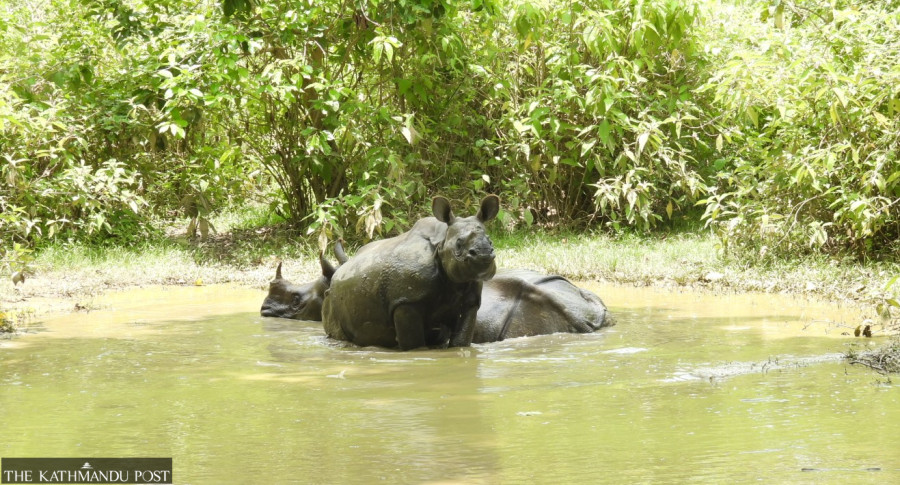
Communities in Meghauli are combining forest-side water management and village-based alert systems to reduce rising human-wildlife conflict. A mother rhino and her calf wallowing in the Radhakrishna Buffer Zone Community Forest of Meghauli. Rhino attacks account for the highest number of human deaths and injuries in Meghauli. Ramesh Kumar Paudel/TKP
Meghauli in Chitwan is a well-known tourism destination. It lies along rivers, streams and the buffer zone of Chitwan National Park, drawing both visitors and wildlife in large numbers. Along with tourists, wild animals frequently move through the area. Each year, incidents of attacks on local residents are reported, causing injuries and fatalities. Livestock and crops are also regularly damaged.
To address the recurring risk, residents have introduced a range of local safety measures. The Meghauli Buffer Zone User Committee provided a siren system, which was installed on a Saturday afternoon.
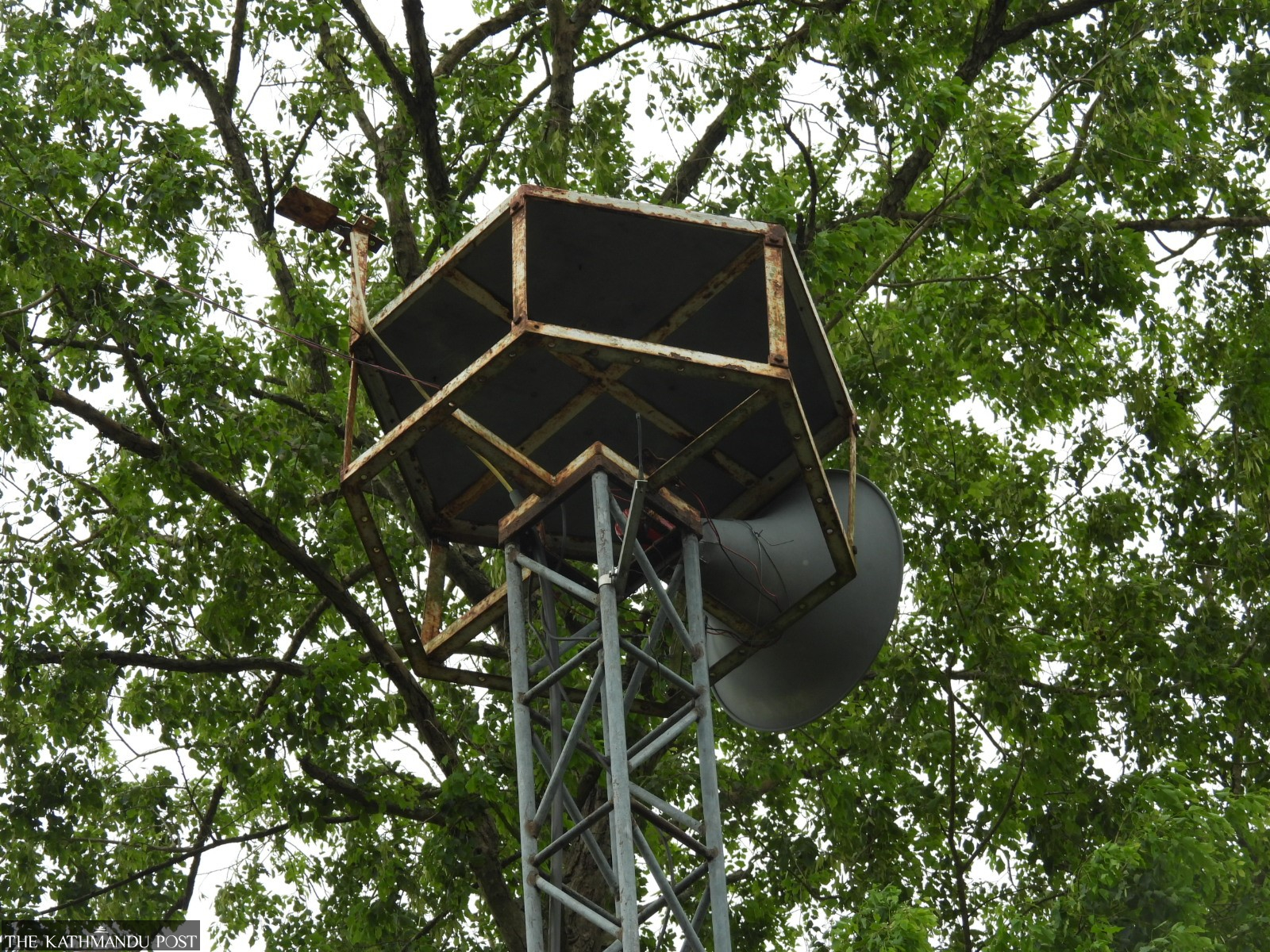
“On the same evening, a wild elephant was spotted. We immediately activated the siren installed earlier that day near the south-western corner of Meghauli Airport. This alerted residents to remain cautious,” said local resident Yam Bahadur Thapa Magar. The microphone has been mounted on a 40-foot iron tower, and the siren is used when animals are suspected of entering the settlement.
The sound can be heard up to three kilometres. “Once the siren goes off, villagers avoid going near the forest and stay indoors. There is also an army post nearby, and the army helps when animals need to be driven back,” he added.
The siren structure built beside the Radhakrishna Buffer Zone Community Forest in Meghauli. Ramesh Kumar Paudel/TKP
60-year-old Khem Bahadur Sunar of Andrauli, a western settlement of Meghauli, died in a daytime rhino attack on August 28, 2025. His home borders the Rapti Niyantran Buffer Zone Community Forest, where residents regularly collect fodder and firewood under constant risk of encounters with wildlife.
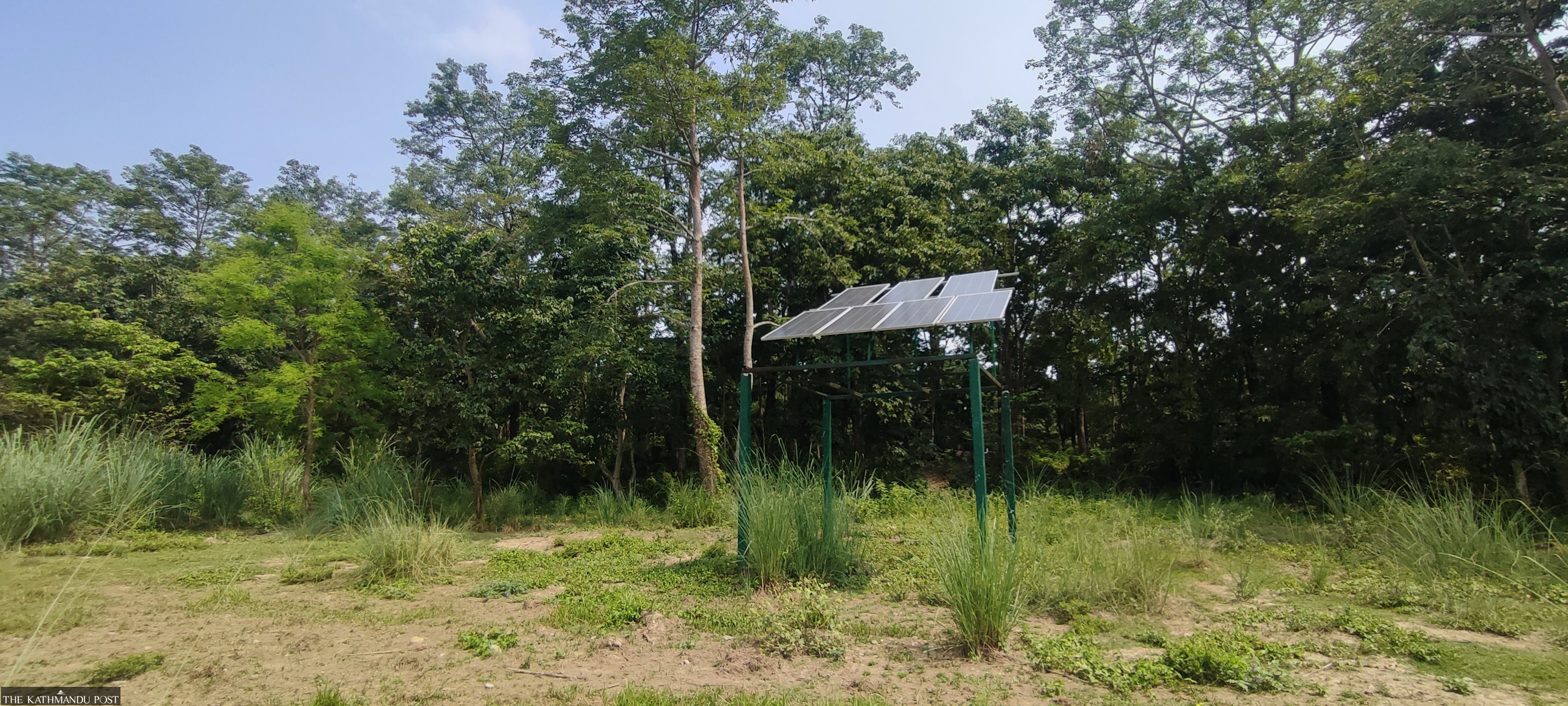
When forests lack sufficient grass or water sources, animals often move out in search of food and habitat. To reduce such movement, the forest committee has installed a solar-powered pump system.
“The pump runs on solar power and has helped manage water in wetland areas. We are also using it to irrigate grasslands so they do not dry out. If grass and water sources are available inside the forest, animals are less likely to enter villages,” said Bishal Kumal, chairperson of the Rapti Niyantran Buffer Zone Community Forest. Areas such as Andrauli and Golaghat are densely populated by the indigenous Kumal community.
“The risk of attacks is also highest in these settlements, so we have prioritised water and grassland management there,” said Mayaram Chaudhary, chairperson of the Meghauli Buffer Zone User Committee. He added that additional sirens will also be installed in these areas, with a total of three planned across Meghauli.
Alongside solar pumps inside forests and sirens in villages, the committee has introduced other mitigation measures. Chaudhary said that since the formation of the buffer zone user committee in Meghauli, between mid-April 1997 and mid-April 2024, 13 people were killed in rhino attacks, six in tiger attacks and three in elephant attacks. Four more deaths have been recorded since then, he added.
“The number of injured people is also high. In the past 25 years, 51 people were injured by rhinos, nine by elephants, three by tigers, and three each by bears and wild boars,” he said. The settlements lie adjacent to Narayani river and Rapti river, with forests playing a dual role as flood protection barriers and wildlife corridors.
There are nine buffer zone community forests in Meghauli. Five lie towards the Rapti river and four towards the Narayani river. While these forests help reduce flooding and riverbank erosion, they have also become key wildlife habitats. Each forest is directly linked with nearby settlements.
Chaudhary said 22,898 households fall under the Meghauli user committee area, covering wards 27 and 28 of Bharatpur Metropolitan City. He said the close overlap between human settlements and wildlife habitats continues to keep conflict risks high.
Solar panels installed inside the Rapti Niyantran Buffer Zone Community Forest. Ramesh Kumar Paudel/TKP
A study conducted five years ago under the Terai Arc Landscape (TAL) project identified Meghauli of Chitwan National Park, Khata of Bardiya and the Kamdi Corridor of Banke as high-risk zones for wildlife attacks, said Prem Paudel, Eastern Cluster coordinator of TAL.
The government runs the TAL project with support from World Wide Fund for Nature. Paudel said many incidents occur due to lack of awareness among residents entering forest areas.
“People often do not consider what clothes to wear, what time is safe to enter forests, or other basic safety measures,” he said.
To address this, the buffer zone committee has deployed three social mobilisers across villages to identify and educate at-risk households. They conduct door-to-door visits covering around 400 households.
The village of Patihani in Meghauli is also among the high-risk areas. Resident Renu Mahato said fear of elephants and rhinos remains constant due to proximity to forests. Wild boars and spotted deer frequently destroy crops, she added.
To support livelihoods, the committee introduced a duck farming programme. Renu and her husband Ram Kumar Mahato started with two breeding ducks and now raise 26 ducklings. After five months, a duck can sell for up to 1,800 rupees.
With homestays and hotels expanding, demand for poultry in Meghauli has increased, making duck farming more viable for local families.
Near Patihani, the Anjana Khola runs along the forest edge. While a concrete barrier was built elsewhere, it was not possible to extend it across the stream. Animals began using it as an entry route into villages. A water-gate system has now been installed, which remains closed unless water pressure opens it naturally.
The Bethari stream, which flows through five buffer zone community forests along the Rapti River, was previously clogged by water hyacinth. Chaudhary said the committee cleared the weeds and built earthen mounds in several areas to improve habitat conditions for wildlife.
In addition, 18 women have been trained in handicraft production linked to Tharu traditions. Their products are displayed at a souvenir shop in Meghauli, priced between 300 and 8,000 rupees. Tourists staying in nearby hotels and homestays regularly purchase them.
“The women make these items in their free time. It has also reduced unnecessary trips into the forest,” said Laxman Kumar Chaudhary, manager of the shop.
In Andrauli, Deu Maya Thapa Magar has also secured her goat shed, which now has protective structures to prevent leopard attacks. The committee has built 41 predator-proof sheds in total.
“We have secured around 75 per cent of the Rapti-side community forest with concrete barriers. The Narayani side remains open. We are combining large and small interventions to reduce risks while continuing conservation work. The results will be visible in the coming years,” Chairperson Chaudhary said.




 25.92°C Kathmandu
1.jpg)