Experts welcome reform agenda, but doubts persist over implementation capacity
Economists and policy experts praise the budget’s emphasis on investment, innovation and digital transformation, but question whether weak implementation capacity and revenue constraints could undermine its ambitious targets.
The government's proposed budget for fiscal year 2026/27 has drawn mixed reactions from economists, policymakers and industry experts, who welcomed its focus on investment, innovation and digital transformation but questioned whether the state has the capacity to deliver on its ambitious promises.
The government has unveiled a Rs 2124 billion budget for fiscal year 2026/27—the largest in Nepal’s history—representing a 25.2 percent increase over the revised estimates of the current fiscal year and targeting 7 percent economic growth alongside major reforms and investments.
Of the total outlay, Rs 1270 billion has been allocated to recurrent expenditure, Rs 431 billion to capital expenditure, and Rs 422.64 billion to financial management, including debt servicing and lending.
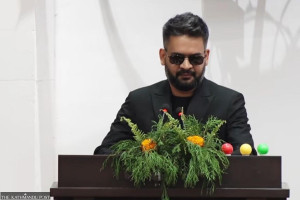
Speaking at a discussion programme organized by the Economics Student’s Society (ECOSS) of the Central Department of Economics, Tribhuvan University on Wednesday, former finance minister Yubaraj Khatiwada said the budget acknowledges several structural challenges facing the economy, including limited access to capital and technology, but falls short in creating stronger incentives for production and entrepreneurship.
Questioning the government's commitment to industrial growth, Khatiwada asked why corporate tax rates had not been reduced if the objective was to encourage entrepreneurship and investment.
“The budget talks about customs duty concessions on imported raw materials, but why not reduce corporate tax rates from 25 and 20 percent to 20 and 15 percent?” he said.
“Taxes linked to consumption have been adjusted, but taxes that could stimulate production remain largely untouched. Reducing the highest personal income tax slab from 39 percent to 29 percent again promotes consumption-driven growth.”
According to Khatiwada, Nepal's economy cannot generate sufficient employment through consumption-led expansion alone.
“If we are serious about employment-centred economic transformation, we need to prioritise the establishment and expansion of productive industries, particularly small, medium and cottage enterprises,” he said.
Khatiwada also welcomed provisions allowing institutional investment in the information technology sector abroad and efforts to rethink Nepal's graduation from Least Developed Country status. However, he argued that fiscal policy remains insufficiently redistributive and raised questions about how the government plans to stimulate both investment and export growth.
Former Nepal Rastra Bank governor Chiranjibi Nepal described the budget as a continuation of existing economic policies, albeit with a stronger emphasis on digital transformation and artificial intelligence. He said the document reflects the government's attempt to promote a more liberal and investment-friendly economy, but questioned the realism of its revenue and expenditure projections.
“The challenge is revenue generation," Nepal said, warning that expenditure commitments appear to exceed the ceilings recommended by fiscal planning mechanisms. He also cautioned that increased demand generated by government spending could place additional pressure on imports and the country's external sector. Nepal's heavy reliance on remittances remains a vulnerability, he added, particularly given uncertainties in major labour destination countries.
While acknowledging the push towards digitalisation, Nepal noted that transforming Nepal into a digitally driven economy would require substantial investments and institutional preparedness.
Digital policy expert Amrita Sharma welcomed the budget's strong focus on digital transformation, saying it could improve public service delivery, transparency and governance. She highlighted measures aimed at supporting the information technology sector through tax reforms, encouraging diaspora investment and promoting artificial intelligence and data centre development.
According to Sharma, such policies could help reduce brain drain by creating opportunities for skilled Nepalis within the country. However, she cautioned that infrastructure readiness and human capital development remain critical gaps.
"The ambition is good, but execution remains the question," she said, adding that investment in skills development appeared to receive less attention than technological infrastructure.
Manoj Paudel, founder and chair of Aadhyanta Fund Management, described the budget as having an "excellent architecture" but said many of its targets remain difficult to achieve. He welcomed tax exemptions on industrial raw materials and efforts to encourage industrialisation. Nevertheless, he pointed to what he called a contradiction between the government's target of achieving 7 percent economic growth and its decision to reduce capital expenditure.
Paudel argued that the budget should be evaluated through three tests: revenue generation, expenditure absorption and policy predictability. "Nepal's capital absorption capacity remains weak, and the bureaucracy's ability to implement ambitious programmes continues to be a concern," he said.
He also called for predictable tax policies, particularly regarding capital gains taxes, easier repatriation of investment income and stronger regulatory institutions capable of supporting private-sector growth.
Public policy expert Prakriti Bhattarai said the budget correctly identifies institutional reform, investment promotion and technological transformation as key priorities at a time when Nepal requires greater economic confidence. She welcomed measures aimed at attracting foreign and diaspora investment but stressed that implementation capacity remains a major constraint.
"The focus should now be on making systems work more efficiently," Bhattarai said. She also questioned whether the concerns of lower-income citizens had been sufficiently addressed in the budget.
Defending the government's approach, National Planning Commission member Pukar Malla said the budget seeks to prioritise productive projects, innovation and improved public service delivery.
According to Malla, the government's challenge is not a lack of policy ideas but weaknesses in execution mechanisms that have historically prevented budgets from achieving intended outcomes. He argued that stronger governance systems, results-based performance evaluations and the consolidation of fragmented empowerment programmes would improve implementation.
Malla also backed efforts to focus public resources on productive sectors and suggested introducing sunset provisions to phase out ineffective programmes.
Concluding the discussion, experts said the success of the budget will ultimately depend less on policy announcements and more on the state's capacity to turn commitments into results.




 21.78°C Kathmandu