Can the Jogbani–Kimathanka road unlock eastern Nepal’s economic potential?
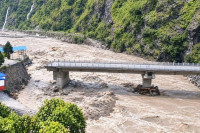
The 390-km route connecting India and China through Nepal promises lower transport costs, stronger trade links, tourism growth and new investment opportunities, but experts say its success will depend on policy support and cross-border connectivity.This file photo shows an aerial view of the Tamor bridge at Mulghat in Dhankuta. Shutterstock
Kimathanka, one of the most remote Himalayan settlements in eastern Nepal, lies in Sankhuwasabha district along the border with China. For decades, the village remained largely beyond the reach of the state. The absence of roads, transport services and basic infrastructure made life extremely difficult for local residents.
That reality is now beginning to change.
A nearly 390-kilometre route linking India and China through Nepal—from the border point of Jogbani in Bihar, India, to Kimathanka on the Chinese frontier—is now connected. The road not only links Nepal’s mountains and plains but also lays the groundwork for a potentially transformative economic corridor between South Asia’s two largest economies.
The Bhotkhola region, long regarded as one of the country’s most isolated areas, is now directly connected to Nepal’s national road network.
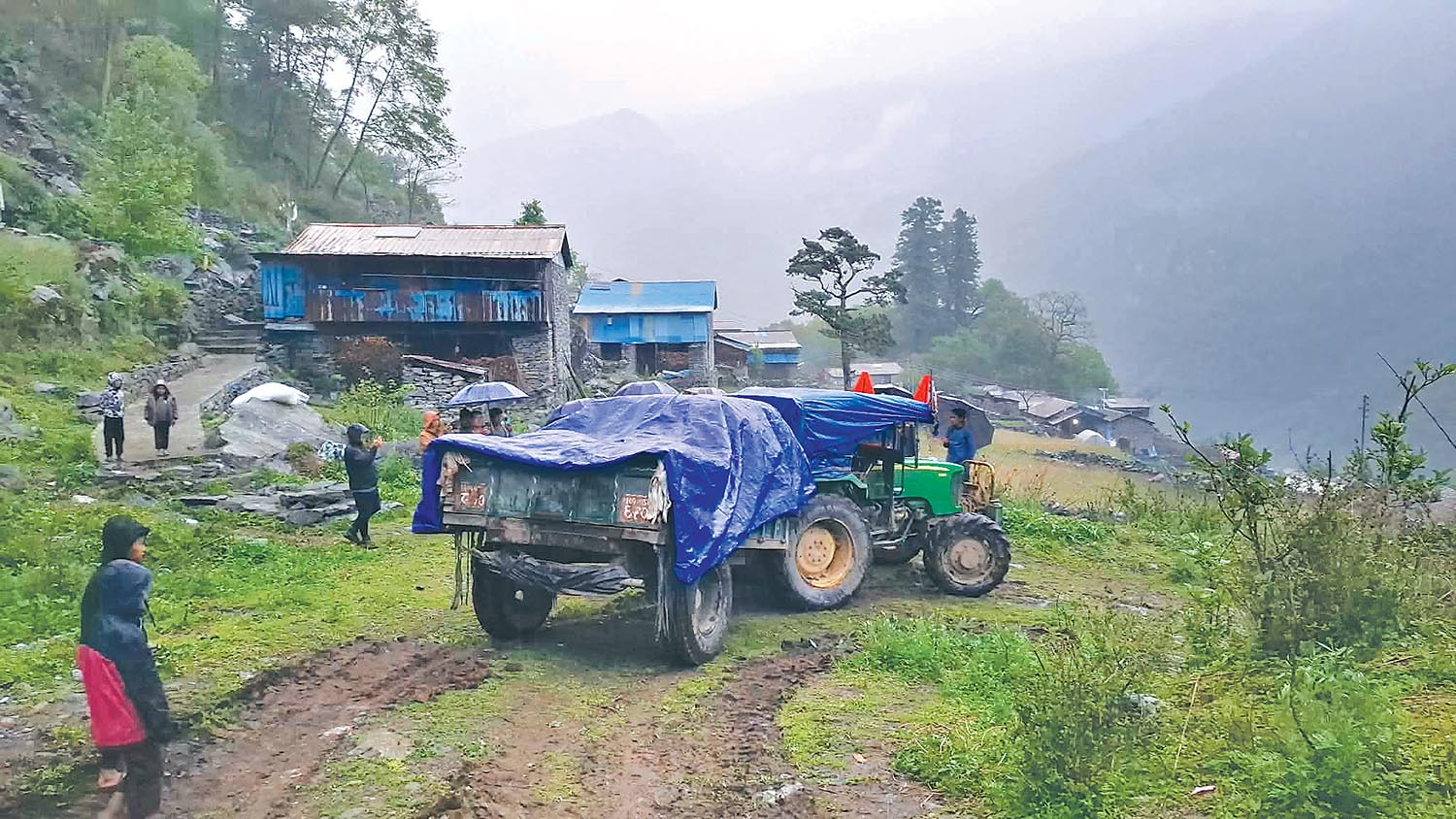
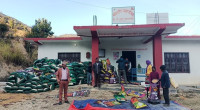
Following the opening of the Khandbari–Kimathanka road section, tractors carrying food supplies reached Kimathanka for the first time last week.
Wangchhedar Lama, chairman of Bhotkhola Rural Municipality, said the arrival of vehicles in the remote Himalayan village has given residents renewed hope that development is finally reaching their doorstep.
The Jogbani–Kimathanka road forms a key section of the Koshi Corridor, a north-south highway in eastern Nepal linking India’s Bihar state with the Chinese border in Tibet. Passing through Biratnagar, Itahari, Dharan, Dhankuta and Khandbari, the route is increasingly being viewed as a strategic trade corridor with long-term regional significance.
More than just a transportation route, the Koshi Corridor carries the potential to serve as a land bridge between Nepal’s two giant neighbours, India and China.
Nepal’s international trade and transport networks have historically remained heavily dependent on India. Business leaders argue that once the corridor becomes fully operational, Nepal will gain an alternative route to diversify and expand its trade connectivity.
Industrialists and traders in Biratnagar believe that if the road is upgraded to all-weather standards, transportation costs and travel time could decline significantly. That, they say, would make imports and exports more efficient while encouraging investment, industrial expansion and job creation.
Economist Bed Raj Acharya said the corridor could create new opportunities for landlocked Nepal to access international markets more effectively.
According to Acharya, if the route is eventually developed into a shorter and more efficient trade corridor connecting India and China, Nepal could establish itself as an important transit nation within South Asia’s trade network.
Business leaders in Biratnagar have therefore begun viewing the road not merely as a local access route but as a strategic economic corridor with national importance.
Nabin Rijal, former president of the Morang Trade Association, said the road’s expansion could directly benefit entrepreneurs and industries across eastern Nepal.
In his view, Nepal stands to gain substantial economic advantages if the border point is developed into a viable Nepal-China trade route.
“Importing goods from China through this route would be easier and cheaper than relying solely on Tatopani or transit routes through India,” Rijal said. “Not only Nepal, but China and India could also benefit commercially from this corridor.”
He believes that if the road is upgraded and remains operational throughout the year, eastern Nepal could emerge as an alternative transit route for India-China trade.
A tractor pictured in Kimathanka, Sankhuwasabha. Courtesy of Ganga Bista
Entrepreneur Mahesh Jaju said the road network could also generate significant benefits for the tourism sector in Koshi Province. Increased tourist arrivals, he said, would stimulate local economies across the region.
“At present, we import Chinese goods through Tatopani, Kerung and sea routes via Kolkata,” Jaju said. “If imports can be routed through Kimathanka, transportation costs could fall considerably. This corridor could prove to be a blessing.”
Industrialists point out that the Biratnagar–Jogbani area is already a major centre for manufacturing, imports and logistics. If cross-border trade through Kimathanka becomes operational, cities such as Biratnagar, Itahari and Dharan could further strengthen their positions as industrial and commercial hubs.
Pawan Kumar Sarada, president of the Koshi chapter of the Confederation of Nepalese Industries, said the province’s economy has long remained concentrated in the Tarai plains.
“Now that the road has reached the mountains, agriculture, medicinal herbs, tourism and cross-border trade can all be integrated into a single economic corridor,” he said. “The country could derive significant economic benefits from this.”
Economists believe tourism may be the first sector to experience visible gains from the new road.
Improved access through Kimathanka could open new opportunities for adventure and nature-based tourism around Mt Makalu, the Makalu-Barun National Park, the Arun Valley and the Himalayan settlements of Bhotkhola.
Until now, many of these destinations could only be reached on foot or by helicopter. With road access now available, both domestic and international tourist arrivals are expected to increase.
Acharya said that linking Bhotkhola’s Tibetan culture, Himalayan lifestyle and natural beauty with tourism development could have a direct impact on local livelihoods and economic activity.
According to him, a road is not merely a line connecting one point to another; it is also a foundation for social and economic transformation.
“The Jogbani–Kimathanka road is a milestone for Koshi Province,” he said. “The challenge now is to maximise the benefits it can generate.”
According to Lama, the road has already made it easier for local producers to access markets.
Potatoes, yak products, medicinal herbs and other agricultural goods produced in the Himalayan region can now reach markets in the Tarai more efficiently. Likewise, consumer goods from the plains are expected to become cheaper and more accessible in mountain communities.
“Transporting goods used to be extremely expensive,” Lama said. “Now daily necessities can be delivered at lower costs, and local products can be sold in the Tarai.”
Residents also point out that the absence of roads had long made healthcare, education and emergency rescue services major challenges. The need to carry sick patients for hours on foot is now expected to gradually decline.
Yet the opening of the road does not automatically guarantee economic prosperity.
According to Acharya, without effective cross-border trade policies, customs infrastructure, investment-friendly regulations and a production-oriented economy, the road risks becoming little more than a transportation link rather than a true engine of development.
“The key question now is how effectively the state can connect this infrastructure with broader economic activity,” he said.




 26.08°C Kathmandu