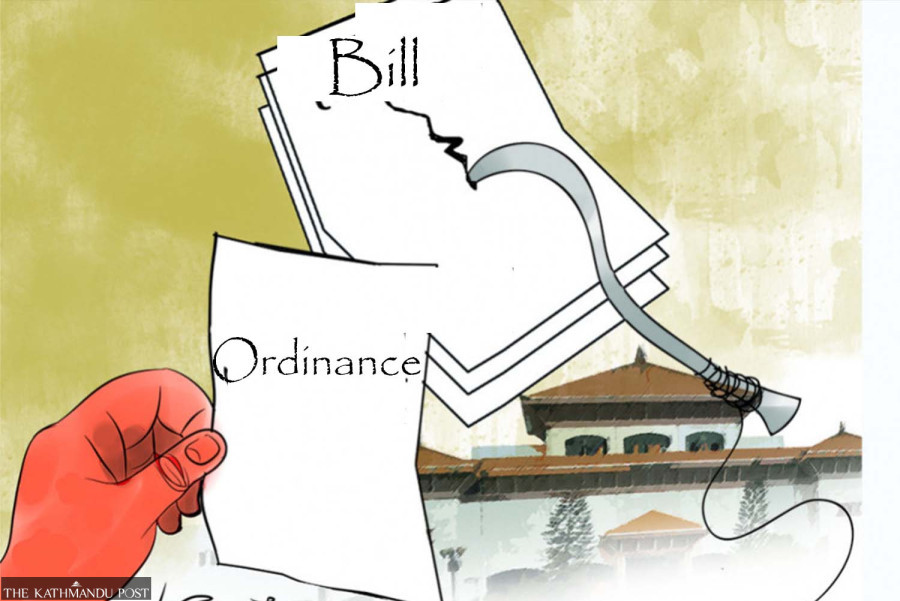
The fate of the eight ordinances introduced by the Balendra Shah-led government now rests squarely in the hands of the opposition parties in the National Assembly, where the ruling alliance has no representation, creating a high-stakes test of parliamentary equation and constitutional framework.
The Constitution of Nepal (2015) makes it mandatory that an ordinance be endorsed by both houses of the federal parliament to remain in force. If either the House of Representatives or the National Assembly rejects it, the ordinance automatically becomes inactive. While the ruling Rastriya Swatantra Party (RSP) enjoys a near two-thirds majority in the lower house, its absence from the upper house has left it vulnerable to other parties' positions.
The government moved the ordinances in a series of decisions on the recommendation of the Council of Ministers. President Ramchandra Paudel issued them over several days, including amendments related to cooperatives, public procurement, the prevention of money laundering, health science institutions, public office accountability, universities, and the Constitutional Council.
Under Article 114 of the constitution, ordinances can be promulgated when Parliament is not in session, and immediate action is necessary. Such ordinances carry the force of law but must be presented before both houses once Parliament reconvenes. If they are not approved within 60 days of the session’s start, they will be automatically annulled.
According to senior advocate Tikaram Bhattarai, the constitutional timeline is strict and leaves little room for delay. “The government must ensure that replacement bills endorsing the ordinances are passed by both houses within 60 days. Failing that, the ordinances will automatically become ineffective,” said Bhattarai.
On Tuesday, the President, on the recommendation of the Council of Ministers, summoned sessions of both houses on May 11. From that date, the 60-day countdown begins, giving the government until July 9 to secure approval. Ordinances must be tabled at the very first meeting of each house, after which the clock starts ticking.
However, the National Assembly Regulations 2018 allow for an even earlier setback. According to rule 89 of the regulations, any member can register a notice to reject an ordinance within two days of its tabling. If such a motion is filed and garners majority support, the ordinance can be nullified well before the 60-day deadline.
This provision has precedent. During a previous coalition between the Nepali Congress and the CPN-UML, a land-related ordinance failed to advance due to opposition in the National Assembly. At the time, despite support from some smaller parties, the government could not muster the numbers needed, and the ordinance remained void after the constitutional deadline.
The current composition of the 59-member National Assembly underscores the challenge. The Nepali Congress holds 24 seats, the Nepali Communist Party 17, and the UML 10. The Janata Samajbadi Party has two members, the Loktantrik Samajbadi Party and the Rastriya Janamorcha have a member each. Two members were nominated by the President. A simple majority of 30 votes is required to approve ordinances.
Given this equation, the ruling side would need support from major opposition forces such as the Congress, the UML, and the Nepali Communist Party.
The Congress has already begun internal discussion. A meeting of its parliamentary party, held at Singha Durbar in the presence of party president Gagan Kumar Thapa on Wednesday, concluded that broader consultations with other opposition parties were necessary before deciding on a unified position. Parliamentary party leader Bhishma Angdembe said discussions would continue in the coming days.
Earlier, the Congress’s Central Work Execution Committee had taken a critical stance on the ordinance related to the Constitutional Council, describing it as driven by political intent and contrary to constitutional principles. The party accused the government of attempting to push through decisions tailored to its interests by reviving provisions similar to those introduced by a previous administration.
“We urge the government to immediately withdraw the ordinance and remain fully committed to the constitution,” the party said in its formal statement. At the same time, it indicated a willingness to support measures that promote good governance and improve public service delivery.
The Nepali Congress, however, said that it will extend constructive support to provisions introduced with good intent, particularly those aimed at strengthening good governance and improving service delivery.
“On all matters included in the ordinances that curtail citizens’ fundamental rights, restrict constitutionally guaranteed freedoms, or go against the spirit of the constitution. We are clear that it is our responsibility to reject them and work towards making those provisions consistent with the constitution,” read the party’s decision.
The UML has also signalled coordination among opposition forces. UML leader Mahesh Bartaula said discussions among opposition parties would begin soon, with a focus on forming a common position.
“We may move towards rejecting the ordinances in the National Assembly. The rules allow us to register a rejection notice within two days of tabling,” he said.
He criticised the government’s decision to introduce multiple ordinances at the outset of its tenure, calling it inappropriate. “Bringing ordinances in this manner at the beginning of a government’s term is not a good practice. There must be some check on this approach,” he said.




 14.4°C Kathmandu