Nepal wants to become a data centre hub. It has no rules for how
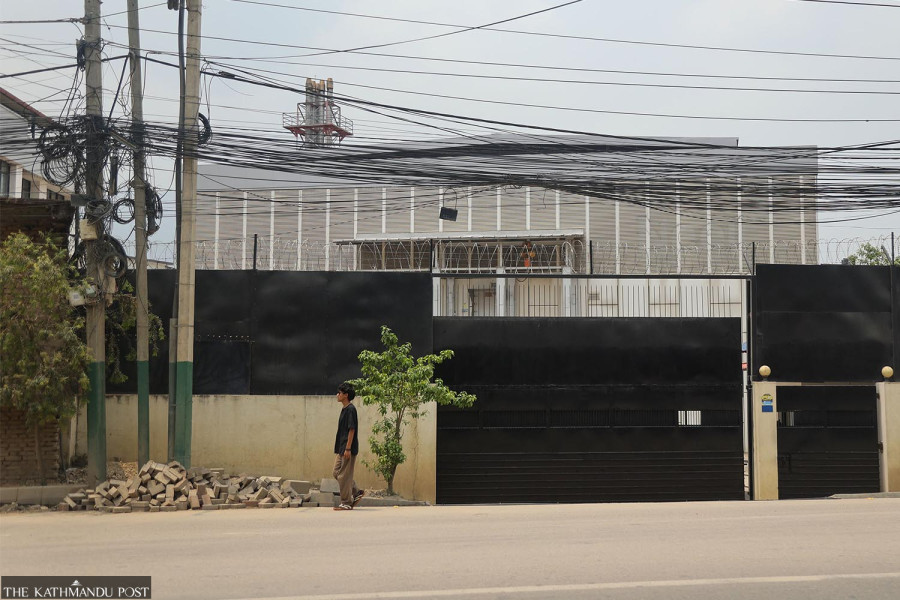
As the ruling party bets on digital infrastructure to transform the economy, the communities that will host these facilities have no legal standing to object. The entrance to the Ncell data centre in Nakhhu, Lalitpur. Suryams Upreti/TKP
The streets outside the Ncell data centre in Nakhhu, ward 4 of Lalitpur Metropolitan City, are not the kind you linger in. Dust coats everything — your clothes, your face, your notebook — within minutes. Heavy vehicles roll in and out at all hours. Security guards stand at the entrance, stationed between the constant rumble of trucks and the low mechanical hum of the facility behind them.
Inside sit rows of servers, cooling systems, and diesel generators that take over when the grid cannot. The people who live around it in ward 4 and adjacent ward 16 did not know that when it was being built.
“They collected signatures from the households during the ground verification (sarjamin)process, saying they were building a warehouse,” said Jyotsna Gupta, chairperson of the Ekta Tol Bikash Sanstha in ward 4. “It became a large data centre. Nobody, including the ward committee back then, was fully transparent about this.”
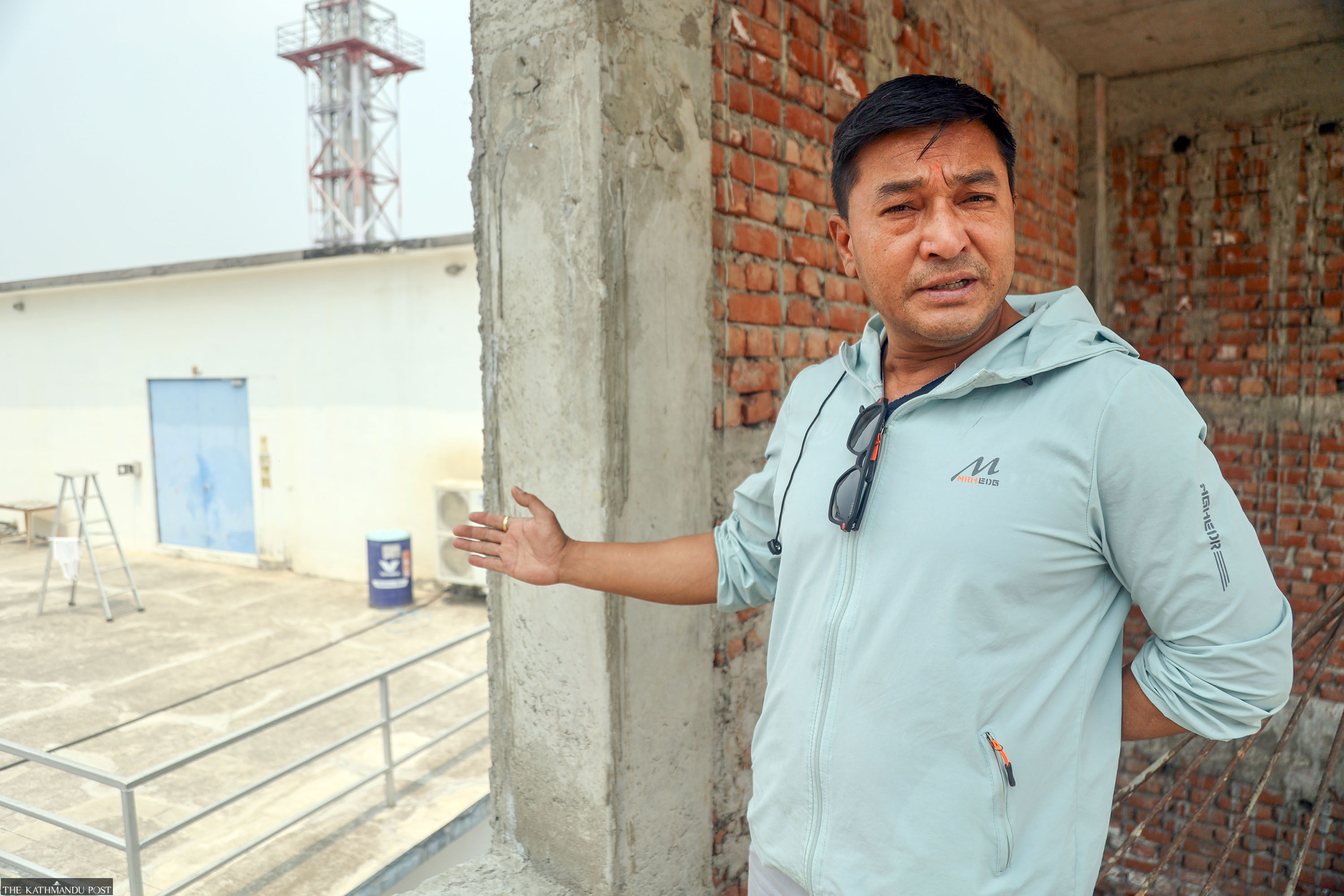
Gopal Dangol, an adjoining neighbour whose formal consent is required for nearby construction, said the documents presented to him described the proposed project as thap tahara (additional shed structures).
“Under Nepal Government rules, any construction project must first have an approved map and neighbours’ consent before its start, so they came to me in my capacity as their sandhiyar,” he said. “When I received the papers, shed structures were mentioned. I gave my consent on that basis.” It was only after speaking with workers on site that Dangol understood that a diesel generator house was being built and, through that, realised the larger project was a data centre.
Ncell held meetings with ward 4 residents, but those consultations did not yield agreement. Dangol said residents, including himself as sandhiyar, remained opposed after being told the facility posed no radiation risk. “We were not convinced,” he said. “That is why we did not give permission.” Lalitpur Metropolitan City approved the project regardless, a decision Dangol said he continues to oppose.
That gap between what was promised and what arrived is not only a local grievance. It is a preview of what the country’s new government is now proposing to do at scale.
Babu Raja, who has run a steel workshop in ward 4 for years, said the protests during construction were significant. “At night, the noise from the machines is so loud that the houses vibrate,” he said. “There is black smoke from the facility every day.” Ram Krishna Raut, who lives directly adjacent, put it plainly: “It disturbs a lot. The noise is there all the time. It would be better if they shifted somewhere else.”
Not everyone in the neighbourhood assigns the same weight to these complaints. Amar Shrestha, a ward 13 resident, said the tipper trucks produce louder noise than the cooling fans and finds it hard to attribute the heat he feels to the facility rather than vehicle exhaust. “But those living directly behind the facility experience more noise and heat,” he added. What residents of both wards agree on is this: nobody asked them.
Gupta’s deepest concern is not the noise or the smoke. “This kind of high-risk infrastructure should not be in the middle of a populated city area,” she said. In Nepal, no monitoring framework exists to produce the data that would allow her to know whether her concern is warranted — or to demonstrate that it isn’t.
In response to queries from The Post, Ncell said via official mail that during the construction of the data centre, it duly followed all legal procedures and obtained the necessary construction certificate as well as construction completion certificate from Lalitpur Metropolitan City, as it was described as a ‘‘Container Block’’ data centre. It is also formally enlisted by Nepal's Department of Information Technology as the country’s first certified data centre under the 2025 directives.
“The operation of the data centre does not generate harmful radiation,” the company said.
The Department of Information Technology, which enlisted the facility, says community notification falls outside its mandate. “We’re not registering a new business or giving them a license,” said Prakash Dawadi, the department's information officer. “We are just monitoring an existing business to see if they meet the parameters in our directives.” The inspection covers infrastructure reliability, fire protection, network stability, and data security — not community consultation. That, Dawadi said, is supposed to happen through an Environmental Impact Assessment before a facility is established, a stage the department plays no role in.
The gap between corporate assurance and publicly verifiable outcomes is not unique to Nepal. A 2025 study examining data centres in Chile and Mexico found that both sites showed signs of local environmental stress — water resources consumed faster than communities could track or contest. In Chile, the government quietly allowed developers to bypass environmental assessments; when questioned, the environment ministry acknowledged the change and said new regulations would be required. Infrastructure built first. Regulation drafted in response. Communities consulted after the fact, if at all. In Nakhhu, this sequence is already history.
Nepal’s newly elected government is now proposing to do this at scale. The Rastriya Swatantra Party, which won the March 2026 elections, has placed digital infrastructure at the centre of its economic vision — transforming Nepal into a global hub for data centres, artificial intelligence, and computational power, fuelled by the country’s hydroelectric energy. Within five years, RSP plans to move Nepal from exporting raw electricity to exporting AI and server processing time. Crypto mining pilot projects are slated to begin in the first year.
The promise has serious advocates. Sudip Acharya, former CEO of Dish Home, argues that Nepal's cheap electricity could become a meaningful competitive advantage, comparable to India or Singapore, and that locally hosted data would reduce the country's dependence on foreign servers. But he acknowledges the conditions are not yet there: Nepal has only one electricity utility, connectivity remains dependent on India and China, and the policy environment is too unstable. “The government needs to act quickly, and those policies must be stable and predictable,” he said.
Computer scientist Dovan Rai is more sceptical. “Clean energy at the source does not mean a clean industry,” she said. If Nepal’s surplus electricity is finite, she asks, who should it serve — households still facing load-shedding (power outages), or server farms pitched to foreign companies? She raises water consumption too: data centres require large amounts of drinking-grade water to cool their machinery, a concern rarely discussed publicly in a country where water stress is already a seasonal reality. The employment argument, she says, does not hold.
“They are data warehouses. Aside from a few security and maintenance roles, they offer limited opportunities.” On cryptocurrency specifically, she is categorical: “Nepal’s institutions and cybersecurity infrastructure are too weak to handle the fraudulent risks and destabilising nature of cryptocurrency.”
Nepal’s central bank has its own concerns. Guru Prasad Poudel, spokesperson for Nepal Rastra Bank, said the country’s current legal framework cannot recognise cryptocurrency because the NRB Act from 2002 only recognises physical currency: paper notes and coins. Crypto, he explained, is a decentralised, private-sector system with no attachment to the formal financial system.
“Because there is no record-keeping or central authority, the liabilities are unknown,” he said. Poudel also noted that mining involves spending foreign exchange, making it a form of foreign investment rather than domestic currency creation. If the RSP government wants to move forward, he said, the first step would be legal recognition of crypto itself, which does not currently exist.
Gopal Dangol, in the neighbourhood, points towards the gas chambers of the Ncell data centre from his property, illustrating how close the facility sits to the surrounding in Nakhhu. Suryams Upreti/TKP
Arnico Panday, a central committee member of RSP who worked on the party’s manifesto, said facilities will only be located at appropriate sites, with environmental impact studies conducted and water use built into site selection. Surplus power, he argued, refers specifically to electricity beyond domestic needs, and with multiple hydropower projects under construction, that surplus will grow. But on enforcement, his answers were less certain.
“We have committed to improving waste management, but will need more work on the specifics,” he said of e-waste. When asked which body would enforce environmental regulations on foreign-operated data centres, he said restructuring is planned but that it is “not yet clear which enforcements will be done by entities under the Ministry of Forest and Environment, which will be done by local governments, and which will be done by others.”
Officials at the Ministry of Forest and Environment confirmed that gap. Under the Environment Protection Rules, Nepal’s environmental regulations operate on a three-tier system — a Brief Environmental Study, an Initial Environmental Examination, and a full Environmental Impact Assessment, corresponding to Schedules 1,2, and 3, respectively. Data centres do not appear on Schedule 3, said Dipak Jnawali, co-secretary at the ministry, meaning no full EIA is required. More broadly, he said, the framework does not envision data centres at all. ‘‘These specific IT infrastructures haven’t been envisioned in the current legal framework,’’ he said. “We have also not yet envisioned the pollution aspects: electronic waste, water consumption, and power consumption in our laws.” No organisation related to databases or IT services, he added, has approached the ministry for any environmental study. The ministry is revising its regulations and plans to include such projects in future legislation.
Dipta Shah, an infrastructure and investment advisor, approaches the question differently. He says he is less interested in the policy debate than in whether the economics make sense — and his verdict is that Nepal does not yet have the evidence.
“We don’t have experience connecting hydropower to a data centre, especially a hyperscaler,” he said. Before serious foreign investment can be attracted, Shah believes Nepal needs a single facility that tests the core assumption: whether the reduced cost of cooling and clean energy offsets the additional capital cost of building a tier 3 data centre in a seismically active zone.
On regulatory uncertainty, Shah is pragmatic. “Policy instability is a risk, but investors ultimately want a commercial return,” he said. “If the math for the commercial transaction works, you can solve for the policy environment in parallel.”
The Ncell facility in Nakhhu has a separate power feeder, so it does not cause load shedding in the neighbourhood. It has received regulatory approval and holds international certifications. None of that resolves what Gupta describes. Whether the facility’s long-term effect on the neighbourhood amounts to harm remains, as far as anyone can determine, unstudied.
RSP holds a mandate that no party in recent Nepali political history has possessed. The vision — renewable energy, high-value exports, a Nepal that sells computation rather than labour — has serious backers. But the question many are asking is not whether data centres should be part of Nepal’s future. It is what gets built into the framework now, before the investment arrives and before the facility sites are locked.
Shah, who spent years advising transactions in Nepal’s technology sector, put it simply: “The RSP’s goals are good for stretching the imagination. But dreams don't become reality without work. We need to be a realistic society.”
Aarya Chand is a reporter at The Kathmandu Post covering social issues. Before moving to the social beat, Chand was an intern covering culture and lifestyle for the Post.




 14.19°C Kathmandu