The government is set to change the number and boundaries of metropolises, sub-metropolises, municipalities, rural municipalities and wards before the local elections due to be held next year.
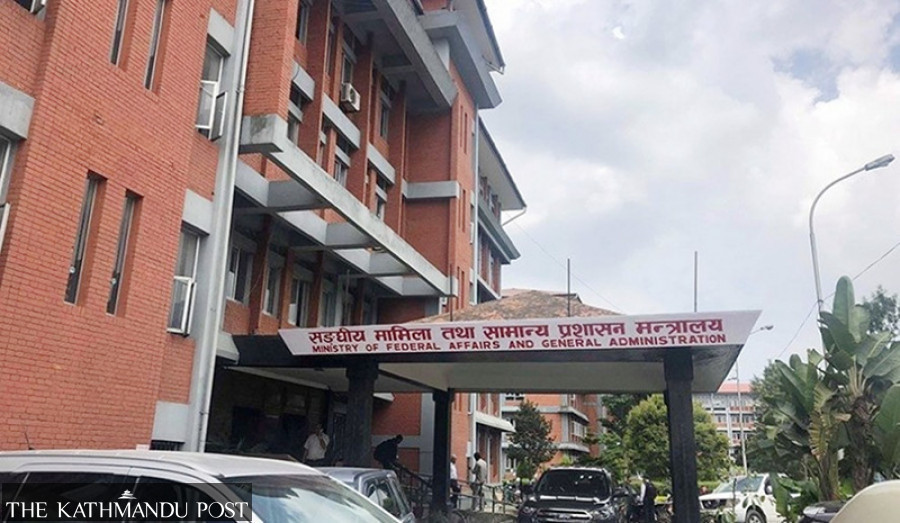
The Ministry of Federal Affairs and General Administration has started working on revisiting the current number and boundaries of local units and sought suggestions from all district coordination committees, local units, and relevant stakeholders.
According to Joint Secretary Prakash Dahal, the ministry has received recommendations from various local units, mostly wards, to change their boundaries as they are facing difficulties in delivering their services. So we have prepared new guidelines and sought suggestions from the local units, he added.
As per the law, the numbers and boundaries of the local units and wards should be revised prior to the local elections. Therefore, the ministry is preparing to complete this task before the upcoming local elections.
On Thursday, the Ministry of Federal Affairs and General Administration sought suggestions on the revision of the number and boundaries of rural municipalities, municipalities, and wards based on the new guidelines drafted before the Gen Z movement in September last year.
The preliminary draft titled “Standards for Revising the Number and Boundaries of Rural Municipalities, Municipalities, and Wards, Merging Local Units, and Reviewing the Classification of Municipalities, 2083”, prepared by the ministry, outlines this process.
The ministry sent a letter to all district coordination committees, local units, and relevant stakeholders requesting suggestions on the proposed draft. The draft aims to systematise the process of revising the number, boundaries, and classification of local units and wards. The ministry has set a three-day period for submitting suggestions on this matter.
The ministry has also urged the Federation of District Coordination Committees, the Municipal Association of Nepal, and the National Federation of Rural Municipalities to facilitate the process.
In each district, if any local units or wards want to merge or change the boundaries, a committee will be formed at the district level to study the cases. This committee, coordinated by the chief of the District Coordination Committee, will also include the deputy chiefs of the concerned local units, the heads of the Survey (Land Measurement) and Land Revenue Offices, the assistant chief district officer, and the Chief Administrative Officers of the local governments and experts. The committee must conduct a study based on factors such as population, geography, and available facilities, and submit its report to the concerned local level within three months.
Now the ministry has started that process, Joint Secretary Dahal said, based on several such pending requests. If any new local unit and ward seeks merger or wants to change their boundaries, technical teams will conduct field inspections and make recommendations.
According to the ministry, an initial draft has been prepared to amend the number and boundaries of rural municipalities, municipalities, and wards, and to review the current classification of municipalities, in accordance with the provisions of Sections 3, 5, 6, 7, and 8 of the Local Government Operation Act, 2017. The draft also includes provisions for the merging of rural municipalities and municipalities.
“As per the 100 point roadmap for good governance, we are expediting this process. When a local unit decides to merge with another or to change its boundaries, it should be approved by the provincial assembly. Then the federal cabinet should approve such changes,” said Dahal.
The ministry is also under pressure from the Federation of District Coordination Committees, the Municipal Association of Nepal, and the National Federation of Rural Municipalities to prepare new guidelines to revisit the existing set-up.
Many wards have complained that due to the lack of proper demarcation, several of their services have been halted and the number of disputes has gone up. Some local units have also demanded their upgradation and asked the ministry to give them that opportunity, said Dahal.
A few local units can go for merger, but the ministry has received recommendation from over 100 wards to change their boundaries and to merge with the next one, he added.
Nepal’s constitution issued in 2015 and the Local Government Operation , 2017 do not specify the number of local units. However, the law does set minimum criteria for the formation of various types of local units. There is also a legal provision allowing two local units to merge if they so wish.
To alter the boundaries or upgrade the status of a local unit or ward, the concerned village assembly or municipal assembly must pass an agenda. Once the proposal is approved by the assembly, it must be sent to the central government for a final decision. The federal cabinet takes necessary decisions based on the proposal from the line ministry.
Some municipalities have proposed their upgrade to submetropolises and some sub-metropolitan cities seek to become metropolises claiming that they have fulfilled the criteria.
“If the required criteria are met, rural municipalities can be upgraded to municipalities, and municipalities to sub-metropolitan or metropolitan cities,” according to Joint Secretary Dahal. A small number of local units will change, some will be upgraded and boundaries of many wards will be redrawn, he added.
At present, the number of metropolitan cities stands at six while there are 11 sub-metropolitan cities, 276 municipalities and 460 rural municipalities. The rural municipalities and municipalities between them have 6,743 wards.
Anil Giri is a Chief Sub Editor covering diplomacy, international relations and national politics for The Kathmandu Post. Giri has been working as a journalist for more than two decades, contributing to numerous national and international media outlets.




 14.82°C Kathmandu