Shockwaves of Iran war hit manufacturing, construction sectors in Nepal
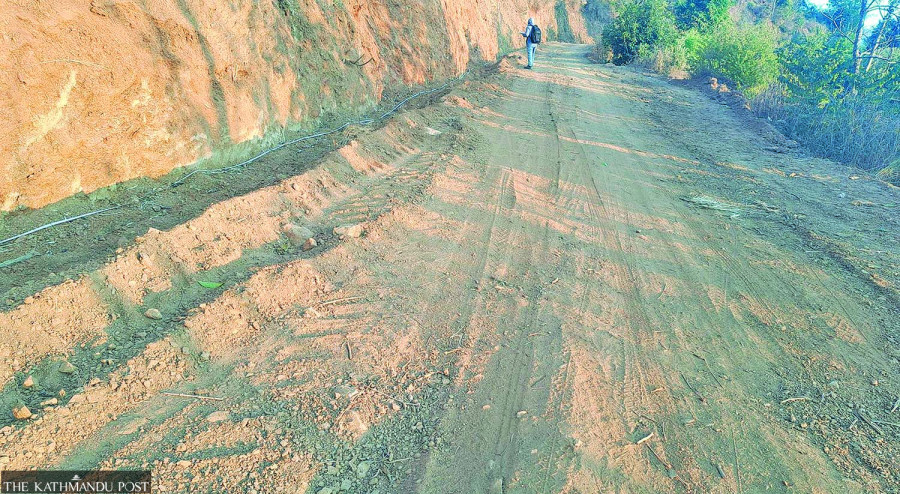
Impact of skyrocketing petroleum prices and riverbed material shortages threatens factory and project shutdowns. Contractor has halted blacktopping works on the Banstari-Jhadewa road in Palpa citing high fuel prices. Madhav Aryal/TKP
Tensions in West Asia have disrupted the smooth import of petroleum products and construction materials, hitting the country’s construction sector hard. Construction firms have begun to feel the impact, leading to workforce cuts and the risk of business shutdowns.
They complain that shortages of raw materials and abnormal price hikes have affected infrastructure projects, including roads. Beyond construction, plastic-based industries in various parts of the country are on the verge of shutdown due to an unavailability of raw materials. The crisis has deepened with depleting stocks, as suppliers fail to deliver raw materials to meet the demand.
Fuel price hikes and a shortage of bitumen have affected around 50 small and large road projects in Lumbini Province. Bitumen, an essential raw material for blacktopping roads, has become scarce along with a sharp rise in price. It is not available even for higher prices. According to contractors, the per kg price of bitumen has gone up from Rs80–84 to Rs150.
Sahadev Khadka, vice-president of the Federation of Contractors’ Associations of Nepal, said the price of bitumen has doubled. Even then, it is hard to find, he added. “When contracts were signed when the price was Rs 80–84 a kg, how can we manage to pay the current price?”
Khadka said contractors would not be able to continue work if prices keep rising. Before the West Asia conflict, bitumen cost Rs80 per kg. The price has gradually risen past Rs150.
According to Bhumishwor Dhakal, the Lumbini provincial minister for physical infrastructure development, at least 40 road projects are in crisis, including Butwal–Gorusinge section, Butwal–Narayangadh roads, sections of the Kaligandaki Corridor in Palpa and Baglung and the Saljhandi–Dhorpatan section of the Mid-Hill Highway.
Most contractors have indicated they cannot proceed with construction under the current circumstances. “Some sections were ready for blacktopping,” Dhakal said, “but we now hear complaints about price hikes and bitumen shortages.”
Preparations were underway to blacktop 8 km of road in Kapilvastu and 2 km in Rupandehi under the Butwal–Gorusinge road section. However, work has now halted due to a shortage of bitumen, said project chief engineer Kushalata Neupane. “Earlier, the project was affected by a lack of riverbed materials; now it is bitumen,” she said.
Nepal primarily imports bitumen from India, while large traders also bring it from countries in the Persian Gulf. A month ago, bitumen imported from India cost Rs90 a kg; it has now reached Rs160. Imports from Gulf countries used to be about Rs10 cheaper per kg but have been halted for the past two months, said Paritosh Gupta, operator of Pioneer Nepal that supplies bitumen across the country.
Nepal imports around 200,000 tonnes of bitumen annually, with the main import season running from mid-February to mid-June. “This time, not even 10 percent of bitumen was imported from the Gulf countries between mid-February to mid-April,” Gupta said. “Imports from India have also dropped by 80 percent.”
He said no traders in the country currently have any bitumen stock. Traders said shortages are increasing in the international market as India is struggling to meet domestic demand due to difficulties in importing crude oil from Iran.
Renu Prasad Pandey, operator of Annapurna Enterprises, which imports bitumen from India, said India fixes bitumen prices on the 15th of every month. Accordingly, the price in the Indian market was set at Rs150 per kg (in Nepali currency) on Wednesday. Adding transportation costs pushes it above Rs160, making imports unfeasible.
“After prices doubled, contractors are no longer demanding bitumen,” Pandey said. “We have not been able to procure it even when we place orders in the Indian market.”
He said bitumen had already stopped entering the Nepali market since mid-November. As the months from mid-December to mid-February are cold, contractors do not usually purchase bitumen.
To resolve the problem, the government and other relevant agencies need to improve supply management, explore alternative sources, and tighten market monitoring, said Khadka, the contractor federation’s vice-president. “To support the construction sector, the government must decide to reduce customs duties on raw materials like iron and bitumen to zero and remove internal taxes,” he said. “Otherwise, the sector may come to a halt.”
He added that rising diesel prices have increased operating costs, including construction equipment, by up to 70 percent, claiming that the current price adjustment mechanism cannot absorb rising costs, with small contractors being hit harder and even large contractors struggling to continue work.
Bitumen imports witnessed fluctuations in Koshi Province. In the first nine months of fiscal year 2024/25, bitumen weighing 116,358,820 kg worth Rs1.63 billion was imported. However, imports have declined during the same period in the current fiscal year 2025/26.
From mid-July to mid-April, 119,449,310 kg of bitumen worth Rs1.42 billion has been imported. Imports through Mechi Customs have increased significantly. According to Mechi Customs, by March 14 of the current fiscal year, 6,758,475 kg of bitumen worth Rs461.813 million has been imported. In the same period last year, only 2,298,798 kg worth Rs146.464 million was imported, said customs information officer Ishwor Humagain.
According to Biratnagar-based importer Suresh Bohara, regional tensions have also affected bitumen imports. He said the conflict involving the United States, Israel, and Iran has reduced crude oil supply.
Bitumen is a by-product of petroleum obtained after refining crude oil. Due to the conflict, reduced crude oil supply has lowered output in India, affecting exports to Nepal, Bohara said.
According to Ujjwal Parsai, chief of the under-construction Asian Highway project in Koshi Province, road works, including blacktopping, have been affected due to shortages of bitumen and diesel.
“If the problem spreads to Lumbini, blacktopping work will come to a complete halt,” he said. “Shortages of diesel have already started creating problems. Construction activities by small and large contractors in Koshi Province have already been affected due to shortages of raw materials and rising prices.”
Impact across districts
Project contractors in Rupandehi have demanded that an emergency be declared and prices readjusted, citing abnormal pricing and shortages of construction materials. They said repeated price hikes in construction materials due to the ongoing war in West Asia have caused significant difficulties for businesses. In addition, a shortage of river-based materials has fully disrupted construction work.
The Contractors Association of Lumbini stated that both national and international developments have affected the construction sector. Entrepreneurs complained that despite repeated increases in the prices of construction materials fixed at the time of contract agreements, payments are not being made even after submitting bills. Acting President Pritam Rauniyar of the contractors’ association said that the government's attention has been drawn to the issue through the chief district officer.
“An emergency should be declared in the construction industry, and relief provided to entrepreneurs,” he said. “Price adjustments should be made in line with rising costs, and contract periods be extended; otherwise, entrepreneurs will have no option but to sign out of contracts.”
According to entrepreneurs, prices of petroleum products, asphalt, cement, and iron rods used in construction have been rising unexpectedly. Uncertainty in crusher plants in the district has also created a shortage of river-extracted materials. He complained that while large contractors are allowed price adjustments, the government discriminates against small contractors.
Nabaraj Shrestha, Vice President of the Contractors' Association of Lumbini, said that if the government takes action against entrepreneurs for not completing construction as agreed, it must urgently ensure the availability of construction materials and issue a price adjustment guideline. According to the association, government projects worth Rs30 billion are currently underway in the district. Around 150 contractors are involved, and about 20,000 workers are employed.
The impact of petroleum price hikes has affected all types of projects in Palpa, from small to large. Due to the worsening situation, contractors have started laying off workers. Contractors have halted blacktopping work, citing rising costs.
Under the Kaligandaki Corridor, only 3 kilometres of blacktopping has been completed this year against a target of 20 kilometres in the Gaidakot–Ramdi–Maldhunga section. Corridor project chief Shiva Lal Dahal said that contractors are unable to manage cash flow due to rising prices. The project currently has 72 kilometres of road under the upgrading contract.
Under the Road Division, 25 kilometres of constituency strategic roads, 17 kilometres under highway upgrading and reconstruction, and 20 kilometres under alternative feeder road upgrading have been contracted for blacktopping.
According to engineer Pabitra Mani Acharya, “if the current petroleum crisis is prolonged, contractors may say they cannot continue,” he said.
Contractors who previously employed 50 to 60 people now have only five to seven workers, said Rajendra KC, general secretary of the Contractors Association Palpa. Diesel price hikes have affected every sector of construction. If the situation continues for a few more days, Palpa’s construction projects may come to a complete halt, said Association President Damodar Gaire.
He also demanded the declaration of a “construction emergency”.
Banke industries risk shutdown
Factories in Nepalgunj of Banke are on the verge of closure due to a shortage of raw materials and rising prices. Production in plastic-based industries has declined, and rising costs of raw materials and consumables are also affecting household kitchens.
Nepal’s industries importing raw materials have not been receiving supplies as required. The biggest shortage is of plastic “granules”. Production of items such as water bottles, bottle caps, drinking water pipes, motorcycle helmet components, plastic chairs, packaging plastics, and cartons has been the first to be affected, according to entrepreneurs.
Kamal Karki, managing director of Star Poly Pipes, said the industry is almost shut due to exhaustion of stockpiled raw materials. “Supplier companies in India have stopped taking orders from Nepali industries,” he said. “If raw materials are not imported within a week, most industries will shut down.”
Entrepreneur Narayan Sharma said that companies transporting raw materials from India and third countries have started sending messages saying they cannot supply goods anymore. “As the price of plastic granules has increased by 60 percent, entrepreneurs are in trouble,” he said.
He added that production of plastic pipes has been halted due to the supply disruption of raw materials. Industries usually open letters of credit (LC) every month to import goods. However, since imports through LC have become impossible, stock has been depleted, forcing industries to shut down, said entrepreneur Balaram Chand.
“After stock runs out, industries have no option but to shut,” Chand said. “No process has been initiated yet to import raw materials from countries other than India. This is creating an extremely difficult situation.”
Plastic industry faces meltdown
Plastic manufacturers in the Parsa–Bara industrial corridor are facing a crisis due to shortages of petroleum-based raw materials. The regional conflict has disrupted petrochemical production and supply, affecting the plastic industry.
Around 150 small, medium, and large plants producing plastic goods in the Birgunj area and the Parsa–Bara industrial corridor are in crisis. Production has been cut to 50 percent, said Madhav Rajpal, senior vice president of the Birgunj Chamber of Commerce. After raw materials became excessively costly, production in most industries has been halved, he said. “The price of polymer granules, an essential raw material for the plastic industry, has increased by up to 70 percent.”
Factories here produce bags, pouches, sacks, chairs, household plastic utensils, and single-use water bottles. Most of them import raw materials from India and other countries. Disruption of shipping routes bringing raw materials via Gulf countries has also contributed to the shortages.
Shipping companies have increased freight charges. The impact of raw material shortages is now visible in the market. Production of water bottles, pipes, plastic chairs, packaging materials, helmets, and other daily-use goods has declined, while prices are rising sharply.
Deepak Tibadewal, operator of Packwell Industry Parwanipur, said that since the US and Israel first attacked Iran on February 28, raw material prices have increased by 70 percent, and finished goods prices have also risen in the same proportion.
“At first, imports of raw materials surged, but now even when demand exists, materials are not available,” he said. “As production costs increased, finished goods became more expensive, but demand for plastic products has now dropped sharply.”
Some manufacturers have limited raw material stocks, risking a complete halt to production within a few weeks. If the situation continues, thousands of workers will be affected, and industrial activity disrupted.
Due to a shortage of raw materials, plastic-based industries in the Hetauda Industrial Area have cut production by 40 percent. Swagat Raj Pyakurel, operator of MM Polymers, which produces bottles for Coca-Cola and other beverages, said that due to difficulties in importing raw materials, production has been reduced by 40 percent over the past week.
He said that if the situation in West Asia does not improve, the industry may shut down.
Plastic plants are currently using existing stock of raw materials. Ram Bahadur Shah, who produces plastic sacks, said he has raw materials only for a few more days of production.
According to Sangita Kunwar, chief of the Industrial Area Management Limited, there are 126 manufacturers currently operating in the industrial area after three ceased operations.
Infrastructure projects stalled
Khadka & Sons Construction of Jumla got two contracts worth around Rs85 million between December 16, 2025 and January 16, 2026, to blacktop the Tadi-Timure section of the Karnali Highway. Both contracts have the mid-July deadline. Nearly a half of the work has been completed, but there is a growing risk that the project will collapse amid rising costs, the company said.
“We are in a do-or-die situation right now,” said company managing director Ankit Khadka. “If we do not work, there is fear that even the work already done will not be paid for; if we continue, the contracts awarded at 10–15 percent lower rates will result in total losses.”
According to Khadka, there is also a shortage of gravel and stones for the Kalikot section.
“We have to bring crushed stones from Jumla,” he said. “One tipper can make only one trip a day, and the cost of other construction materials is beyond what anyone thinks.”
The company also took another contract worth Rs44 million for the Nagma–Rachuli road. Rising material prices have delayed work further, Khadka said.
Bitumen required for blacktopping roads is taken from Nepalgunj to Kalikot. “Bitumen is expensive here, and fuel prices are high there,” he said. “Arranging for transportation has become extremely difficult for us.”
OPC cement that cost Rs1,050 per sack has increased to Rs1,275, PPC cement from Rs1,000 to Rs1,175, and steel rods that cost Rs95 per kg have reached Rs121, Khadka said. “Even then, materials are not easily available.”
According to the Road Division Office Jumla, 17 of 21 contracts this year have been signed. Most projects supposed to be completed this fiscal year have clocked only up to 20 percent progress. Although around Rs2.5 billion worth of work is ongoing on the Karnali Highway, most contractors are delaying work, said Information Officer Saurab Kumar Singh.
Due to delays, 10 contracts were terminated recently, and public notices have been issued asking four construction companies why their contracts should not be terminated, and action should not be taken.
To take another example, construction work in the Jajarkot section of the national pride Mid-Hill Highway has also been affected. Out of the 85 kilometres under the Jajarkot section, 35 kilometres, including the Mantabhir section, remain to be blacktopped. The contract for the road was awarded to Sharma/Singh & Brothers JV for around Rs450 million.
Although the contractor resumed work after leaving it stalled for a long time, it has now been affected again due to material shortages, said Nabin Kharel, information officer at the Mid-Hill Highway Project Office, Dailekh.
“Work had picked up pace in between,” he said. Due to rising material costs, completing blacktopping work in sections such as Kudu–Syaulikhola (17 km), Syaulikhola–Karkigaun (18 km), and Karkigaun–Mantabhir (10 km) has become difficult.
The 93 multi-year contracts awarded this year by the Ministry of Physical Infrastructure and Urban Development of Karnali Province have not made progress. Ministry spokesperson Ramesh Subedi said that large projects are not progressing, resulting in low budget expenditures.
Out of the Rs10.73 billion budget, only about 20 percent has been spent in the nine months of the current fiscal year. “Problems have emerged right at the peak budget spending season,” he said. “None of the projects scheduled for completion this year will be over, not even multi-year projects.” The ministry has allocated funds for 521 projects this year, including around 100 new ones.
(With inputs from Madhav Dhungana in Bhairahawa, Madhav Aryal in Palpa, Rupa Gahatraj in Nepalgunj, Shankar Acharya in Parsa, Pratap Bista in Hetauda and Krishna Prasad Gautam in Surkhet)




 14.4°C Kathmandu