Poor infrastructure and tardy legal processes push children in correction centres into deeper distress
Law requires that such children be kept under supervision while ensuring their educational, intellectual and psychological development, including the right to study, play and recreation
Overcrowded rooms where movement itself feels restricted, toilets that require long queues, and no space for play or physical activity. This sums up the reality of juvenile correction homes across the country.
Designed as spaces for rehabilitation, the correction centres meant for children in conflict with the law or those involved in juvenile offences have instead become sites of congestion and neglect. With facilities stretched far beyond capacity, children often live in conditions that fall short of even the most basic standards of care.
In several cases, the population is two to three times higher than what the infrastructure was built to accommodate. Basic child rights safeguards, including privacy, sanitation, and recreation, are routinely compromised—raising troubling questions about the state’s role in protecting those it has placed in its custody.
According to the Ministry of Women, Children and Senior Citizens, around 1,200 children are currently housed in 10 juvenile correction homes across the country, navigating a system that appears ill-equipped to meet even their most fundamental needs.
Despite legal provisions ensuring children’s right to development, juvenile correction centres operating across the country are struggling with poor management and a lack of basic facilities. These centres, located in Hetauda, Birgunj, Bhaktapur, Rupandehi, Doti, Biratnagar, Banke and Kaski, house children involved in offences or legal disputes, and most are overcrowded, holding two to three times their capacity on average.
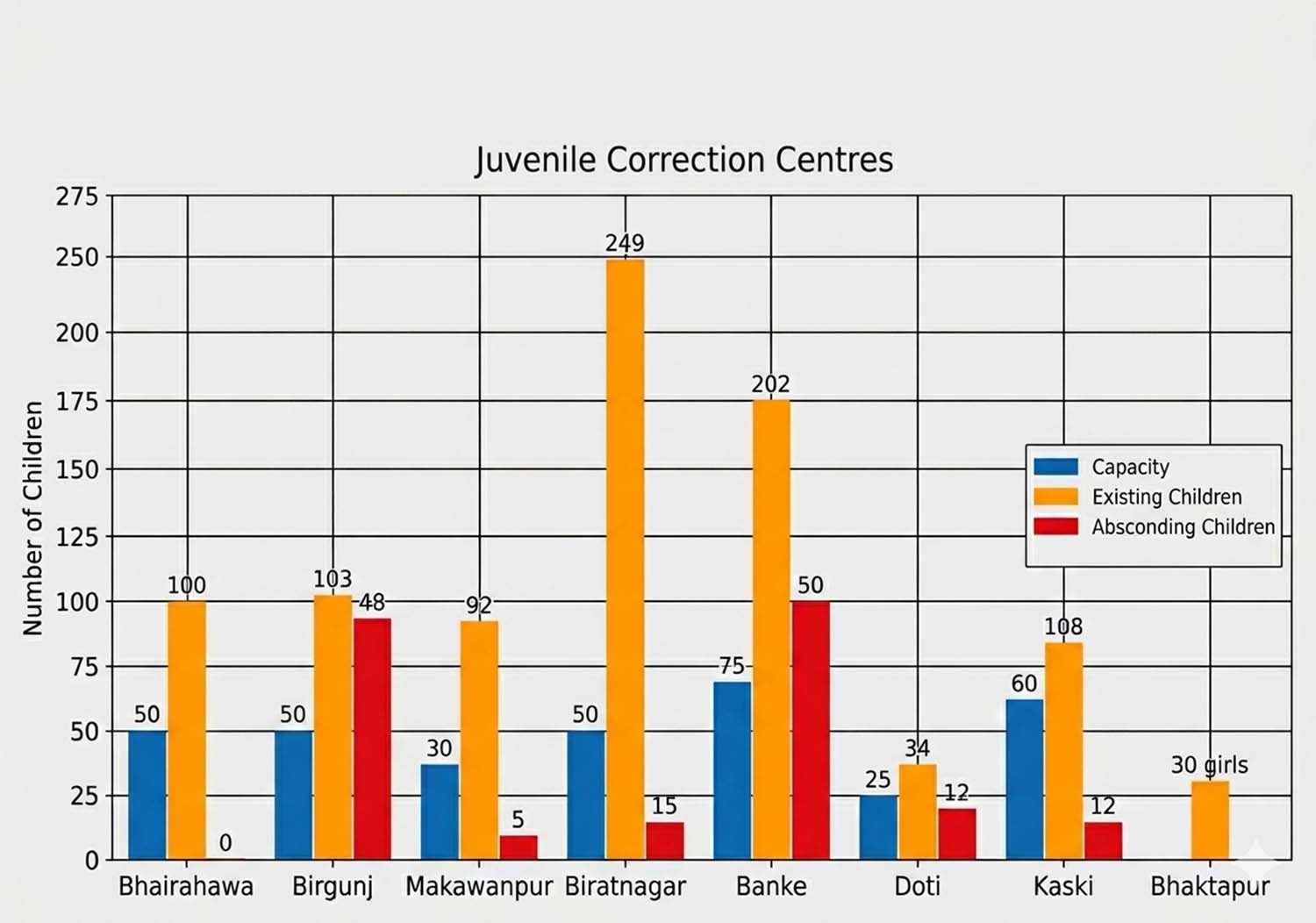
For instance, the condition of a juvenile correction centre in Bhairahawa is dire, housing around 100 children aged between 14 and 24 against a capacity of only 50. Spanning two kattha and six dhur (778.85 square metres) of land, the facility lacks the space and infrastructure required by set standards, depriving children of fresh air and sunlight.
The building, which housed the Women and Children Office until September 2018, was later converted into a juvenile correction centre. It lacks adequate arrangements for sleeping, food and toilets, said the facility chief Bodhraj Acharya. “Children are crammed into limited spaces, with three to four sharing a single bed,” he said. “Overcrowding makes it particularly difficult during summer.”
The small building lacks proper sleeping accommodations and kitchen facilities, and there is no school, library, or playground. Due to space constraints, children are even kept in the security guard’s room, he said.
A boy who has been in the centre for six years said the cramped building is suffocating during summer. “We are confined to a narrow space,” he said. “We have to queue for everything—cooking, eating, using the toilet and sleeping.”
Acharya said skill-based training cannot be conducted due to a lack of space. “Many have skills but have no opportunity to use them,” he said. “Sports equipment is provided, but there is no space to play.”
The law requires that such children be kept under supervision while ensuring their educational, intellectual and psychological development, including the right to study, play and recreation. Senior advocate Shiva Prasad Gaudel said the Bhairahawa facility has turned into a place of abuse rather than reform. “The law exists, but there is no one to speak for the children,” he said. “They are deprived of education, recreation and freedom.” He warned that such conditions could push children towards criminal behaviour rather than reform them.
A Birgunj-based correction centre accommodates 103 children, far beyond its capacity of 50. Of them, 21 have already been sentenced, while others are in judicial custody. According to the centre’s chief, Tika Krishna Kafle, 22 are above 18 years of age, and the remaining are minors. Most cases involve rape, attempted rape, gang rape and related offences, with around 70 children facing such charges. There are 13 cases related to drug offences.
Lack of income-generating opportunities has made it difficult for them to spend time. Five children from the facility appeared in the Secondary Education Examination (SEE) this year. One inmate has tuberculosis. The only correction centre in Madhesh province has 22 rooms within an area of 1 kattha 18 dhur (643.4 sq metres). Kafle said an inadequate budget has led to recurring problems, including maintenance and the purchase of basic items such as fans and lights.
Juvenile correction centre in Sanothimi, Bhaktapur. Post File Photo
Deprived of education
In Makawanpur, a correction centre in Hetauda-11 has 92 children, exceeding its capacity of 30. The building, spanning five kattha of land, is too small, forcing children to sleep on the floor, said chief Pradip Gautam. Most are aged between 14 and 23, with 65 accused of rape cases.
Despite the legal provision that only those below 18 be kept in reform homes, those who committed offences as minors continue to stay even after crossing 18 while serving sentences, he said. Children in the facility are also deprived of education, while the library remains non-operational due to space constraints.
Established in 2018 under the Ministry of Women, Children and Senior Citizens, the facility has no space for play, and children spend their days confined to rooms. Gautam said managing education is also a challenge due to the varied age groups. “The main problem is a lack of space,” he said.
Although the facility was meant for children from Chitwan and Makawanpur, it now houses children from 28 districts. A staff member said a lack of budget for infrastructure and schooling has left their future uncertain. “The ministry does not respond to our concerns,” he said.
The facility houses 92 children, including 65 in rape cases, 11 in murder cases, nine in drug-related cases and others in theft, road accidents and public offences. Each child receives 700 grams of rice and Rs80 per day for expenses, provided every 15 days by the Bhimphedi regional prison.
Lack of transport has made it difficult to present children in court when required. The facility has to request vehicles from the District Police Office.
Severe overcrowding in Biratnagar
The Biratnagar correction centre accommodates 239 inmates against a capacity of 50. Of them, 142 are minors, and eight are Indian nationals. Around 127 are serving sentences in rape-related cases.
Chief Sandip Neupane said 28 inmates above 18 have been shifted to the Morang prison due to space constraints. “Keeping all in one place increases the risk of conflict,” he said. Five inmates were injured in a clash nine months ago.
Officials said mixing minors with adults increases the risk of abuse. “Older inmates tend to dominate younger ones,” he said.
According to staff Rikesh Niraula, the law allows the release of inmates who have served more than 67 percent of their sentence upon recommendation, but the provision has been suspended following the 2025 Gen Z movement. Of 206 who escaped during the protests, 15 still remain at large.
Although the government had decided to transfer those above 18 to Nuwakot, the decision has not been implemented. Officials said the daily allowance is insufficient given rising inflation. “It is not enough to cover food expenses,” one staff member said.
The facility runs an in-house school with 130 students, eight teachers and two assistants. Education is available only up to Grade 10. Students pursue higher studies externally and sit exams from inside the facility, said Sanat Koirala, principal of Deepjyoti School run by the facility. This year, 14 children, including 12 regular and two supplementary candidates, sat the SEE from the school.
There are no authorised positions for dedicated security staffing, and 10 police personnel have been deployed from the district police office.
Cases take years
The law requiring cases involving minors to be resolved within three months has not been implemented. Rights activist Basanta Gautam said children need both adequate facilities and timely justice, adding that complex legal provisions and weak implementation have compounded the problem. “Delays in court processes prolong cases despite separate judges. There is a need for steps to ensure children’s welfare and protection,” he said.
Kishor Sharma, chief of Jayendu Juvenile Correction Centre in Banke, said there are complaints regarding investigation procedures, education and infrastructure. Most inmates face charges related to sexual offences, along with murder, drug and theft cases.
The facility houses 202 children, including 98 below 18 and 106 above. Of them, 102 cases have been settled, while 100 are under trial. Of 115 who escaped during the Gen Z unrest, 65 have returned, while 50 remain at large. Nine offenders have been transferred to Naubasta prison.
Protection remains a challenge
In Doti, the correction centre houses 34 inmates against a capacity of 25. Limited resources have made supervision difficult. Children from multiple districts are housed together, including eight each from Baitadi and Achham, five from Bajhang, four each from Darchula and Doti, three from Dadeldhura and two from Bajura.
Efforts are being made to improve behaviour and education. Five inmates appeared in the SEE this year. Due to space constraints, supplies have been stored at the District Administration Office. Twelve inmates who escaped during the Gen Z unrest are still at large.
Juveniles relocated after clash
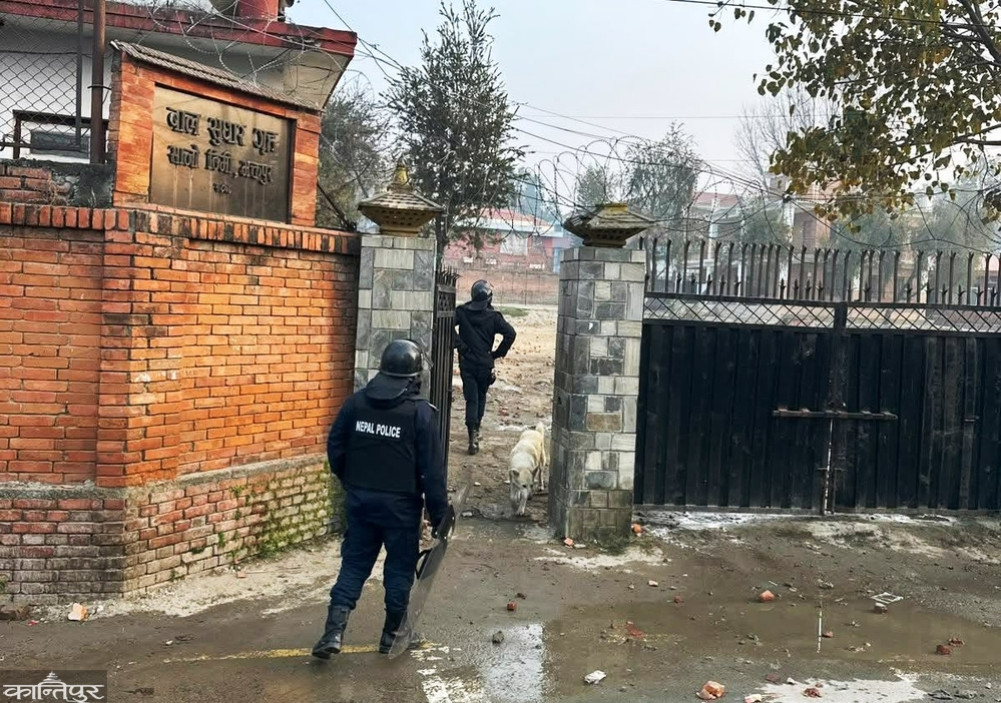
Some juveniles have been relocated from the juvenile correction centre at Sano Thimi in Bhaktapur after a clash broke out on the night of January 22, 2026. According to police, the clash stemmed from a dispute among the juveniles themselves, leading to arson and vandalism of the centre’s building. Some children were injured in the incident. Following the damage, all structures inside the centre were affected, making it uninhabitable and forcing authorities to relocate them temporarily.
Bhaktapur Chief District Officer Umesh Kumar Dhakal said the juveniles have now been placed in correction centres outside the Kathmandu Valley. Of the 169 juveniles at the facility, 84 have been transferred elsewhere. The remaining 24 girls have been kept at the same centre. “As the damage made it unfit for accommodation, only the boys were relocated, while the girls have been kept here,” he said.
In September 2023, anger had also erupted among juveniles at the facility after a 19-year-old from Ramechhap district died due to a lack of timely treatment, leading to vandalism.
12 juveniles in Kaski correction centre still at large
Twelve juveniles who escaped from the Kaski correction centre during the Gen Z protests are still absconding. Until September 9, 2025, there were 109 juveniles at the centre in Pokhara-18. On that day, inmates from the Kaski District Prison entered the facility and helped the juveniles escape, said office chief Durga Raj Subedi. “We have appealed through various means for them to return,” he said. “Many have come back on their own, but 12 are still absconding.”
According to him, the Kaski correction centre has a capacity of 50 to 60, but currently houses 108 juveniles. Of them, 57 are below 18, and 51 are aged between 18 and 24. The largest number—53—are charged in rape cases, followed by 20 in murder cases. Five each are involved in drug-related offences and incest cases, while others are serving sentences for road fatalities, theft, attempted murder and cybercrime.
“At present, we have accommodated them somehow in seven rooms,” Subedi said. “The government’s promise to expand the facility has not been implemented yet.”
Earlier, the centre was run with financial support from UCEP Nepal. In addition to the Rs80 daily allowance and 750 grams of rice provided under prison regulations, UCEP Nepal covered other expenses. From the current fiscal year, however, the centre has been operating under the Ministry of Women, Children and Senior Citizens. There are eight staff members.
The centre provides education up to Grades 6 to 10 for 47 children. Nine of the children who absconded during the Gen Z protests are still at large. Juveniles from 11 districts of Gandaki province, as well as from Dolakha, Lalitpur, Kavrepalanchok and Bhojpur, are housed at the facility.
(With inputs from Pratap Bista in Hetauda, Parbat Portel in Biratnagar, Rupa Gahatraj in Nepalgunj and Mohan Paneru in Doti)




 24.72°C Kathmandu