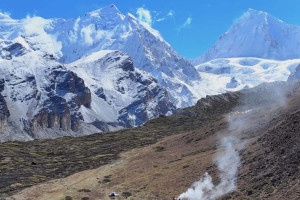
Remote Saipal in Bajhang welcomes return of local government office after decades
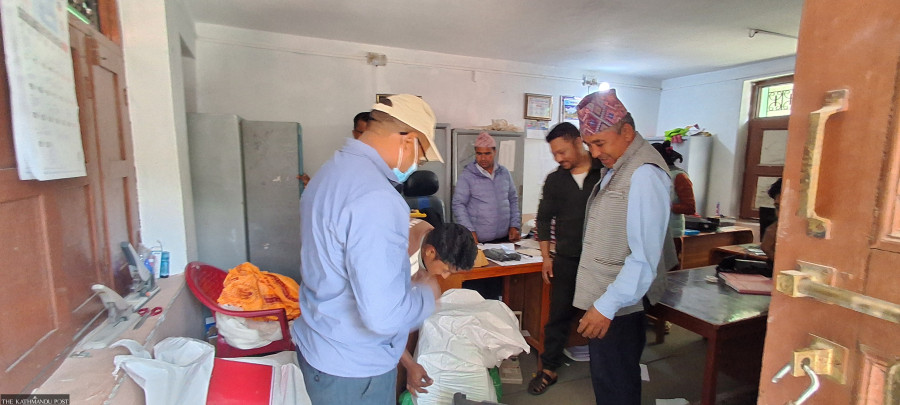
The office was shifted to Chainpur during the Maoist insurgency. Locals are hopeful about better access to government services and relief from long and costly journeys to district headquarters. Officials pack documents to transport them to Saipal from the district headquarters in Chainpur, Bajhang. Basanta Pratap Singh/TKP
After nearly 23 years, the office of Saipal Rural Municipality in Bajhang has been relocated back to its original base, ending decades of hardship for local people who were forced to travel long distances to access basic public services.
The office had been shifted to Chainpur, the district headquarters of Bajhang, during the Maoist insurgency (1996-2006) due to security concerns. Even after the end of the decade-long conflict and transition to federalism, it remained in Chainpur, primarily due to the lack of internet connectivity, banking facilities and road access in Saipal—one of the country’s most remote local units. As a result, administrative and financial services continued to be delivered from rented premises in the district headquarters.
With the office now reinstated in Kanda village of Saipal this week, residents will be able to access essential services locally. For years, locals had to endure up to four days of walking and spend significant sums of money just to get routine work done, like recommendations or completing administrative procedures.
“Earlier, we had to walk for three to four days to reach Chainpur even to meet our elected representatives. We would spend between Rs20,000 and Rs30,000 for even minor tasks,” said Basanta Bohara, a local resident. “Now that services are available here, both time and money will be saved. After two decades, we are finally receiving services at our doorstep,” he said, expressing his happiness.
The relocation is expected to significantly reduce the financial burden on residents, who often had to make repeated trips to the district headquarters for tasks such as opening bank accounts, signing project agreements, withdrawing instalments and processing payments. According to the locals, such repeated travel also inflated project costs and affected the quality of development works.
Local government representatives say the move will not only benefit residents but also make life easier for teachers and government employees, who previously had to travel to Chainpur for salaries and other administrative work. “Teachers and employees had to go to the district headquarters to process salary recommendations and submit reports. This increased their expenses and also disrupted office work and students’ studies. That problem has now been resolved,” said Narendra Dhami, spokesperson for Saipal Rural Municipality.
According to Dhami, frequent travel between Saipal and Chainpur had also been a major inconvenience for local representatives, consuming both time and resources. “People often complained that they had not truly felt the presence of Singha Durbar (the central secretariat in Kathmandu) in the village,” said Dhami, referring to the federal government’s promise of decentralised governance. “We ourselves had to spend eight to ten days a month just travelling back and forth.”
Local government officials believe that they can truly work for people after the reinstatement of rural municipal office in their own local unit. Manbir Bohara, chairman of Saipal Rural Municipality, said relocating the office had been both a necessity and a political commitment. “It was our electoral promise to deliver all services from within the rural municipality,” he said. “At the same time, residents were increasingly questioning why federalism had not translated into accessible local governance.”
A key factor enabling the shift was the recent establishment of a banking facility in Saipal. Everest Bank opened a branch in the area last October, addressing one of the major logistical hurdles that had previously prevented the office from relocating.
Bohara expressed confidence that having all officials and staff stationed within the local unit would improve service delivery, ensure timely monitoring of development projects and enhance overall efficiency. “With everyone based here, development works will be faster and of better quality,” he said.




 25.89°C Kathmandu