The position of the leader of the main opposition is constitutionally significant, as it carries key parliamentary responsibilities and includes ex officio membership in the Constitutional Council, a body responsible for key constitutional appointments.
However, despite its importance, the Nepali Congress, the main opposition party, has so far failed to appoint its parliamentary party leader, even after the conclusion of the first session of the federal parliament, exposing ongoing internal disagreements within the party.
The Congress had earlier even published a timetable to elect its parliamentary party leader on April 7, but the schedule was not implemented.
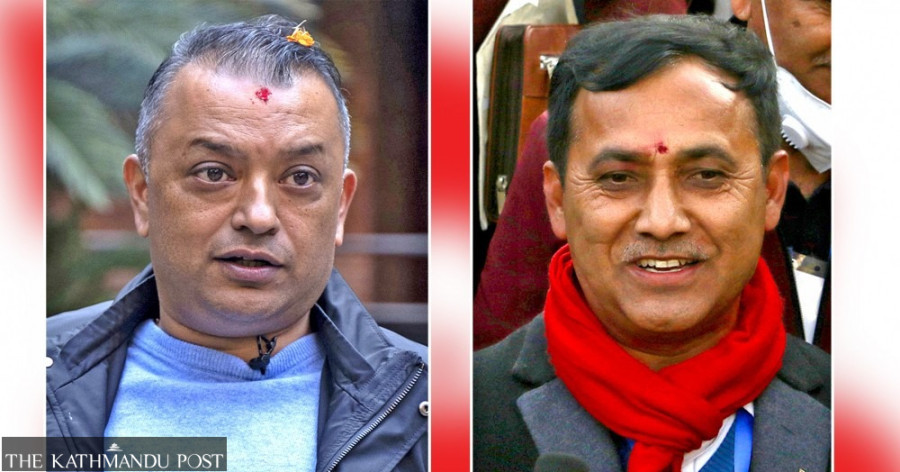
“The delay stems from differing positions taken by party president Gagan Kumar Thapa and vice-president Bishwa Prakash Sharma over who should hold the post,” said a party lawmaker on condition of anonymity.
While Thapa has backed Mohan Acharya, who won the first-past-the-post seat from Rasuwa, Sharma has proposed Bhishmaraj Angdembe, a former joint general secretary of the party who was elected through the proportional representation system, according to party leaders.
With both sides maintaining their respective claims, the party has so far been unable to reach a consensus on the selection of its parliamentary party leader.
Due to it being a constitutionally significant position, President Thapa is keen to see a trusted person chosen as parliamentary party leader, but there has been a delay in doing so, said a party leader.
Among the six national parties represented in Parliament, the ruling Rastriya Swatantra Party and four other parties have already chosen their parliamentary party leaders.
Congress insiders say the delay is largely because several leaders are eying the post. They also note that the party, which was the largest in the previous parliament, has been preoccupied with reviewing the outcome of the March 5 election, in which it suffered a heavy setback. According to them, the parliamentary party leader will likely be selected once the review process concludes.
“If the leader is chosen through consensus, it could happen even sooner. Otherwise, if the situation requires a vote, the election for the parliamentary party leader will take place after the review of Bagmati province is completed,” said central committee member Ajaya Babu Shiwakoti.
Shiwakoti, however, rejected claims that the delay in selecting the parliamentary party leader was due to differences between party president Thapa and vice-president Sharma.
“If the party president puts forward a name, it is not the case that the vice-president would reject it,” he said, insisting that the delay should not be attributed to any disagreement between the two leaders.
However, leaders close to former party president Sher Bahadur Deuba, who was ousted by a special general convention in January, say the delay in choosing the parliamentary party leader stems from a lack of understanding among party leaders.
“On the scheduled date, the leader should have been either chosen by consensus or elected through a vote. The fact that neither happened suggests that there is disagreement within the leadership,” said Min Bahadur Bishwakarma, a Deuba loyalist.
Party spokesman Devaraj Chalise said could not give a clear explanation of why the party failed to select its parliamentary party leader within the scheduled timeframe.
At the first meeting of the House of Representatives on March 26, Angdembe addressed the House on behalf of the Congress.
Angdembe, who is regarded as being close to Deuba, had opposed holding the party’s special convention in January. That convention ousted Deuba and elected Thapa as new party chief, while the Deuba faction challenged the decision at the Supreme Court. A hearing scheduled for April 5 was postponed.
Meanwhile, during the first parliamentary meeting, Angdembe openly spoke in support of party president Thapa from the floor of the House. Within the party, there was growing discussion that allowing him to address the session—and his public backing of Thapa in Parliament—had strengthened the possibility of him emerging as the parliamentary party leader.
The Congress has 38 lawmakers in Parliament, of whom 18 were elected through the first-past-the-post system and 20 through the proportional representation system.
The list of proportional representation candidates had been submitted to the Election Commission before the party’s special convention and was prepared by the Deuba-led executive committee. As a result, 16 of the 20 lawmakers elected through the proportional system are considered to be aligned with the party’s rival faction.
Bishwakarma, the Deuba confidant, also claims that their side has six lawmakers among those elected directly.
“Counting both our group and that of Shekhar Koirala [another leader of the anti-establishment faction in the party], we have 22 out of the total 38 lawmakers. If an election takes place, there is a strong possibility that many among the leading contenders will receive our support,” he said.




 20.45°C Kathmandu