Chaudhary in charge of merged agriculture and forest ministry
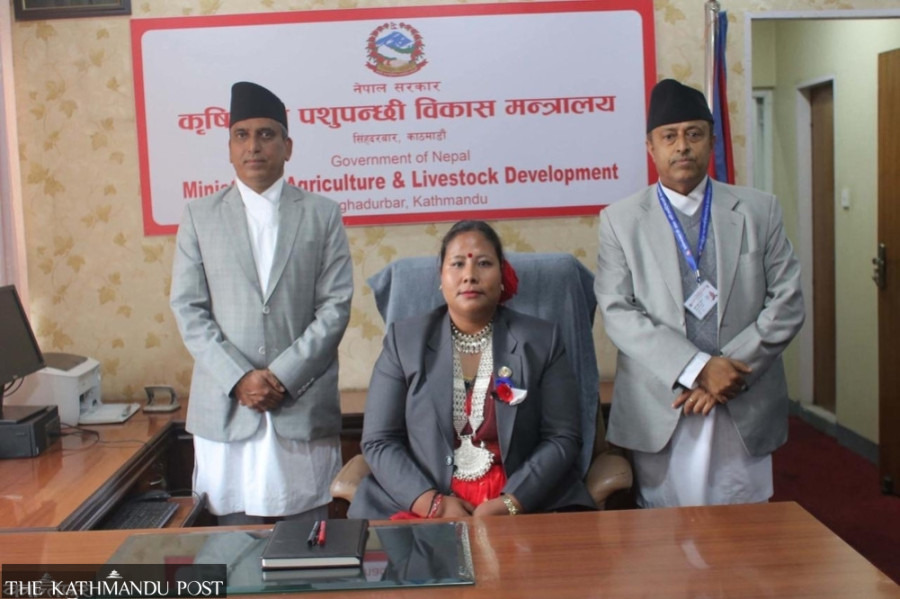
Chaudhary faces the challenge of addressing policy gaps while driving agricultural growth and sustainable forest management under an integrated ministry model. Gita Chaudhary, agriculture minister Post photo
Rastriya Swatantra Party’s proportional representation lawmaker Gita Chaudhary has been assigned the Ministry of Agriculture, Livestock Development and Forests and Environment in the new government led by Balendra Shah.
A 33-year-old from Kanchanpur, Chaudhary has long advocated for human rights and social justice. A legal practitioner and founder of Youth Advocacy Nepal, she has been active in issues affecting marginalised communities. Her role now shifts from advocacy to policymaking at Singha Durbar.
The new government has merged the agriculture and forest ministries into a single entity, a move experts say could help address long-standing policy gaps. Nepal Agriculture Research Council scientist Dipendra Gauchan said that integrating the two ministries is a positive step, noting that rural livelihoods are closely tied to both farming and forest resources.
However, the merged ministry also brings multiple challenges. Parbati Gautam, general secretary of the Federation of Community Forest Users Nepal, said priorities should include scrapping multi-layered taxes on community forests, managing Chure under the Forest Act, and adopting scientific wildlife management to protect crops and property.
Chaudhary’s background comes from a farming family in Kanchanpur. Her upbringing, shaped by her grandfather’s experience as a kamaiya labourer, and her early exposure to social activism influenced her focus on education and justice. She pursued law, later completing a master’s degree and practising in Kathmandu before entering politics.
The government has set an ambitious target of expanding Nepal’s economy to $100 billion within five years. Achieving this, experts say, will require agricultural transformation and the development of forest-based industries. Chaudhary is expected to prioritise coordinated irrigation systems and increased production.
Despite forests covering 46 percent of Nepal’s land, the country continues to import timber worth billions annually. Reducing this dependency while promoting sustainable forest use is among the key policy challenges.
Addressing the impacts of climate change on agriculture, particularly drought and flooding, will also be critical, along with managing human-wildlife conflict amid rising wildlife populations.
Chaudhary has said she is committed to addressing education, health and social justice issues through policy reforms, particularly for marginalised communities and farmers. How effectively the integrated ministry addresses these priorities will define her tenure.




 12.97°C Kathmandu